The restoration project of a 17-kilometer section of the Morava River was completed well in advance by the water managers from the Slovak Water Management Company. The work was completed 12 months earlier and at the same time 12 million euros cheaper than the original plan from June 2023. This was appreciated by the Minister of the Environment, Tomáš Taraba.
The restoration project of a 17-kilometer stretch of the Morava River was managed by the water managers from the Slovak Water Company (SVP) well ahead of schedule. The work was completed 12 months earlier and at the same time 12 million euros cheaper than the original plan from June 2023. This was appreciated by the Minister of the Environment, Tomáš Taraba.
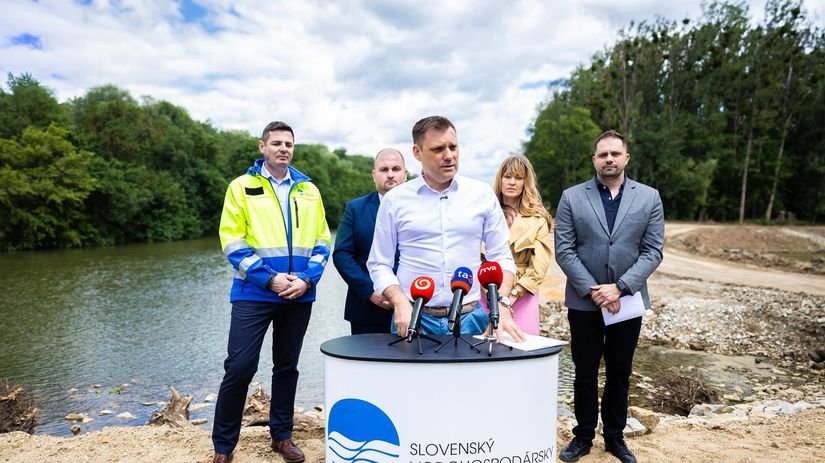
However, he considers it an “extreme scandal” and “doesn’t understand how one project can fly by 100 percent” that they saved up to half of the 24 million euros originally planned by the previous government. The project was to be handled by private companies. “I am really amazed that for nature protection, some people only think that it is invoicing through private companies. I think that the set of experts that we have and who work for state companies, which were established by law for this, must be used to the full,” said Taraba. He did so together with SVP General Director Jozef Moravčík directly in Záhorí, near the restored section of the Morava River.
Project of the decade
The minister assigned the revitalization project of the Morava riverbed to a water management company under the management of the ministry. “Some told us that the state-owned enterprise would not be able to do it. On the contrary, it did it much faster and did it for half the price,” added the Minister of the Environment. As the CEO of SVP Moravčík confirmed, it was the largest construction of this state-owned enterprise in the last decade. 130 people worked here skillfully on 14 constructions of the project, while it was about improving the passability of the shoulders “where there was no water”. This will also change the overall biodiversity of the country.
During the works, the water managers restored the side branches of the river, removed overgrown trees and inappropriate interventions on the banks, and in several places returned the flow to its natural form. They used exclusively natural materials for the modifications – stone, wood or tree trunks. Heavy equipment, including excavators and trucks, was also deployed in the project. In total, they moved almost 248,000 cubic meters of soil.
The state border must be moved
“What is important to say is that the border between Slovakia and Austria will also move. Because the original route of the Morava River will end here, some meanders will change. The Austrian side is also working on exactly the same profile as we on the Slovak side. And since the middle of the river is the border between Slovakia and Austria, its route will naturally change,” explained Taraba. The area around the river should be made much more accessible for tourism.
The millions saved according to the financing rules of the recovery plan will remain for Slovakia, for other projects. “The 12 million is not returned to the EU budget. Since it is a recovery plan, it will remain with the Slovak Republic and can we use it for other environmental projects?” added the minister.
They will restore more than 200 kilometers of rivers
Another 14 million euros from the recovery plan will go to projects that will bring increased biodiversity and water quality to other locations. The revitalization of the Turiec River is planned for 1.1 million, the Cirocha River for 600,000 euros, the Žitava River for 1.1 million euros, and the Poprad River for 560,000 euros. Additional funding is directed to similar projects on the Hron River for 3.1 million euros and for the Revúca River 3.2 million euros.
Minister Taraba stated that they will re-sign the contracts when the beneficiary is again the Slovak Water Management Company. These projects are intended to improve flood protection, water quality and support natural fish migration. Almost 210 kilometers of rivers will be crossed. But the goal is not only protection against floods, but also the restoration of natural life in rivers. “These projects have a significant contribution to nature conservation, fishing and the sustainable use of waterways,” emphasized Moravčík.