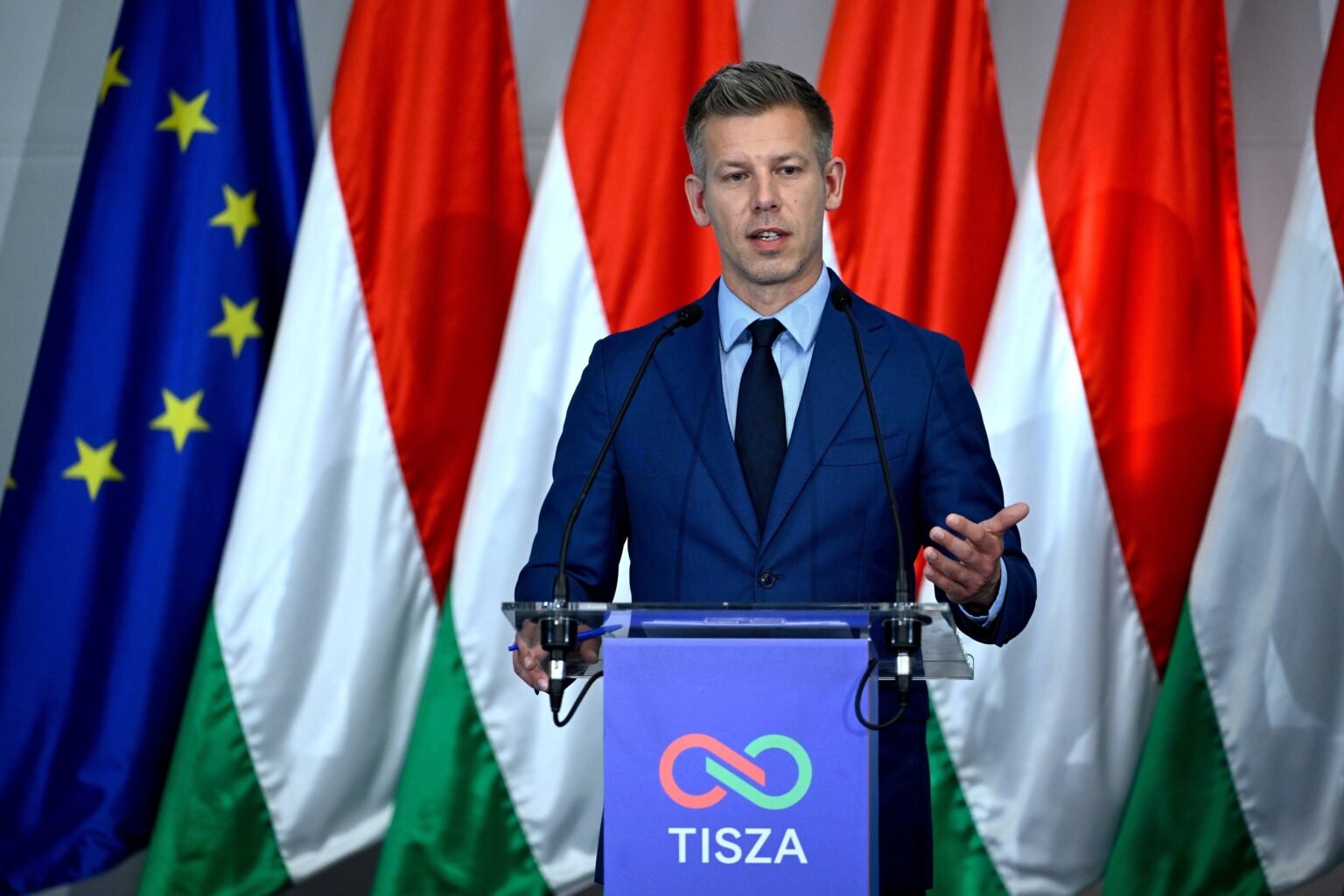
 Hungary’s new prime minister wants closer ties with Austria and other central European countries to wield more power in Brussels
Hungary’s next leader wants to revive Central Europe’s influence by capitalizing on its imperial past. Prime Minister-elect Peter Magyar says he will deepen ties with neighboring countries, particularly Austria, based on strong economic ties and a shared history rooted in the late nineteenth-century Austro-Hungarian Empire.
– We used to share the same country, and Austria is a key economic partner of Hungary. I would like to strengthen the relationship between Hungary and Austria for historical, but also for cultural and economic reasons – said Magyar after his victory over Viktor Orbán in the Hungarian elections earlier this month.
Magyar defeated Orban in part by promising to reset Hungary’s relationship with the EU, but he wants to do so within a strong bloc of central European countries led by like-minded right-wing leaders who he believes share the same cultural views, economic interests and conservative views on everything from migration to energy policy. With the exception of Poland, these countries positioned between Western Europe and Russia have also traditionally shown a greater willingness to maintain business ties with Moscow.
The new Hungarian leader has already publicly outlined how he could realize his vision of a Central European bloc. At a press conference earlier this month, he proposed merging the Visegrad Group (an informal alliance of Hungary, Poland, the Czech Republic and Slovakia) with the Slavkov format, a cooperation framework involving Austria, the Czech Republic and Slovakia.
– I believe that this is in the interest of every country, including Austria and Hungary. That’s why I hope that we will be able to make progress here – Magjar said.
In a clear signal of that strategy, Magyar said his first state visits as Hungary’s new leader will be to Warsaw and Vienna in early May.
Although he sees Austria as a more natural ally, Hungary has a lot to learn from Polish Prime Minister Donald Tusk, including how to unlock EU funds held back by concerns about the rule of law. One of the main priorities of the Hungarian is to ensure the release of 18 billion euros of frozen EU funds. He is also pushing for access to 16 billion euros in European defense loans and the lifting of a one-million-euro-a-day fine on Hungary for its refusal to comply with EU migration law.
Strengthening of cooperation in Central Europe following the Benelux model
The Austrian government seems open to the idea. A senior Austrian diplomat, speaking on condition of anonymity to discuss internal thinking, said there was an inherent logic in strengthening cooperation between Central European states within the EU along the lines of the Benelux model.
– We are all countries of approximately the same size with many common interests and together we would be more relevant in terms of voting capacity – said the diplomat.
For Austria’s conservative government, deepening ties with Hungary has long been a strategic ambition. In the early 2000s, before the accession of several former communist countries to the EU, Austrian leaders proposed a renewed alliance with Central Europe. The effort ultimately failed, hampered by fears in Poland and Slovenia that Vienna was trying to regain its hegemony more than 80 years after the collapse of the Austro-Hungarian Empire.
Now Hungary is proposing a closer alliance. And Polish leaders, with their country’s growing economic and military power, no longer feel threatened by that prospect, experts say. Austrian conservatives also see a new opportunity now that Orban is no longer in power.
Despite certain differences, experts claim that there remain strong common interests among the countries of Central Europe, especially when it comes to economic initiatives and large infrastructure projects.
– If these countries could present integrated proposals and integrated projects that are coordinated, it would strengthen their position when it comes to the distribution of funds and cohesion money from Brussels – said Reinhard Heinisch, a political scientist from the University of Salzburg.
Magyar’s push to build a Central European union may also be based on his understanding of how power in Brussels actually works. The new prime minister spent nearly a decade there as a diplomat under Orbán before breaking with the populist Fidesz party and becoming an MEP with his conservative political force Tisza.
– He is actually the first Hungarian Prime Minister who has a perfect understanding of how the Brussels and EU machine works. And if you want to interfere more in Brussels, if you want to be a counterweight to big countries like France and Germany, then you have to join forces – concludes Stefano Bottoni, a professor focused on Eastern Europe at the University of Florence.