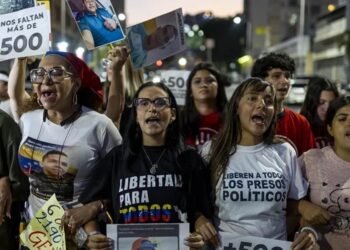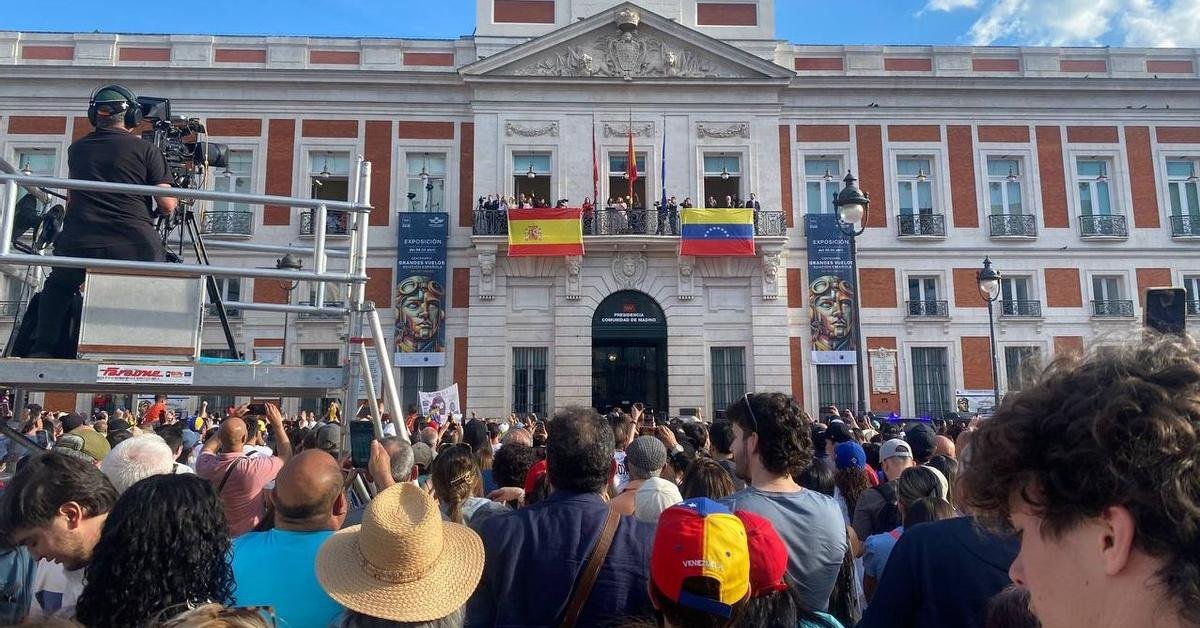
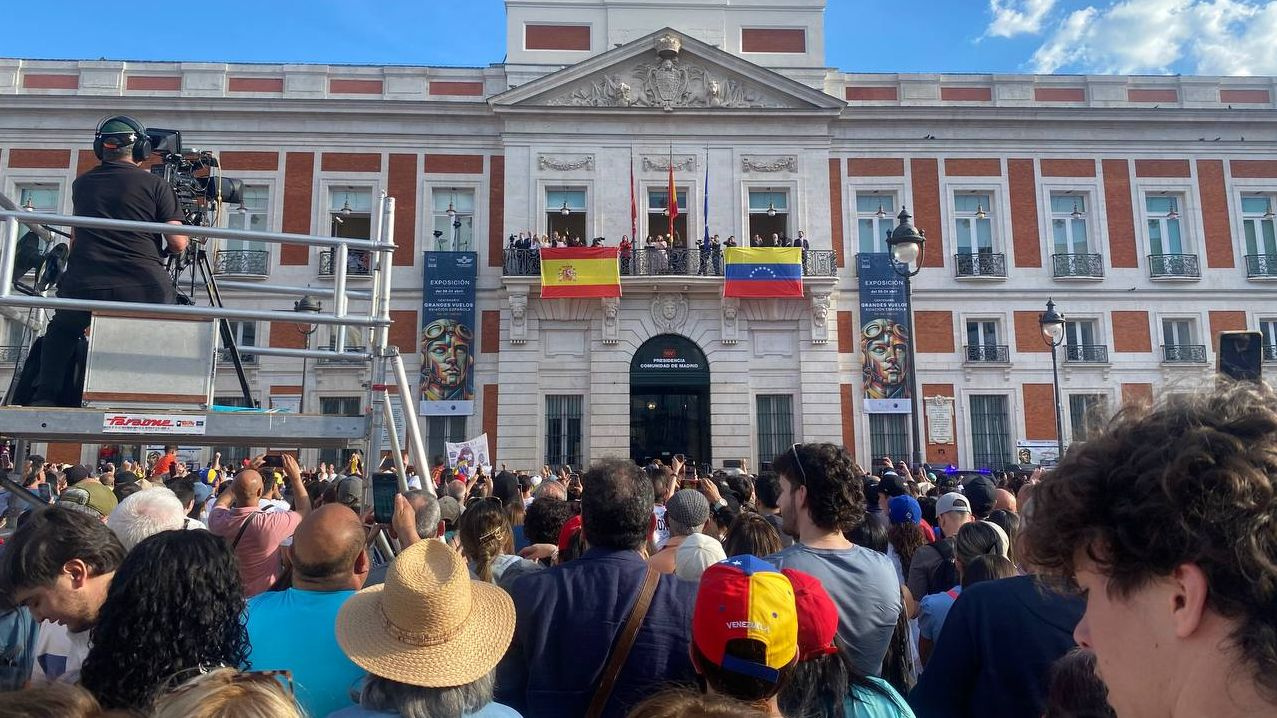
Madrid/This Saturday Puerta del Sol once again became a protest square and a scene of exile. Thousands of Venezuelans – also along with dozens of Cubans – gathered in the center of Madrid to accompany the visit of María Corina Machado, who for years has become one of the most visible faces of the Venezuelan opposition and, for a large part of the diaspora, a political and moral reference against Chavismo.
Several hours before the start of the event, the square began to fill with Venezuelan flags, t-shirts with the colors yellow, blue and red, posters in favor of freedom and family groups arriving from different parts of the capital and other Spanish cities. There were mixed accents, children on shoulders, mobile phones held high, and a slogan repeated over and over again: “Until the end.”
Machado’s visit to Madrid had raised expectations since days before. His agenda combined political meetings and institutional recognitions. On Friday he received the Golden Key of the city of Madrid from the mayor, José Luis Martínez-Almeida. This Saturday she was honored at the Real Casa de Correos, headquarters of the regional Government, where Isabel Díaz Ayuso presented her with the Gold Medal of the Community of Madrid. The concentration in Sol functioned as a political and emotional extension of those events.
The most anticipated moment came when Machado appeared on the balcony of the Real Casa de Correos
For many of the attendees it was not just about seeing an opposition leader, but about encountering a shared cause far from their country. In Puerta del Sol, Venezuelan politics stopped being international news and became personal experience. Each flag was also a biography of exile, that of the one who emigrated out of fear, that of the one that left due to hunger, that of the one that left behind his parents or his children, that of the one that still does not know when he will be able to return.
The most anticipated moment came when Machado appeared on the balcony of the Real Casa de Correos. He did not go down to the square or tour the crowd, but his exit was enough to spark a prolonged applause. Thousands of people greeted her with shouts and applause. The Venezuelan community received her with honors reserved for a head of state.
The rally not only served to support Machado, but also to send a message against the Venezuelan regime and demand international support for the democratic opposition. On the posters one could read complaints against repression, demands for respect for the popular will and calls not to normalize the situation in Venezuela. Among those attending, the idea predominated that exile cannot be resigned to distance or silence.
“My presence in Spain coinciding with the Progressive Forum was not intentional, but providential”
The opposition leader also confirmed in Madrid her distance from Pedro Sánchez and the bloc of “progressive” Latin American leaders meeting this Saturday in Barcelona. In a two-hour press conference, he maintained that “what happened in Barcelona” had confirmed why a meeting with the president of the Spanish Government “is not convenient,” alluding to the Democracy Summit and the positions expressed there on Venezuela. He thus responded to the statements of Gustavo Petro, who warned of an alleged fear of the opposition’s return, and to the call of Luiz Inácio Lula da Silva and Sánchez to political non-interference in the South American country.
“My presence in Spain coinciding with the Progressive Forum was not intentional, but providential,” said Machado, before defending that there is “no people in the world as prepared for free elections” as the Venezuelans. Very different was the tone he reserved for Donald Trump, whom he praised as the only head of state who, he said, has put the lives of his citizens in danger for the freedom of Venezuela. Machado also confirmed that she is coordinating with the United States Government on her return to the country, despite the risks that, she assured, will not make her give up.
In that same intervention, he charged against Delcy Rodríguez, whom he accused of representing “chaos, violence and terror,” and defended that the only stable solution for Venezuela is through “clean and free” elections that allow an orderly democratic transition.