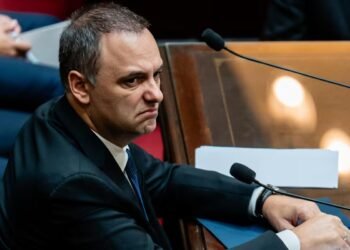
In a session marked by the opposition’s attempt to expose to Manuel Adorni due to their judicial and patrimonial situationthe main allies of the Government in Congress opted for another path: They avoided any reference to the most sensitive issues and concentrated their interventions on management claims linked to their provinces.
None of the blocks that usually guarantee votes to the ruling party – Pro, the UCR, the Integration and Development Movement and the provincial spaces – asked about the wealth growth of the Chief of Staff, travel expenses or the causes that involve him. There were also no mentions of other uncomfortable files for the Government, such as the $LIBRA case or the investigation into the National Disability Agency (Andis).
The most striking silence was that of Pro: He didn’t directly speak up. The UCR, meanwhile, had a single intervention. The Corrientes Diogenes González He avoided any political questioning and limited himself to pointing out the lack of works in the north of the country. In general terms, he stated that “no works were mentioned” for his region, and asked to address productive and tourist corridors.
The same scheme was repeated in the Integration and Development Movement (MID). The Buenos Aires native Eduardo Falcone He focused his intervention on the stoppage of road works, particularly on Route 5, without advancing on the official’s judicial front. Oscar Zagohe frontman of space, avoided appearing on the scene.
The “Force of Change” interblock, made up of the previous spaces, had 20 minutes to ask questions. They completed it Karina Banfi (Forward Buenos Aires) and Jose Garrido (Santa Cruz), who also avoided direct confrontation.
Banfi, for example, pointed to problems in allocation of subsidies in Bahía Blanca. He pointed out errors in the data crossing and asked for an administrative review: he said that there are beneficiaries “rejected without explanation” and even cases in which the system declared them dead. Also He demanded to know what happened to a remainder of the program’s funds.
From allied spaces with greater autonomy, the tone was somewhat more critical, although without moving away from the management axis.
The Santa Fe Gisela Scagliahead of the United Provinces block and close to the governor Maximiliano Pullaroquestioned the state of national routes and the lack of definitions on retentions. He warned that some corridors concentrate high accident rates and asked for a concrete plan: he stated that “you need to know what the strategy is” and demanded predictability for the agricultural sector.
His block had the absence of the radical Martin Lousteau.
The behavior was similar in the provincial blocks. The Federal Innovation deputies – aligned with the political power of governors Hugo Passalacqua (Misiones) and Gustavo Sáenz (Salta) – avoided any reference to Adorni and focused their interventions on local demands.
The missionary Alberto Arrua He questioned the scope of a border control plan and warned that it covers a minimal portion of the territory. In addition, he asked for definitions for the herbal sector: in summary, he demanded a plan to assist “more than 12,500 families” affected by deregulation.
In the same line, Yamila Ruiz He demanded details about works committed by the Nation. He demanded specific start and end dates, and once again put a historic claim on the table: a special customs zone to compensate for the asymmetries with Brazil and Paraguay.
References from the political center such as Miguel Pichetto and Nicolas Massot They did not participate in the debate. Pichetto, in fact, justified his decision on social networks and questioned the atmosphere of the session, which he described as “an unprecedented act” with the ruling party mobilized en bloc. “Turning the Chamber of Deputies into a space of barbarism is one step lower in the decline of Argentine institutions,” he said. And he concluded: “Beyond the judicial result, the figure of the chief of staff has lost all relevance and institutional authority.”