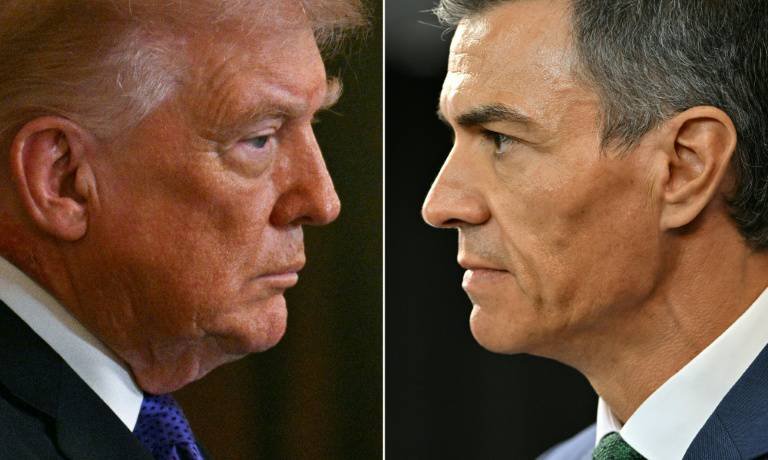


Madrid (AFP) – Spanish Socialist Prime Minister Pedro Sanchez has become a prominent figure on the left worldwide, especially through his sharp debates with US President Donald Trump, a position that is expected to be strengthened by his hosting an international summit of progressives in Barcelona on Friday.
Between his frequent spats with Trump, his harsh criticism of Israel, and Spain’s open immigration policy, Sánchez stands out as an exception in a Europe that has leaned to the right for years.
In the latest phase of the dispute with the US Republican administration, the Spanish Prime Minister expressed his strong opposition to the war on Iran, despite Trump’s threat to impose punitive trade measures after Madrid refused to allow the Americans to use its military bases in the war.
Sanchez is also one of the few prominent Western leaders who described the bloody and devastating Israeli war in Gaza, after the Hamas attack in October 2023, as “genocide.”
Thanks to these positions, Spain has gained “leadership, influence and prominence in many countries,” according to what Ignacio Molina, a researcher at the Real Elcano Institute in Madrid, told AFP, referring especially to the Arab world and Latin America.
Molina points out that other countries oppose Israel and the United States, but Spain, due to its membership in NATO and the European Union, has more weight than Ireland or Norway, which recognized the State of Palestine at the same time as Madrid recognized it in May 2024.
Juan Botella, a professor of political science at the Autonomous University of Barcelona, confirms that, thanks to its positions, Spain now “enjoys greater weight among the major countries in the European Union than it did previously.”
– ‘Trump’s arch-rival’ –
It seems that Sanchez, who currently heads the Socialist International, is also receiving increasing attention from international media, and has, for example, published opinion articles in the New York Times and Le Monde Diplomatique.
“Pedro Sánchez has become the standard bearer of Western political opposition to the US president,” the Wall Street Journal wrote in March, while the Financial Times described him as “Trump’s arch rival in Europe.”
The “Global Progressive Mobilization” summit, which will be held on Friday and Saturday in Barcelona, will provide a new opportunity for the Socialist Prime Minister to position himself in the leadership of the left at the international level.
Brazilian President Luiz Inacio Lula da Silva, South African President Cyril Ramaphosa, and Mexican President Claudia Sheinbaum are expected to attend the summit, which aims, according to its organizers, to mobilize efforts to confront the rise of the extreme right.
“We, progressive parties and governments, must unite and tell citizens that we belong to something that goes beyond domestic politics, goes beyond our borders, and has a positive and humanitarian outlook,” Sanchez said Tuesday during his fourth visit to China in four years.
But while the Spaniard stands out on the international scene, he is causing division in his country, where he has not obtained a parliamentary majority since he took power in 2018, and where many of his close associates, political allies, and family members face corruption-related investigations and trials.
– “The gain is greater than the loss” –
Juan Botella points out that Sánchez “plays the foreign policy card to the maximum, because he feels comfortable in this area, and because the majority of public opinion supports him” in it.
An opinion poll published by the daily newspaper El Pais in March showed that more than 68% of Spaniards opposed the war against Iran, including voters from the Popular Party, the largest opposition party.
For its part, the Popular Party accuses the Prime Minister of using foreign policy to regain voter support and divert attention from the scandals affecting his relatives and his party.
Juan Tovar Ruiz, a professor of international relations at the University of Burgos, believes that he is “using this image of a progressive leader, opposed to Trump, to win votes on the left.”
But such a strategy has “consequences at the European level” as Spain may lose the support of some traditional right-led allies, such as Germany and Italy, warn Tovar Ruiz and Ignacio Molina.
However, Molina believes that “in the end, the gain is greater than the loss” in this strategy.