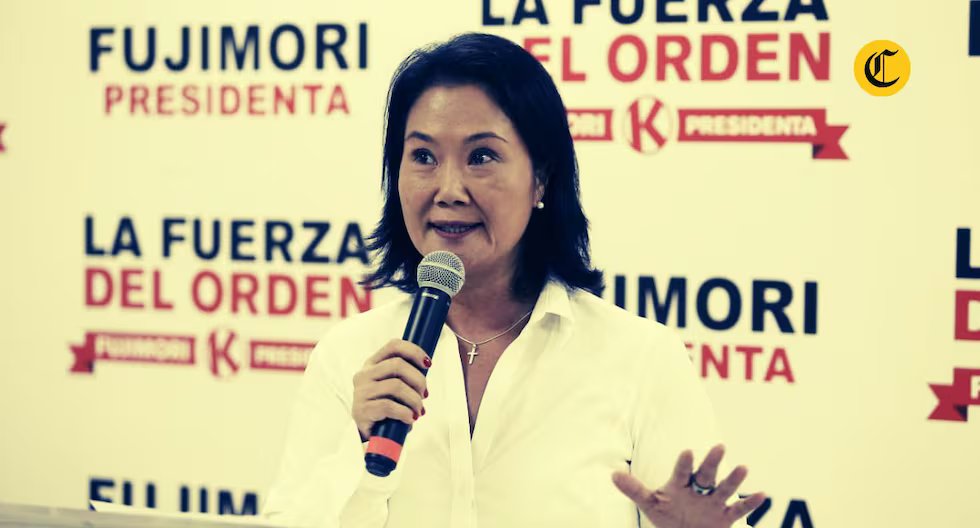

The presidential candidate Keiko Fujimori (Popular Force) offered to make available to Rafael Lopez Aliaga (Popular Renewal) the command of representatives of his party. The gesture was accompanied by criticism of the leader of Renovación Popular, for invoking the insurgency.
“We put at the disposal of the Popular Renewal political party the command of Fuerza Popular representatives to share all the information in order to contribute to clarifying the facts and ensuring that the truth prevails,” Fujimori said in a statement.
This is not the first time that the candidate has built bridges towards López Aliaga. During the presidential debate he told him that he did not want to fight with him and that a large majority of Peruvians hoped to see them in the second round.
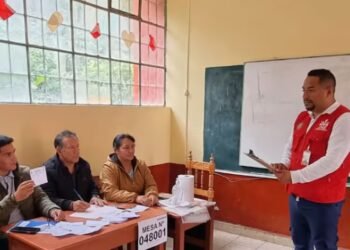
However, Fujimori also distanced himself from the position adopted by the leader of Renovación Popular. He warned that political actors must avoid generating chaos, in a context in which election day was marked by logistical failures in the distribution of electoral material.
“I am not going to respond to Mr. López Aliaga’s insults, to which we are sadly accustomed. However, we cannot allow an insurgency to be called,” he stated.
Until the closing of this note, there was no response from Renovación Popular to the offer. This newspaper tried to collect the position of the candidate for the first vice presidency, Norma Yarrow, as well as the legislator Alejandro Muñante, but did not obtain statements.
Strategy
The specialists consulted by The Commerce They agreed to point out that Fujimori’s offer is aimed at capturing the support of López Aliaga’s voters ahead of the second electoral round.
“Fujimori activates a strategy of broadening the base and implicit coordination with López Aliaga’s electorate, key to building a majority. However, he moves along a very delicate line,” says political scientist Karen López.
That “delicate line” that López refers to is the dilemma that the candidate faces. If it validates or gets too close to the fraud discourse promoted by Popular Renewal sectors, it runs the risk of being associated with a narrative that erodes the legitimacy of the electoral process. But if he distances himself too much, he could lose the support of a segment of voters who share ideological affinities with his proposal.
“Its main structural restriction is played out in this balance, since rather than capitalizing on an advantage, I would say that it once again enters a second round forced to compete as the least risky option, in a scenario of high fragmentation and low adhesion,” adds the specialist.
The political calculation is not limited to the electoral level, but also includes future governance, in the opinion of lawyer Alejandro Rospigliosi, specialist in electoral law.
“She knows that she is going to go to the second round with Mr. Roberto Sánchez and, therefore, she needs López Aliaga’s votes to win. And as a second point, she will need the Senate and Chamber of Deputies bench that Popular Renewal obtains for the legislative management. Here she is acting with intelligence to begin to build a good relationship with that bench,” he told El Comercio.
Beyond the political dimension, Fujimori’s proposal has a technical component. Electoral law specialist José Tello explained that Fuerza Popular representatives have collected information in the field that Renovación Popular probably does not have.
“Keiko is saying that his people have been in the field collecting information on election day. These representatives have collected data that can inform Renovación Popular’s defense, strengthen its position or support efforts such as observations of minutes or requests for recounts before the competent Special Jury. Basically, they are the evidence collected in the field, which is what Renovación apparently does not have,” he said.
Tello referred to the difference between reporting irregularities and having evidence to support them. As he explained, if Renovación Popular had documentation, it would have already presented formal appeals to the corresponding authorities.
“They would already have all the minutes in the jury presenting the corresponding appeals, but they have nothing. Keiko has already learned from past elections. It is a gesture that makes her look more democratic in the eyes of public opinion,” he said.
Alejandro Rospigliosi explained that the main role of the representative is to be vigilant at the voting station on election day. Verify that, at the time of counting, the polling station members correctly count the voting cards and transfer them to the vote record.
During this stage, representatives can make observations and even challenge votes. “For example, you can challenge a ballot alleging that the vote is null because the ‘X’ is outside the box; then the polling station members must decide whether it is inside or outside. Then, they must ensure that the accounting of the votes is correct. However, that stage has already passed. We are no longer in that phase,” he said.
In the current stage, the role changes. “What the legal and technical representatives can do now is verify that the records that the ONPE is processing and uploading in the count are correct. What comes now is the phase of electoral justice: the annulment of records due to different inconsistencies,” he explained.
In electoral justice, the strategy may consist of looking for defects in the minutes to cross them out and subtract votes from the main rival. “But obviously that does not suit Keiko, that is why the offer is purely political,” he stated.
With this, Fujimori seeks to present herself as a candidate who is committed to transparency and technical verification of the results, and at the same time build bridges with a like-minded electorate.
For specialists, accepting the offer would imply for Renovación Popular to recognize the need for technical and political support. Meanwhile, rejecting it could reinforce a confrontational discourse.
FACT
Fuerza Popular accredited at least 187 representatives before the Special Electoral Juries, including regular and alternate legal representatives, legal and voting center technicians, according to official information from the JNE. However, the record does not detail how many polling station representatives were registered by that party.
In comparison, Renovación Popular accredited at least 208 representatives, while Together for Peru registered 162.