BAKU, Azerbaijan, June 23. Kazakhstan and
Belgium have signed a number of strategic agreements aimed at
advancing artificial intelligence, science, digital infrastructure,
and space technologies.
As reported by Kazakhstan’s Ministry of Artificial Intelligence
and Digital Development, the documents were signed during the visit
of Kazakhstan’s President Kassym-Jomart Tokayev to Belgium.
“The agreements reached open new opportunities for attracting
investment, implementing joint research projects, introducing
advanced technologies, and strengthening Kazakhstan’s position as
one of Eurasia’s leading technological hubs,” the ministry
said.
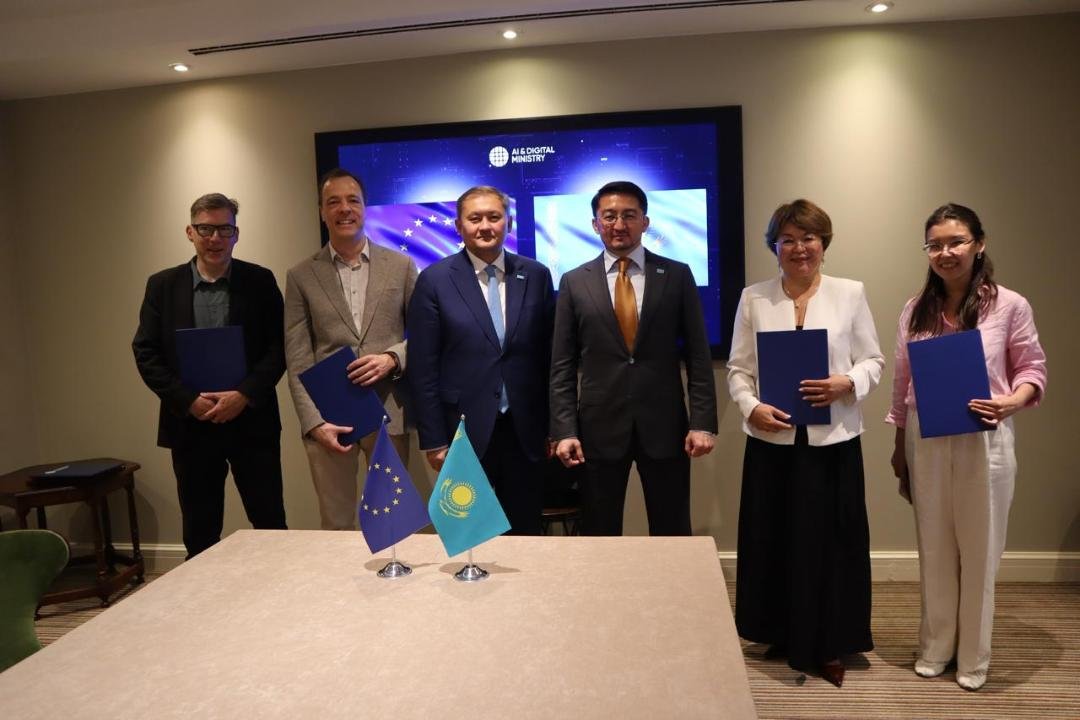
Kazakhstan was represented at the signing ceremonies by Deputy
Prime Minister and Minister of Artificial Intelligence and Digital
Development Zhaslan Madiyev, as well as Minister of Science and
Higher Education Sayasat Nurbek.
During the visit, cooperation agreements were signed with Ghent
University and KU Leuven, two of Europe’s leading scientific and
educational institutions. The agreements envisage joint research,
the establishment of international scientific teams, academic
mobility, personnel training, and the implementation of
technological projects within the framework of Kazakhstan’s
cooperation with the European Union and the Horizon Europe
program.
According to the ministry, Horizon Europe serves as an important
mechanism for Kazakhstan’s integration into the European Research
Area, expanding the participation of domestic scientists in
international consortia and promoting joint scientific and
innovation projects.
The new agreements create a practical basis for preparing joint
applications, launching research programs, establishing
international laboratories, and introducing scientific developments
into the economy.
The ministry noted that the signed agreements also lay the
foundation for advancing the AI for Science and Innovation agenda,
which focuses on using artificial intelligence to accelerate
scientific research, model complex processes, develop new materials
and technologies, analyze data, and create innovative solutions for
industry and the economy.
“The central platform for implementing this agenda in Kazakhstan
will be ALEM.AI, bringing together the capabilities of artificial
intelligence, science, universities, research centers, startups,
and industrial partners. The platform is viewed as an entry point
for international partners into Kazakhstan’s AI for Science and
Innovation ecosystem and as a tool for launching joint projects
under Horizon Europe,” the ministry stated.
Cooperation with Ghent University will focus on research in
mathematical modeling, scientific computing, digital twins, and
artificial intelligence. Partnership with KU Leuven will expand
cooperation in sustainable materials, critical minerals,
engineering education, technology commercialization, and the
industrial implementation of scientific developments.
The International Science and Technology Center (ISTC), which
has extensive experience in forming international research
consortia and supporting science and technology projects, will also
join the implementation of joint initiatives.
In addition, during the visit, a joint activity agreement was
signed between JSC National Company Kazakhstan Gharysh Sapary and
Luxembourg-based Hydrosat S.à r.l., which specializes in satellite
analytics for water resource management and agriculture.
The agreement provides for the implementation of the pilot
project “Water Resource Management in Kazakhstan Using Copernicus
and Hydrosat.