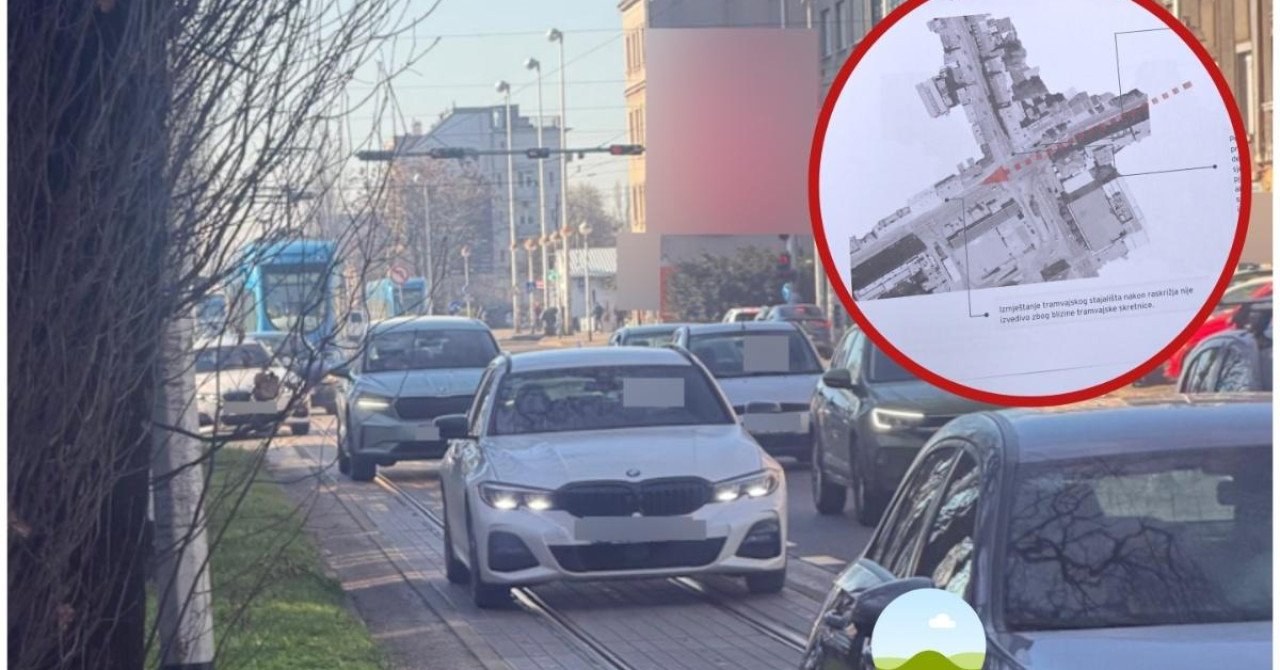
Congested yellow lanes are the cancer of public transport in Zagreb. Due to non-compliance with the rules, trams and buses are late, transport is unpredictable and unreliable, and therefore not attractive to passengers. The City has now decided on an epochal change.
We spoke with an associate professor at the Faculty of Traffic Sciences Luka Novačkowho, in cooperation with Ernst & Young, created a detailed analysis that would be the basis for solving this pressing issue. They proposed a total of 38 measures to the client, i.e. the City. Some changes won’t appeal to drivers, some to pedestrians, while some require greater cooperation from local and state governments. However, all points have one thing in common – they would speed up public city traffic.
Satellite images and analysis
We met the professor in his office at the university. A large stack of papers greeted us on the desk, and each sheet was full of text, charts and satellite images of important city intersections. To begin with, we asked him to define the term “school” for us, before we dive into all the details of the study.
– These are traffic lanes that are intended for the movement of public transport vehicles, that is, trams and buses, but, of course, if the signaling allows, also some other modes of transport, such as taxis – Novačko explained. He says that it is more important than the definition itself to clarify why they are used at all.
We spent 15 minutes at one of the key intersections in Zagreb and were amazed by what we saw
Since Zagreb does not have a leveled public transport system, such as an underground metro, the installation of yellow lanes is considered one of the measures that can increase the competitiveness of trams and buses compared to private cars. In other words, they should be allowed to be reliable, as well as to be able to respect their timetable.
– It is important for you to know that if you go to work at the same time, you will usually arrive at work, school or college at the same time every day. This is the only way to solve the problem of congestion. The city must do everything in its power to improve public transport.
The Zagreb tram network has about 24.5 kilometers of yellow lanes, while only 1.5 kilometers belong to buses. This would mean that tram corridors have a coverage of 21 percent of yellow stripes, and buses less than one percent. Also, about 50 percent of the tram tracks are not physically separated from motor traffic, but share it with them, and this only increases the chance of traffic accidents. In addition, a collision with a tram in, for example, Savska cesta, through which nine tram lines pass, leads to the collapse of the entire tram system in the city.
– We have to see the trip as a unit. We have to look at the passenger, not the vehicle he is in. We have an average of 1.3 people in a car, while there can be more than 100 in a tram. We would achieve more significant results in saving time if we speed up public transport – said the professor. If public transport were faster, more reliable and time-competitive with a private car, a larger number of private car drivers would start using it as a daily alternative in the long term, which would reduce the load on the road network and contribute to less traffic jams.
Time is money, says Novačko. If, due to the introduction of the proposed measures, tram traffic speeds up by two minutes, in order to understand this, we must first understand that each passenger then saved two minutes. But not only in one tram, because the savings apply to the entire network. When these numbers begin to multiply, we come to the point that hundreds of hours can be saved daily, weekly, monthly and annually that would otherwise be unnecessarily wasted waiting. The goal is clear – to enable more frequent tram departures so that as many drivers as possible can transfer to them. And thus the congestion on the roads disappears.
Penalties for violators
It is important to emphasize that violators on yellow lines, who “hitchhike” trams and buses, are rarely penalized. Controlling and punishing reckless drivers is the responsibility of the MUP, and Novačko believes that significant progress could be achieved by transferring that role to local self-government. Measly fines of 30 euros are not so much a problem, says the professor, as the fact that many are not sanctioned for their behavior. With today’s technology and camera system, the ticketing process is faster and easier than ever. As a reminder, the Zagreb Police Department replied that in 2026, in the period from January 1 to May 31, they recorded 954 such violations, that is, just over six per day. The reporters of Jutarnji counted so many violations at just one intersection with yellow tapes in Zagreb, and that in five minutes.
However, what are the measures that could lead to a revolution in transport? Regarding the expansion of the yellow lane zones, the most interesting proposal to us is the one concerning the Freedom Bridge, over which as many as 12 ZET bus lines cross. Due to the high traffic density, especially in the morning and afternoon peak hours, buses get stuck in traffic jams just like cars, even though they carry significantly more passengers. There are four traffic lanes on the bridge, two in each direction, and considerable time would be saved if one lane on each side were converted into a yellow lane. However, the losses in road traffic would also be noticeable.
– The consequence would be that there would be only one traffic lane left for cars, so the tail of the crowd might stretch all the way past Dubrovnik Avenue. And we have to think about such things when we plan solutions – Novačko said. By the way, there are already yellow lanes for buses in Ulica Hrvatske bratska zajednaje, near the Bandić fountains. This expansion move would create a “shuttle” corridor that would shorten the travel time from Novi Zagreb to the city center. It would also reduce the chances of public city transport vehicles getting stuck in a jam and having to “jump” lines.
A critical crossroads
Then we moved on to the measures concerning tram traffic. Professor Novačko immediately cited the one between Ozaljska and Selska on Trešnjeveca as an example of an extremely bad intersection, one of the worst in this research. Only when you think about traffic more seriously, you can understand why the journey from Cibona to Remiza can sometimes take nine minutes, and sometimes 25.
The right turn from Ozaljska to Selska is problematic, he explains. There is a yellow lane for trams, but it breaks before the traffic lights to give space to cars turning right. When the traffic light for going straight and right in Ozaljska is lit, pedestrians are allowed to pass in Selska. Cars turning have to stop to let them pass, while trams wait behind them. If at some point there are many pedestrians or many cars turning, then the tram may lose its cycle at the traffic light, i.e. it will turn red. And that’s when the collapse occurs.
What is the solution? The situation is such that if you want to give priority to someone, the others will have to be deprived. In the analysis, these measures are specifically proposed here. The possibility of turning right can be canceled for cars, and then they should find their way at another intersection, but this opens up the possibility that the problem is simply transferred from one location to another. Also, the pedestrian crossing on Selska can be abolished, so cars turning should not stop. However, with that decision, pedestrians would be “resentful”. In any case, we should not forget that such unpopular solutions would significantly speed up the traffic of the tram, that is, a greater number of passengers. The tram should not be viewed as a single vehicle, but it should be remembered that there are a hundred passengers in it, the professor emphasizes.
The problem of Ozaljska is that the parking spaces are located on the sidewalks, and they are located next to the tram tracks. This means that there are no yellow lines there because cars have to get to those places somehow. And this is a big challenge that somehow has to fit into the whole concept of speeding up public transport. What to do in that case? Abolish those parking spaces to give priority to trams? How would that decision be received?
Cancellation of parking?
Novačko revealed to us that there are about 2,500 parking spaces along the yellow lines of Zagreb. It seems to be an unsolvable puzzle. Such a number of places cannot be abolished simply and painlessly, even if from the perspective of speeding up public transport, such a decision would be smart. Also, about 5,000 taxis are registered in Zagreb, and they are mostly allowed to use yellow stripes. Are taxis really vehicles of public city transport or should they be deprived of that privilege?
And that is one of their proposed measures. In particular, there is a possibility to cancel the license for taxi vehicles to operate on yellow lanes on Ilica from Gjura Čanić Street to Republike Austrije Street. The same decision can be made in Jukićeva street, in Savska from Tratinska to Vodnikova, on the corridor Vodnikova – Mihanovićeva – Miramarska underpass, and on Maksimirska from Bukovačka to the Dubrava interchange. The problem with taxis is not only that they use yellow lines, but that they can stop on the tracks to pick up or drop off passengers, which means that the trams have to wait.
A series of changes
Among other concrete measures, it is proposed to move the pedestrian crossing at Trešnjevački plac, that is, at the right turn from Ozaljska towards Ulica grada Vukovara. This case is a copy of the one from Ozaljska-Selska, because right-turners “hitchhike” trams that drive straight. There is also the option of abolishing the right turn completely, which would mean that a roundabout would be introduced. Another proposal refers to the intersection of Savska and Vukovarska, where tram traffic would be accelerated by moving the rails to the edges of the roadway. Currently, they are located in the middle of the roadway, which slows down the tram. Changes have also been proposed at the Savska – Vodnikova intersection with the aim of reducing the wait for trams at the intersection.
Finally, nowadays technology has advanced so that there are numerous applications that show exactly where buses or trams are located, says Novačko. If the network were predictable and regular, trips could be easily planned and monitored, which is important to travelers. New, more advanced trams are also being purchased, but this is all for naught if the tracks they have to run on are busy.