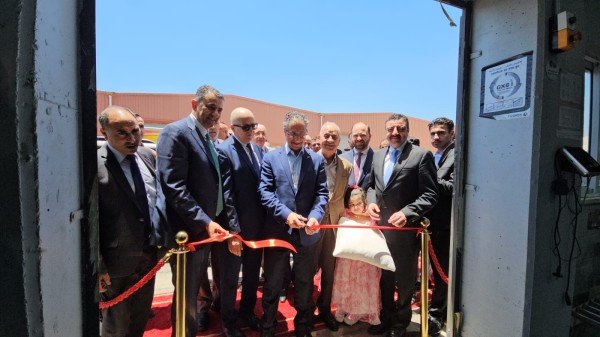
The Minister of Industry, Trade and Supply, Engineer Yaroub Al-Qudah, confirmed that the Jordanian food industries represent one of the most prominent industrial sectors capable of achieving high added value to the national economy, through its integration with the agricultural sector and its reliance on local production inputs, which contributes to strengthening national supply chains, supporting farmers, and directing agricultural production towards crops that meet the needs of the industry.
Al-Qudah said, during the opening of the “Laris” factory for the food industry in Al-Hassan Industrial City, in the presence of representatives of the sector, that the project contributes to meeting part of the local market’s needs for potato products, and keeps pace with the rapid transformations in consumer patterns that are increasingly moving towards frozen products and manufactured vegetables, which enhances the ability of the industrial sector to respond to the requirements of the local and regional market.
He added that the Jordanian food industry sector is one of the leading sectors that have achieved distinguished success stories and whose products have reached various foreign markets, based on a strong national production base, stressing the importance of the role played by the Jordan Chamber of Industry in promoting food industrial integration based on local production inputs.
He pointed out that the government continues to support the industrial sector and production projects that depend on raw materials and local production inputs and achieve integration between different economic sectors, indicating that such projects represent a model to be followed in achieving added value, enhancing food security, creating job opportunities and supporting economic growth.
He stressed that this project represents an important strategic step in strengthening the national food security system by providing a high-quality local product that contributes to meeting the needs of the local market and reducing dependence on the importer, in line with the state’s trends towards supporting value-added food industries.
The judges added, during the opening, which was attended by a number of representatives, the head of the Jordan Chamber of Industry, Fathi Al-Jaghbir, the head of the Irbid Chamber of Industry, Hani Abu Hassan, the Director General of the Food and Drug Administration, Dr. Rana Obaidat, the General Director of the Jordan Industrial Estates Company, Adi Obeidat, and the Chairman of the Board of Directors of the cities, Obaid Yassin, that the factory embodies a successful model and reflects the ability of the national industry to invest local agricultural products and transform them into competitive industrial products, which contributes to achieving higher levels of self-sufficiency and opens new horizons for farmers and industrialists to Both.
Al-Qudah pointed out that the government pays great attention to productive projects that provide job opportunities and promote economic development in the governorates, stressing that such qualitative investments contribute to stimulating economic activity, raising the competitiveness of the Jordanian industrial sector, and supporting the Kingdom’s efforts to achieve sustainable development and enhance food security.
He stressed that the frozen potato factory represents a model of modern food industries that are compatible with local and regional market changes, and keep pace with the shifts in increasing consumer patterns towards manufactured food products of high quality and added value, noting that this type of project contributes to enhancing food security and raising the competitiveness of the Jordanian industrial sector.
He added that the factory constitutes an important complementary link with the agricultural sector and Jordanian farmers by providing a sustainable market for agricultural products and achieving a remunerative economic return for farmers and investors alike, which requires strengthening agricultural awareness and guidance regarding crops and varieties that are involved in manufacturing processes in a way that ensures the compatibility of agricultural production with the needs of factories and markets.
The Minister stated that many Jordanian food factories depend mainly on the local product, which enhances the added value of the national economy and provides new job opportunities, stressing that the government and the Ministry of Industry and Trade, in cooperation with the industrial cities and concerned parties, continue to provide various forms of support, empowerment and facilities for promising industrial projects, especially in the food industry sector, in order to enable them to expand, grow and contribute more to achieving sustainable economic development.
For his part, Abu Hassan stressed that the royal directives on the necessity of working to achieve food security and attention to agricultural industrialization were a clear message to all governmental and private institutions, capital owners and investors, especially Jordanian expatriates, because of their comprehensive impact on the system of living and economy in the Kingdom.
He added that the opening of the frozen potato factory represents a qualitative addition to the industrial and food sector in Irbid Governorate, and reflects the growing confidence in the investment environment in the Kingdom.
He stressed that the project will contribute to absorbing an important part of local agricultural production, providing direct and indirect job opportunities, in addition to enhancing integration between the agricultural and industrial sectors, which will reflect positively on the national economy and local communities.
Abu Hassan pointed out that the factory was established by a Jordanian investor who came from Germany for the purpose of investing in Jordan. He began his first work by freezing local potatoes, and the factory’s work was later extended to include other products.
In turn, the Jordanian investor, Rikaz Al-Sharaa, confirmed that he chose to establish a project in Irbid Governorate and the Ramtha District in Al-Hassan Industrial City in particular as a center for the project since the lands are agricultural in the Ramtha District, indicating that the factory provides 104 job opportunities for Jordanians.
He added that the establishment of the frozen potato factory came out of the belief in the importance of investing in the Jordanian agricultural product and transforming it into value-added food products, which contributes to supporting farmers and creating a stable market for their production.
He stressed that the factory adopts the latest technologies in manufacturing and freezing processes to ensure the production of frozen potatoes with high-quality specifications that meet the needs of the local market and compete in foreign markets. He expressed his aspiration to expand in the future and increase production capacity in a way that enhances the factory’s contribution to achieving food security and providing more job opportunities for the people of the region.