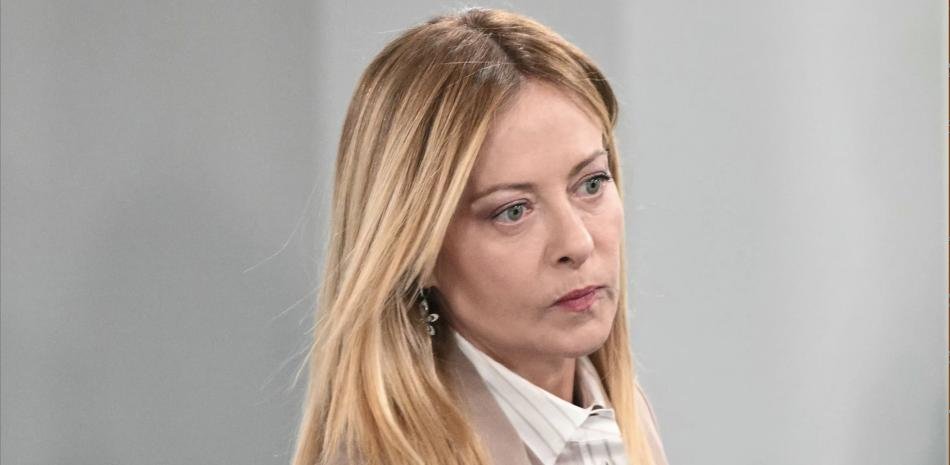
The Italian government closed ranks on Friday to attack the president of the United States, Donald Trump, for his claim that Prime Minister Giorgia Meloni had “begged” him for a photo during the recent G7 summit, a retort that suggested that the country, which has been a historic ally of the United States, had had enough of the president’s bluster and criticism.
Italian Foreign Minister Antonio Tajani abruptly canceled a trip to the United States scheduled for this weekend and described Trump’s statements as “serious and offensive” toward Meloni and all of Italy. Subsequently, the Ministry of Foreign Affairs announced that the business and scientific forum that Tajani was going to attend in Miami had also been canceled.
Meloni, for his part, posted a video in which he called Trump’s claims “completely made up” and expressed his astonishment that he would make up such things about an ally.
“Italy and I are not begging,” he said forcefully.
Trump made the comments in an interview broadcast Friday morning on the La7 network. The La7 correspondent asked the president about Ukraine, but he brought up Meloni and the conversation turned to their meeting, captured on video, during the recently concluded G7 meeting in Evian-les-Bains, France. Meloni and Trump were filmed chatting at various times, including alone on a small couch.
According to La7, Trump said Meloni had “begged” him for a photo opportunity. The Republican stated that he was not obliged to do so, but that he felt sorry for her and accepted, La7 indicated. The network has a dubbed version of the conversation on the Internet, not the original audio in English.
Meloni, amazed and defiant
Trump’s boastful attitude underscored how his alliance with Meloni — long considered one of his closest friends in Europe — has deteriorated over his war in Iran, his tariffs against Europe and his complaints when someone disagrees with him.
The president lashed out at Meloni in April when she refused to support his war in Iran and defended Pope Leo XIV when Trump attacked him.
But Meloni’s forceful response on Friday suggested he no longer fears Trump’s verbal attacks, which could even work in his favor in a country where public opinion of the American president has cooled, said Lorenzo Castellani, a political scientist at Luiss Guido Carli University in Rome.
“In a way, this was a favor to Giorgia Meloni, in the sense that, until a few months ago, she was accused of being a kind of Trump vassal in Europe,” he said.
In his video, Meloni explained that he was responding to Trump’s claims because “certain things deserve an immediate response.”
“Donald Trump’s statements are completely made up. Frankly, I am stunned,” Meloni declared. “I don’t know why the president of the United States behaves like this with his own allies. After all, this is not the first time it has happened.”
The above was an apparent reference to an interview that Trump gave in April to the Italian newspaper Corriere della Sera, in which he criticized Meloni’s refusal to support the United States and Israel’s war in Iran. The prime minister did not respond publicly at the time. By Friday, it seemed he’d had enough of his bragging and attacks.
“I can only say that it is a shame that he does not show the same determination in the face of the enemies of the West, in the face of the enemies of the United States, in the face of leaders with whom, on the other hand, he is much more accommodating,” Meloni said on Friday. “But there is one thing you must remember: Italy and I do not beg.”
The White House has not yet responded to a request for comment on Meloni’s remarks.
The Italian prime minister had initially sought to build on the traditionally strong ties between the United States and Italy as Trump began his second term, presenting herself as a “bridge” between Washington and the European Union. She was the only head of state of the bloc to attend his inauguration.
But relations have deteriorated over the US war in Iran, which Meloni has called illegal, and over Trump’s stance on Ukraine, which Italy strongly supports. Trump’s tariffs and strong US support for Israel over its war in Gaza have been other points of friction.
Italian officials close ranks around Meloni
By Friday afternoon, solidarity with Meloni had spread across the government and political spectrum, and included a call from President Sergio Mattarella, Italy’s highly respected head of state.
“Whoever attacks @GiorgiaMeloni attacks us all,” published the Minister of Transport, Matteo Salvini.
Justice Minister Carlo Nordio alluded to the sacrifice of American troops in World War II to underscore the damage to U.S.-Italy relations caused by Trump.
“The thousands of crosses marking the graves of American soldiers who died to free us from the Nazi-fascist dictatorship did not deserve such a painful blow to our fraternal ties,” Nordio said in X.
Defense Minister Guido Crosetto said he did not believe Meloni would ever beg someone for a photo, “not even under threat.”
A “fantastic” friendship deteriorates
Meloni and Trump had started on the right foot, since both leaders agree ideologically on many issues. As head of a far-right party, Meloni supports curbing migration and promoting traditional values.
In 2025, weeks before Trump’s inauguration, the prime minister met with him at his Mar-a-Lago residence, a visit she said “exceeded expectations.” It was, he said then, “an opportunity to confirm a relationship that promises to be very solid.”
In the months since, Trump repeatedly praised her, calling her “fantastic,” “incredible,” beautiful and a friend.
But stark differences emerged over Ukraine. More recently, Meloni strongly warned against US threats to take Greenland by force, saying he did not believe Washington would go that far and that Italy would never support such a move in any case.
Meloni also received support from an unexpected ally in Europe: the president of Spain’s socialist government, Pedro Sánchez, who was asked about the dialogue on the sidelines of a European Council meeting on Friday.
“All my solidarity,” he told reporters, referring to Meloni. “Not only have I said it publicly in response to a question from you, but I have also done it privately, in the European Council itself I have conveyed my solidarity in the face of this attack that is neither political nor personal… I really don’t know how to describe it either.”