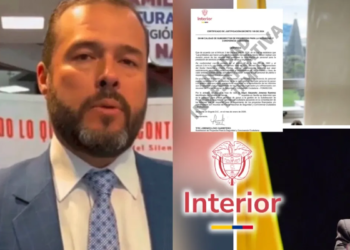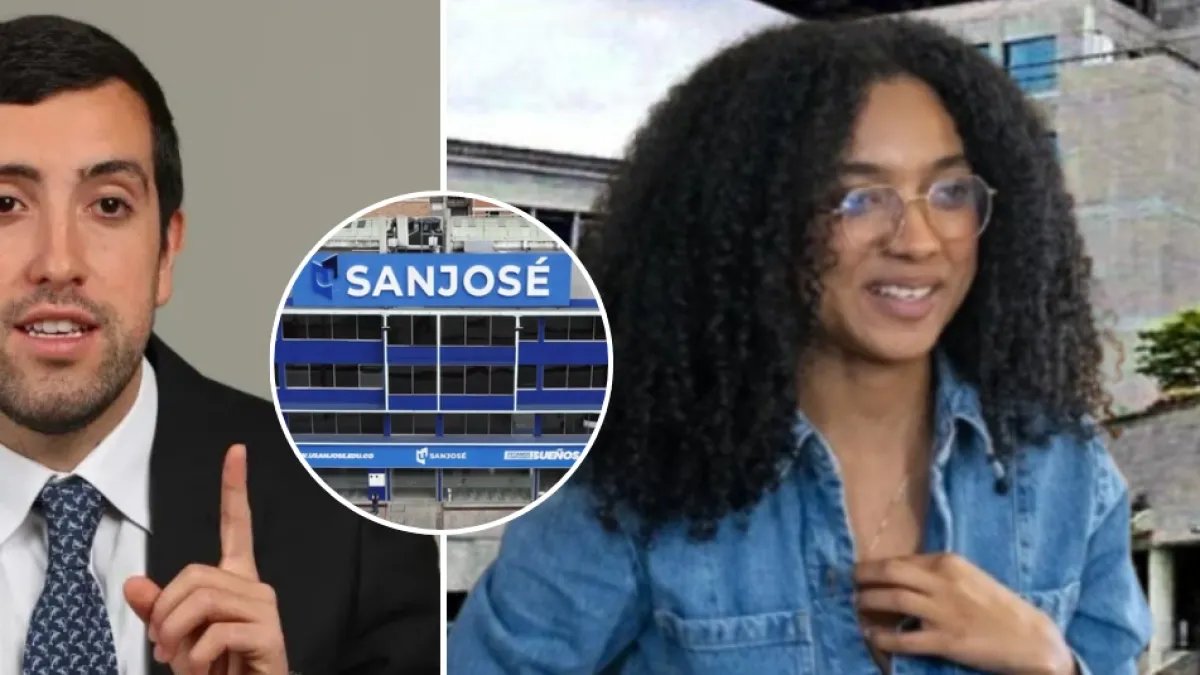
Felipe Alzate He is the lawyer who defended Juliana Guerrero in the scandal of false degrees that he obtained at the San José University Foundation. In recent months, the criminal was in the negotiations that led to a three-year sentence, obtained through a pre-agreement with the Prosecutor’s Office.
The legal benefit that reduced his sentence by half was endorsed by a Bogotá judge. However, During the hearing, the attorney in the case requested that copies be certified against Juliana Guerrero, considering that they could investigate her for a crime against public faith..
Alzate described the Attorney General’s request as an act of disloyaltyand stated that this is one of the arguments why he supports the idea of President Abelardo De La Espriella’s government to withdraw the Public Ministry from criminal proceedings.
About Juliana Guerrero, The lawyer stated that it is not known what amount he paid to obtain the two false titles.or if there was some other arrangement in between. The young woman was disqualified from holding public office for two and a half years, and will have to pay nearly 175 million pesos in fines.
Juliana Guerrero at pre-agreement hearing. Photo:Private file
Juliana Guerrero was convicted in one of the most high-profile cases in recent months. How do you receive the decision?
Before talking specifically about the sentence, I would like to give a context of what happened in the context of the hearing, the decision she made and the procedural instance. She, regardless of her condition, of her closeness at the time with former President Gustavo Petro, has the same guarantees as any person. And in this scenario, Juliana did nothing other than take advantage of some of those powers to agree or submit to a pre-agreement.
If it had been raided, he would not have had to publicly apologize to the country, the university community, or the people he already mentioned. She chose to negotiate with the Prosecutor’s Office, to recognize her mistake. The sentence is a mathematical issue: if it was six years, half of it had to be three.
She studied eight semesters at the Universidad del Cesar and came to Bogotá to obtain the fraudulent degrees. Luis Carlos Gutiérrez, the former general secretary of the educational institution, was already convicted for this. How was the negotiation with the Prosecutor’s Office?
Before that, there is something very interesting that you just mentioned. She had attended the University of Cesar, was on the verge of completing her university degree and made a decision that was more illicit than incorrect. She had almost the professional qualities of a person who can obtain an accounting degree. Secondly, we have never thought about a principle of opportunity.
Luis Carlos Gutiérrez, former general secretary of the San José Foundation. Photo:Private file
We began to dialogue with the Prosecutor’s Office to reach an agreement beneficial for both parties. It is obvious that the Prosecutor’s Office, the administration of justice and Juliana obtain a benefit, which in her case is the reduction of the sentence.
How much did she pay to get the two cards? There is a fine of about 175 million pesos, is that due?
No, the fine is a separate issue. I do not know what the specific circumstances of the falsehood were, and that was not the subject of any evidentiary debate, much less mention in the court ruling.
Under a principle of opportunity she could be left with immunity, but it involved her speaking against other smeared people…
Of course, the figure of the principle of opportunity is absolutely different from the pre-agreement. In the principle of opportunity, at least in the one you mention, obviously she would have had to commit not only to testify, but also to deliver elements that corroborate her statement. That was not the path chosen by her, although evidently within the framework of my representation I raised it with her, but she was adamant that this is not her intention nor her interest.
Felipe Alzate, criminal lawyer. Photo:Private file
After the preliminary agreement had been presented, the attorney stated that copies had to be certified to investigate Juliana Guerrero for another crime against public faith. You came out to defend her…
Before answering that question, the example of that hearing exemplifies very well the urgent need for the Public Ministry and prosecutors to exit criminal proceedings. That was an act of absolute disloyalty. The current minister, Dr. Iván Cancino, has been a defender of this throughout his academic and professional life, and I believe that it is time to have that discussion.
In my opinion, the action is not only disloyal but also evidently wrong on the part of the Public Ministry agent. Submits a reckless request to certify copies for a crime that has already been investigated. The question is: why then was Juliana not charged with this crime of falsehood at the time? Well, she was not charged because the correct criteria of the Prosecutor’s Office ends up subsumed in falsehood.
What I understand is that the Attorney General’s Office has made a mistake in requesting that she be investigated for two crimes…
Sure, sure.
Juliana Guerrero has another open investigation for an alleged corruption scheme that she set up with her sister Verónica, apparently. How is it progressing?
We filed a formal request for them to listen to us, to actually know the filing number, although they have not yet given us a response. And the second thing, at the moment that we become aware of the circumstances that this process is going through, because as we have stated, it was demonstrated within the framework of this action, our interest has always been and will be to give the necessary explanations or accept the responsibilities that may arise. Although in that case, there is obviously nothing to accept.
Hearing against Juliana Guerrero. Photo:Private file
Is the conviction for false degrees already final?
The pre-agreement is firm, but we appealed a specific point which is the certification of copies. The rest, obviously, will no longer be the subject of discussion by any judicial body.
And who will define that?
The Superior Court of Bogotá.
Carlos López – @CarlosL49 – carben@eltiempo.com