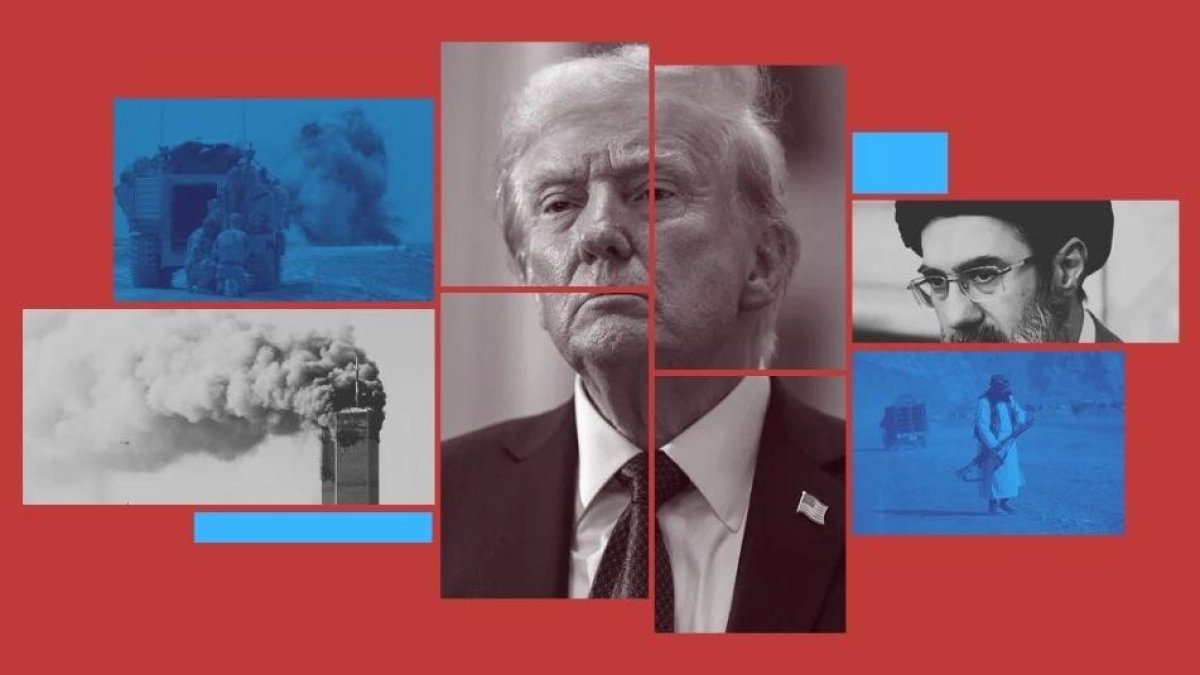
USA commemorates this Friday the 25 years of the terrorist attacks of September 11, 2001 against New York and Washingtonan event that forever changed both its history and its relationship with the world.
READ ALSO
As with every anniversary, events are planned in several cities across the country to remember the nearly 3,000 people who died that day, pay tribute to those who participated in the rescue efforts and those who gave their lives to defend the country.
But this time the date comes with a bitter taste.
Although the war in Afghanistan, which began as a direct response to the attacks, ended five years ago, the country is once again immersed in a conflict in the Middle East. And, paradoxically, in one that began under the mandate of Donald Trump, a president who campaigned against the so-called “forever wars” and promised to keep the United States away from that type of military adventures.
Since last February 28, US forces have been fighting against Iran in a conflict that has now lasted more than six months, has left 18 US soldiers dead and whose cost will reach at least US$37.5 billion by the end of September, according to Pentagon estimates. Trump insists that this is not a new eternal war and this week he minimized its dimension compared to previous conflicts. But the Pentagon has extended deployments in the Middle East until 2027 and nearly 50,000 US military personnel remain mobilized in the region.
View of the Twin Towers in New York. Photo: AFP
The day America’s sense of invulnerability was broken
On the morning of September 11, 2001, 19 members of Al Qaeda hijacked four commercial airliners. Two were crashed into the Twin Towers in New York and another into the Pentagon, on the outskirts of Washington. The fourth, believed to have targeted the Capitol, fell in Pennsylvania after passengers attempted to regain control of the aircraft.
Until then, despite the numerous wars in which the US had participated, Its territory had remained practically immune to attacks from outside.
9/11 put an end to that feeling of invulnerability and provoked a transformation of American foreign policy whose consequences remain valid a quarter of a century later.
The reaction was almost immediate.
Intelligence agencies identified Al Qaeda, led by Saudi Osama bin Laden and refugee in Afghanistan under the protection of the Taliban, as responsible for the attacks.
READ ALSO
Then-President George W. Bush demanded that the Taliban hand over bin Laden and, in response to his refusal, on October 7, 2001, the United States and Great Britain began a military operation that was later joined by other countries.
Within weeks, the Taliban regime collapsed.
But what began as a relatively concrete operation to destroy Al Qaeda, capture its leaders and preventing Afghanistan from becoming a terrorist sanctuary again ended up becoming a gigantic mission to stabilize and rebuild the country.
It would last 20 years.
Along the way, the response to 9/11 extended far beyond Afghanistan.
Bush declared a “global war on terrorism,” identified Iraq, Iran and North Korea as part of an “axis of evil,” and developed a doctrine under which Washington reserved the right to act preemptively against threats before they materialized.
In 2003, the US invaded Iraq claiming, among other things, that Saddam Hussein possessed weapons of mass destruction.
Construction workers inside the World Trade Center structure. Photo: AFP
Hussein’s regime quickly fell, but the occupation sparked years of insurgency and sectarian violence and helped create the conditions from which the Islamic State would later emerge.
The price of the response: it weakened Al Qaeda, but failed to eliminate the terrorist threat
The human and economic consequences of that quarter of a century are enormous.
According to the project Costs of War from Brown University, the post-9/11 wars have cost about US$8 billion.
More than 940,000 people died directly as a result of violence in Afghanistan, Iraq, Syria, Pakistan and elsewhere. When indirect deaths caused by displacement, the destruction of health systems, hunger and other consequences of conflict are included, Brown estimates that the toll may be between 4.5 and 4.7 million people.
At least 38 million were displaced.
The wars also transformed the US from within.
Congress approved the Patriot Actwhich considerably expanded the Government’s powers to carry out surveillance. The Department of Homeland Security was created and a huge intelligence infrastructure was built, airport security, immigration control and the fight against the financing of terrorism that still exists.
READ ALSO
Twenty-five years later, the balance is still the subject of debate.
Al Qaeda never again carried out an attack comparable to 9/11 on US soil. Bin Laden was located and killed by US special forces in Pakistan in 2011. and the central structure of the organization was severely weakened.
But the threat did not disappear.
Al Qaeda maintains branches in different regions. In Somalia, the Sahel and Yemen, organizations linked to the group continue to operate and the United Nations continues to report its presence in Afghanistan.
Furthermore, five years after the chaotic US withdrawal from Kabul, the Taliban are once again ruling Afghanistan, the same movement that the US ousted from power weeks after 9/11.
The case of Iraq was different, but it also left deep scars. Both experiences fueled a growing fatigue among Americans in the face of prolonged military interventions whose objectives ended up changing over time.
Pedestrians cross the Brooklyn Bridge away from the World Trade Center towers. Photo: AFP
Trump turned that exhaustion into one of his political flags.
During his first government he sought to withdraw troops from Afghanistan and in February 2020 he signed the agreement with the Taliban that laid the foundations for the exit that Biden would execute the following year. In his campaign to return to the White House, he once again presented himself as a president opposed to new wars and repeatedly criticized US interventions aimed at changing foreign governments.
The return of the “eternal wars”?
Hence the particular symbolism of this anniversary.
Twenty-five years after 9/11 and five after the end of the war in Afghanistan, the US is once again fighting directly against a Middle Eastern country.
The war against Iran began on February 28 and has lasted much longer than Trump initially anticipated. In the first days he even talked about a four or five week campaign. Six months later, the attacks and reprisals continue.
Trump rejects that there is a contradiction.
In June, questioned about his campaign messages against new wars, he maintained that he had never guaranteed that the US would not enter one. And this week he once again minimized the conflict, arguing that there are no ground troops fighting in Iran and that US operations essentially consist of intermittent attacks.
READ ALSO
The difference with Afghanistan and Iraq is important.
So far, there is no US occupation of Iranian territory nor a mission of nation building comparable to those that consumed years and enormous resources after 9/11. It is also not possible to know if the current conflict will end up becoming something similar.
But Afghanistan didn’t start out as a 20-year war either.
It started as an operation to destroy Al Qaeda and punish the regime that had given it shelter. Iraq was initially presented as a relatively quick intervention to eliminate a threat that Washington considered intolerable.
In both cases, initially defeating the opponent was much easier than handling what came next.
That is perhaps one of the great lessons that this anniversary leaves behind.
During these 25 years, the United States has proven that its enormous military superiority allows it to destroy targets, overthrow governments and eliminate enemies with extraordinary speed. What he never quite managed to resolve was how to control the political consequences of those victories.
Iranian billboard would advertise against Donald Trump in the middle of the war with the United States. Photo: AFP
Now, when a new war rages in the Middle East under a president who made the rejection of endless conflicts one of his flags, The story of 9/11 takes on unexpectedly contemporary relevance.
Because perhaps the main lesson of the wars that began that day is not how they begin, but how difficult it is to know when and how they end.
SERGIO GÓMEZ MASERI – EL TIEMPO Correspondent – Washington – @sergom68