In the analysis, the EU heads of state and government agree: The relationship between EU on China is no longer acceptable – and the EU must lose no time in finding an answer to the Chinese export offensive. Industry Commissioner Stéphane Séjourné gives the EU a maximum of three years to protect its own industry from pressure from Chinese imports. The trade deficit could rise to 500 billion euros in 2027. Today it is at a billion euros a day and the trend is constantly rising.
EU Council President António Costa discussed the topic “China“Therefore, it was put at the top of the agenda for the June summit. The EU leaders were thus directly following up on the debate at the G-7 summit in Évian. Costa just didn’t want to name the child. Officially, the bosses spoke at dinner about “macroeconomic imbalances.” This was a conscious decision in order to be able to discuss things in peace without provoking a direct reaction from China, it was said in Brussels.
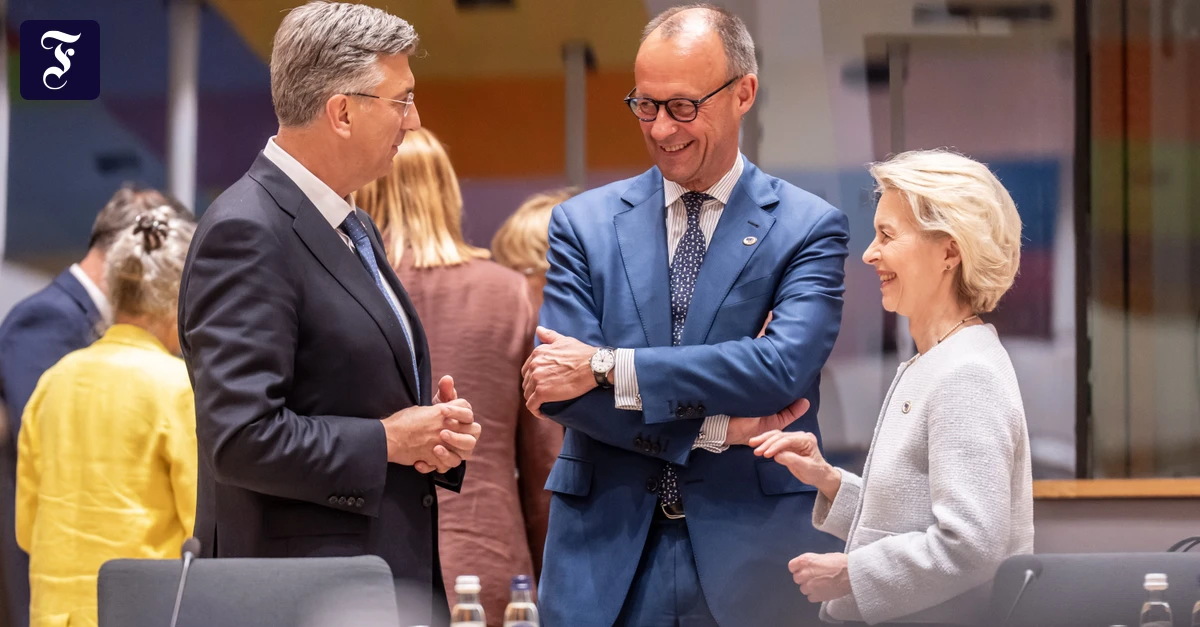
Chancellor Friedrich Merz (CDU) strictly adhered to the script when he entered the council building in Brussels. He did not mention the name “China,” even though his comments on monetary policy were clearly aimed at the much-criticized undervaluation of the Chinese renminbi. Others showed less restraint. Even before the summit began, Austrian Chancellor Christian Stocker (ÖVP) demonstratively agreed with the verdict of Belgian Prime Minister Bart De Wever.
Is the EU too afraid of China?
A few days ago, De Wever criticized that the EU was too afraid of China and was sharply attacked by the Chinese side for this. “We are very careful with many partners, including China,” said Stocker. The EU must realign its relationship with China, demanded the Austrian Chancellor and make it clear that the country is currently more of a systemic rival than a cooperation partner.
French President Emmanuel Macron has been calling for this for a long time. A few weeks ago he introduced a new trade protection instrument based on the American model. Like the Sector 301 investigation there, the EU should be able to impose tariffs if a foreign country’s policies or practices are unfair and burdening trade. This certainly meets with approval from some member states.
In addition to France and Belgium, Poland, the Netherlands, Sweden, Denmark and Lithuania are pushing for a tough course towards China. “We are very open to a discussion about it,” emphasized Dutch Prime Minister Rob Jetten on Thursday. For some countries, the focus is not just on the economy. It also disrupts China’s support for Russia in the Ukraine war.
Germany shrinks from open confrontation
Other countries such as Germany, Spain and Greece are more cautious. The German economy is too dependent on trade with China for Merz to want to go on an open course of confrontation and provoke a trade war. However, in Germany the chemical industry, green technologies, mechanical engineering and the automotive industry are suffering massively from the “China shock 2.0”. There is therefore pressure to act in this country too.
A large majority of member states fear that it will cost the EU dearly if it hesitates now – in any case more expensive than if it quickly decides to take concrete steps against China. 10,000 jobs are being lost in Europe every month, diplomats warn. If China reacts to a tougher course from the EU with countermeasures such as restricting the supply of important raw materials, it would be temporarily painful, but in the long term it would be better than leaving the field to the country.
However, everyone hopes that in the end this will not happen and that Beijing will be more interested in finding a solution through dialogue than in seeking open confrontation. The key is to find the right balance between carrot and stick, say diplomats.
Commission: Creatively apply existing trading instruments
That is the task of the European Commission after the summit. It is intended to develop concrete proposals on how the EU can correct imbalances in trade and combat Beijing’s subsidies more aggressively. Individual commissioners like Séjourné or foreign affairs representative Kaja Kallas may push for a hard line. Nevertheless, it currently looks as if Commission President Ursula von der Leyen will take up Germany’s concerns and not immediately propose a new instrument along the lines of the Sector 301 investigations.
Such an “overcapacity instrument” – as it is called in Brussels jargon – will only lead to long debates, says the Commission. It is also questionable whether the EU should use a country that has not done well in the trade conflict with China, the Council and Commission said in unison on Thursday. In the end, it could be more efficient and, above all, faster to use the EU’s traditional trading instruments more creatively.
The Commission’s current focus is on making the EU less dependent on supplies from China. The de-risking of China, which was announced by President von der Leyen in 2023, has not made sufficient progress, it says. Trade Commissioner Maroš Šefčovič recently called for a “diversification instrument”.
Semiconductors and rare earths as a warning
Semiconductors and rare earths have shown how dangerous dependence on one supplier is, says Šefčovič. In an extreme case – this is the idea – the EU could require companies from important industries to purchase central components from different providers by law. Only a certain percentage, around 40 percent, should come from one country. The Commission says that the goal can also be achieved if the EU creates new incentives for diversification or steers companies in the right direction through tariffs. This could affect entire sectors. The lever for this would be protective mechanisms (“safeguards”). The role model would be the safeguards that have just been passed for the steel industry.
Stocker also suggests creating a toolbox modeled on the tariff package that the EU put together against the USA. This included tariffs on imports worth 93 billion euros from the USA. The EU used the package in the Greenland conflict. Berlin also apparently wants to specifically look for areas in which China is vulnerable in order to be able to put the country under pressure.