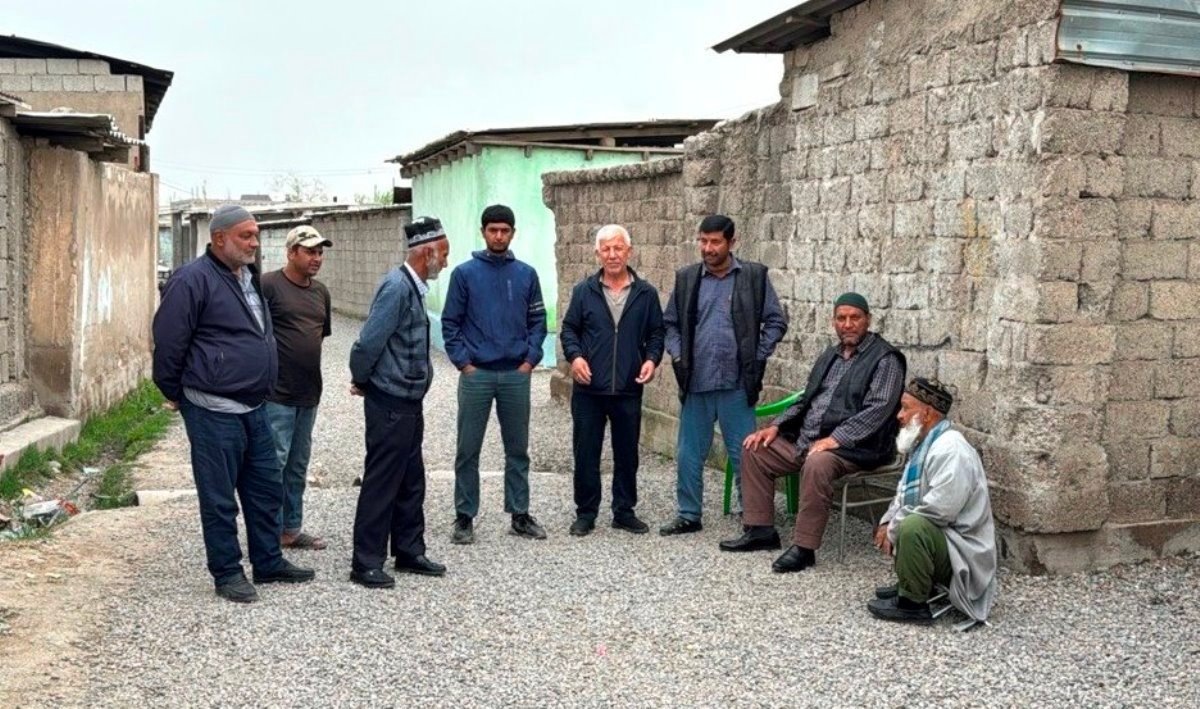
The Gypsy people have lived on the territory of Tajikistan for many centuries, remaining faithful to their traditions and customs. However, little is known about the modern life of this community, and its representatives are often viewed through the prism of established stereotypes and are often stigmatized.
How do Roma live today, what difficulties do they face, and what opportunities exist for them? What are the consequences of stigmatization and the lack of a special state program for their deeper integration into society?
Our journey to the village of “Kanali Bolo” in the city of Gissar began with a conversation with a driver who has lived next door to the gypsies for many years:
“This is a very united people. They get together, choose a leader and listen to him.”
We arrived at school No. 96 of this village, a group of men was sitting there, but they refused to talk to us without the permission of the village chairman.
One of them took us to the chairman’s house, but we did not find him at home. Only his wife talked to us for a few minutes and told us that they lead a “traditional way of life” and never went “to the steppe” (that is, they did not engage in begging – ed.).
“They are interested in their children’s studies”
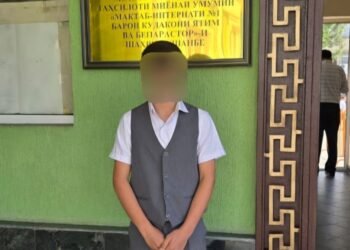
We went back to school again. Schoolchildren were lined up in the courtyard before the start of the second shift.

Deputy director Khisori Jumaev said that over the 15 years of his work at this school, the level of education among Roma children has improved significantly compared to previous years, and the school is trying to pay as much attention to these children as possible.
“Previously, no one was interested in children’s studies or their school supplies. In recent years, parents have been coming, asking about their children’s progress, trying to ensure that they study, master a profession and find a job,” says Dzhumaev.
He also reported that 149 children of Roma origin are studying at this school, which is significantly more than in previous years.
It should be noted that today more than two thousand children from the Roma community receive education in 50 schools in the country.
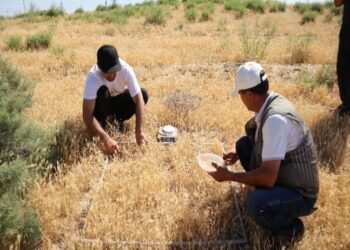
Then we visited the family of Tojiddin Normakhmadov, a resident of the village of Sokhtmonchiyon.
“I worked as a driver and was engaged in animal husbandry, I never begged. My wife too. My children are educated and lead normal lives. One works in Khujand, the other studies,” says Tojiddin.
Speaking about the tradition of begging, he noted that it can be preserved as an element of tradition, but in a more symbolic form.
From conversations with local residents, it turned out that today young representatives of this community are also drafted into the army and undergo military service. In addition, cases of marriages between representatives of this community and other residents of the region are increasingly common, which indicates their integration into society.
“There is little reliable information…”
Experts believe that the problems and opportunities of this community require deeper study and special integration programs.
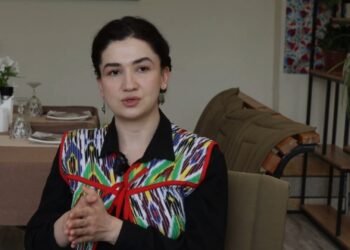
In particular, Tajik lawyer Dilrabo Samadova noted that, despite the growing public interest in the life of the Roma, “there is still not enough reliable information about them.”
According to her, there are several reasons why this group remains invisible, and one of them is the lack of systematic research and official statistics.
Samadova believes that the reason for the lack of accurate data may also be incomplete documentation by representatives of this community.
Tajik sociologist Umeda Akhmadova says their attempts to study the modern life of this group were unsuccessful because “they chose to distance themselves.” That is why there is still no full-fledged sociological study of the community.
Psychologist Nigina Mamadzhonova called such closeness “protection of one’s values and traditions.”
“They fear that if they mix closely with the local population, they will lose their values and traditions, and the community itself will disappear. Therefore, they try to stick together and avoid close communication with other groups,” she noted.

“Stigmatization and discrimination have pushed them to the periphery”
According to Dilrabo Samadova, one of the factors of social isolation of this community is stigmatization.
“Members of this community are not always willing to speak out because they fear discrimination,” she added.

Experts attribute the reasons for stigmatization and discrimination, first of all, to the traditions and way of life of this community.
“There is a clash of values and traditions here, since activities and habits that are common among Roma are perceived as alien by other groups of the population and become a reason for condemnation,” says another Tajik sociologist Zulaiho Usmonova.
Dilrabo Samadova believes that the isolation of the community itself and stigmatization from other groups have created a certain distance, due to which many people form a negative image of the Roma without sufficient information and personal communication with them, which is certainly wrong.
According to Mamadzhonova, fear exists on both sides: “some are afraid of a foreign culture, others are afraid of losing their own cultural identity.”
Experts emphasize that this distance, stigma and mutual fears become an obstacle to full integration.
What should I do?
According to Dilrabo Samadova, the state and civil society should play an important role in the integration process.

“The creation of an organization engaged in research and protection of the rights of this community, as well as the development and implementation of a state program could contribute to a deeper integration of Roma into society. In addition, the professional approach of the media is important. If they are told objectively, respectfully and without sensationalism, it can change the way society views the community,” she said.
The psychologist supported this idea and noted that “it is necessary to accept them as they are.” Experts emphasize that the Roma of Tajikistan are citizens of the country, and their rights are guaranteed by the Constitution.
Another proposal of the psychologist is that the media more often publish positive stories from the lives of representatives of this community.
Romanian experience
In European countries where representatives of this community live, there are special programs aimed at protecting their rights, regardless of the attitude of society.
For example, in Romania there is a “Strategy for the integration of citizens of Romanian nationality belonging to the Roma people for the period 2022–2027”. It covers a wide range of issues – from protecting rights at the state level to education, culture and health care.
According to experts, if a similar program and organization to protect the rights of Roma are developed and implemented in Tajikistan, the integration of this community will become more effective. In this case, its representatives will be able to more actively participate in various spheres of public life, which will contribute to the formation of a more mature and tolerant society.
An example is Tojiddin Normakhmadov, who works as a driver and is engaged in livestock farming, his wife raises children and runs the household, and the children work and study.

It should be noted that the majority of representatives of the Roma community in Tajikistan live in the districts of Varzob, Penjikent, Gissar, Vahdat, Vose and Jaloliddini Balkhi. According to historians, the Roma moved from India to Central Asian countries, including Tajikistan, about five to six centuries ago. In each country where they settled, they adopted the language and traditions of the local population.