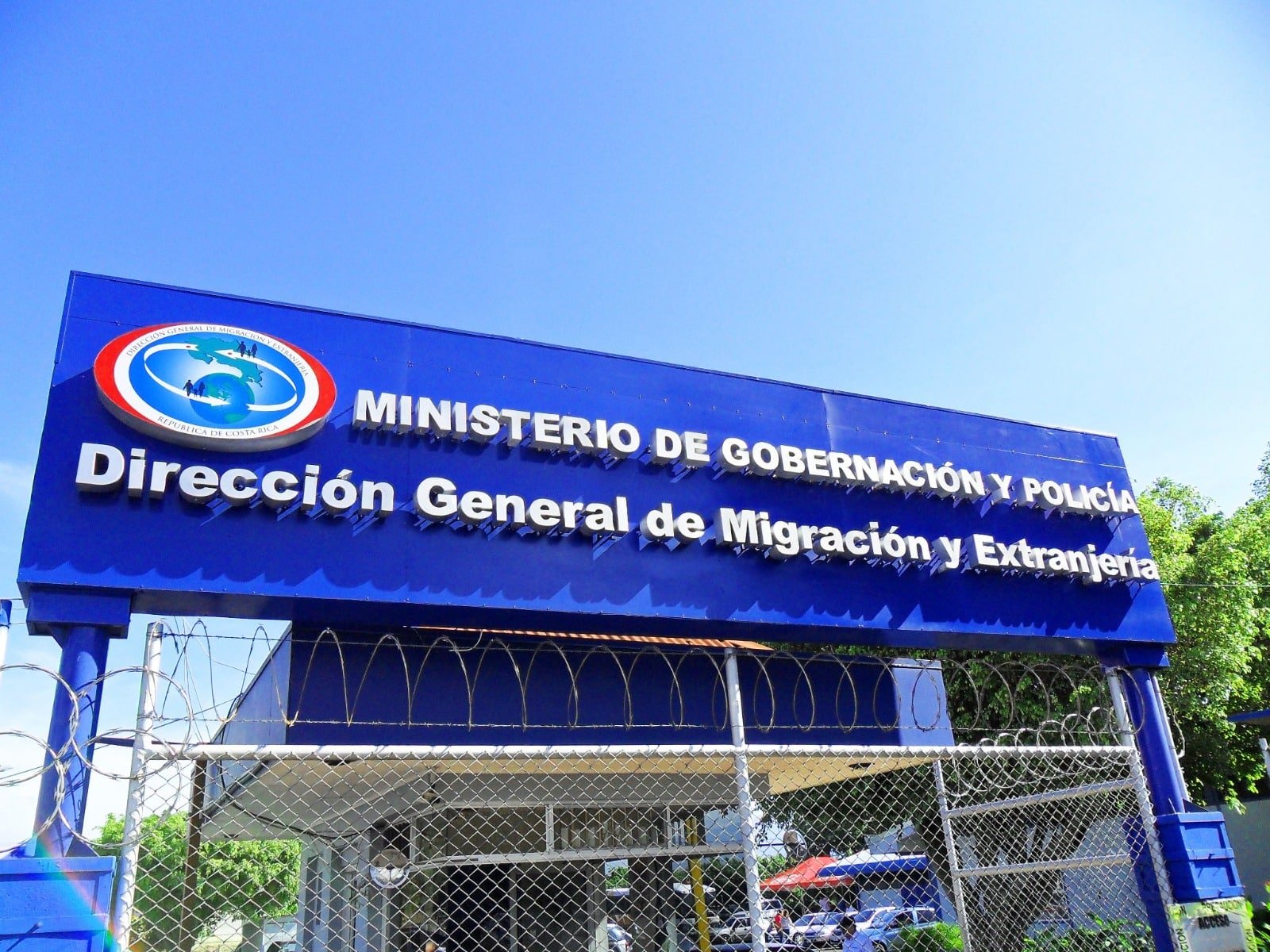
Thousands of Nicaraguans who for years have waited for a response on their refugee requests in Costa Rica, or who received a negative resolution without achieving another immigration alternative, will be able to opt for special category reactivated that will allow them to reside and work legally in the country.
The General Directorate of Migration and Immigration (DGME) announced the reactivation of the so-called “Special temporary complementary category for Nicaraguans, Venezuelans, Cubans and Colombians whose requests for recognition of refugee status are pending resolution or have been denied”, according to resolution DG-0064-05-2026 published in The Gazette on May 29, 2026. The institution set the entry into force of the measure for September 1, 2026.
The resolution constitutes a relevant immigration change announced by Costa Rica in recent years because it opens a regularization alternative for people who remain trapped between unresolved refugee files, negative resolutions and difficulties in accessing another immigration category. This category It stopped working in 2024 and in 2025 it had been ruled out reactivating it.
The DGME itself recognized that the country has registered a considerable increase in refugee requests since 2014 and admitted that a significant number of people remain in conditions of vulnerability, uncertainty and migratory irregularity while awaiting a final decision on their situation.
The magnitude of this population is reflected in data from the UN Refugee Agency (UNHCR). In May 2025, The agency reported that Costa Rica was hosting more than 194,000 Nicaraguan asylum seekers and 9,216 people formally recognized as refugees from Nicaragua. UNHCR also indicated that Costa Rica hosts more than half of the entire displaced Nicaraguan population in the world.
The DGME will allow people who requested refuge since June 1, 2014 to apply, a date that significantly expands the potential universe of beneficiaries.
Who can apply for the category?
The new immigration category will benefit Nicaraguans, Venezuelans, Cubans and now also Colombians who meet several conditions established by the resolution.
The interested person must have submitted a refugee application between June 1, 2014 and May 7, 2026.
In addition, you must have remained in Costa Rica since the presentation of that application and maintain a file pending resolution, an application declared manifestly unfounded or an application that was definitively denied.
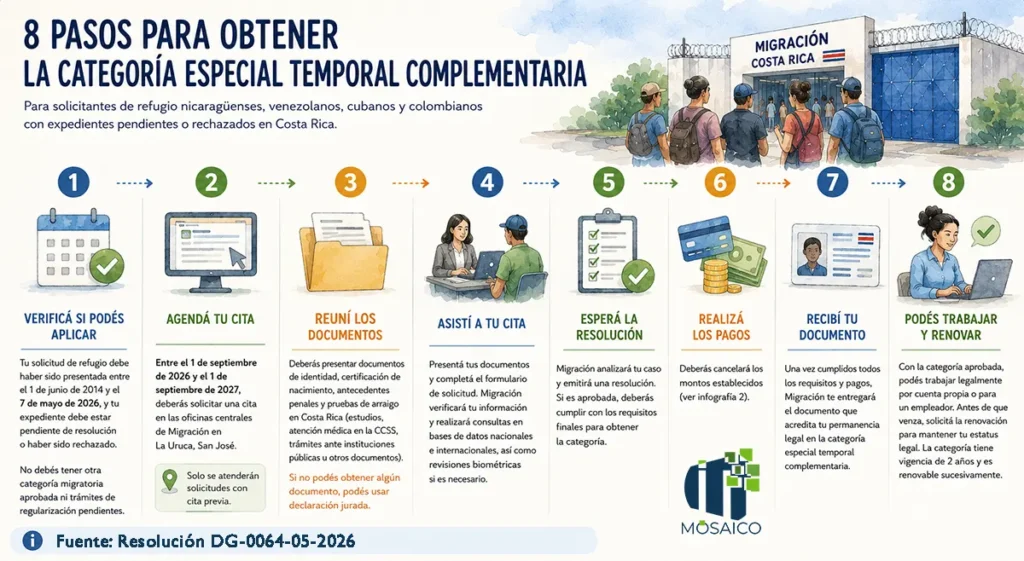
The DGME will also require that the person does not have another approved immigration category or maintain other pending regularization processes. Likewise, the institution excluded from this benefit those who can opt for one of the ordinary immigration categories provided for in Costa Rican legislation.
Before approving each application, the institution will carry out criminal and police background checks using national and international databases.
The resolution also authorizes biometric reviews when Immigration deems it necessary.
Legal work and renewable permanence
The resolution will allow the beneficiaries to work legally in any paid activity, both self-employed and under a dependency relationship.
This point represents one of the main benefits of the new category, since many refugee seekers have faced difficulties in accessing formal jobs or improving their working conditions while waiting for an immigration resolution.
The DGME will grant the category for periods of two years and will allow successive renewals for identical periods. The institution will retain the power to review each person’s immigration history before approving a renewal.
Beneficiaries will not need special permits to leave Costa Rica and return to the country, although they must meet the immigration requirements applicable to other special categories.
Proof of roots and mandatory documents
The DGME will require a series of documents to prove identity, nationality and permanence in Costa Rica.
Among the requirements are birth certificates, criminal records, identity documents and proof of roots. To prove this roots, the interested person may present proof of educational enrollment, documents that demonstrate the registration of children in Costa Rican educational centers, medical care records in the Costa Rican Social Security Fund (CCSS) or other documents issued by public institutions.
The resolution also allows some documents to be replaced by sworn statements when the person demonstrates a material impossibility to obtain them.
Immigration will receive applications by appointment between September 1, 2026 and September 1, 2027 at its offices in La Uruca, San José.
How much will it cost to obtain the new category?
The resolution also establishes a series of mandatory payments for people who receive a favorable resolution.
The DGME will charge 25 dollars for the immigration application and an additional 20 dollars for the two years of initial validity of the category.
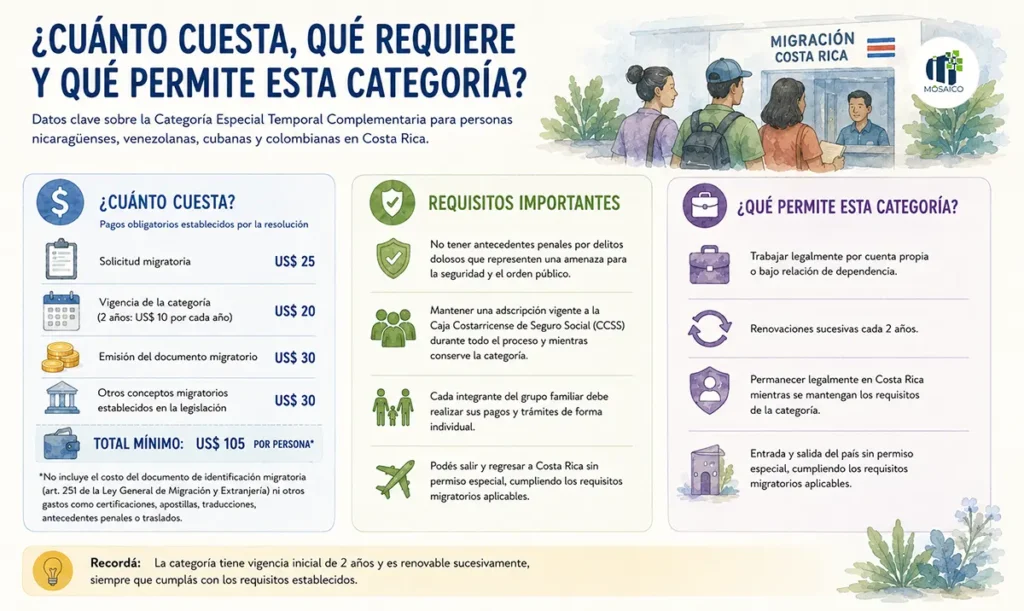
The beneficiary must also pay 30 dollars for the issuance of the immigration document and another 30 dollars contemplated in Costa Rican immigration legislation. Added to these amounts is the cost of the immigration identification document established in article 251 of the General Law on Migration and Immigration.
The payments expressly detailed in the resolution amount to at least $105 per person, not including expenses related to certifications, apostilles, notarial authentications, translations, criminal records or travel to carry out the procedure.
The DGME will also require that the person maintain a current affiliation with the Costa Rican Social Security Fund, an essential requirement to complete the documentation and subsequently maintain the immigration category.
The resolution obliges each member of a family group to make deposits individually, so the total cost will increase depending on the number of people requesting the special category.
Costa Rica recognizes the pressure on its refuge system
Beyond the reactivation of the immigration category, the resolution offers an x-ray of the Costa Rican refuge system.
The DGME recognized that Costa Rica has received a considerable increase in refugee requests from Nicaraguans, Venezuelans, Cubans and Colombians since 2014.
The institution also admitted that not all applicants meet the legal requirements to obtain recognition as refugees, a situation that has contributed to the growth of a migrant population that remains in vulnerable conditions while trying to regularize their status.
In the resolution, the institution argued that the political, social, economic and public order situations that the countries of origin of this population are going through justify the adoption of complementary protection mechanisms that allow a regular stay in Costa Rica.
The DGME also cited criteria from the Inter-American Court of Human Rights on complementary protection for people who do not fit within the traditional definition of a refugee, but who could face risks to their life, freedom or integrity if they return to their countries of origin.
*This article was originally published in CSI Mosaic.