Havana/Madrid/In peeling walls here and there, in a column on Reina and Galiano Street, in the props of a building about to collapse, at the entrance of a bookstore, in a trash can on San Rafael Boulevard, on San Lázaro Street, at the door of some abandoned warehouses on Infanta Street, in a closed multiplex cinema, in a Metrotaxi kiosk, in the space of some destroyed ATMs on Obispo Street that serve as a bedroom to the beggars, in the glass of an Oficoda in Carlos III, and beyond the center of the city, in El Vedado, in an old ruined business on 19th Street, along 23rd, on a light post next to an illegal venduta in front of the ghostly K Tower, on the wall of a school on the corner G, on the corner with J, on the stairs of the El Carmelo cafeteria. In all these places, and in many “countless” others – he doesn’t even remember the number – including Matanzas, Pinar del Río, Sancti Spíritus, Villa Clara, Camagüey and even Panama – graffiti artist Abraham Echevarría has left his mark over the last few years. Three simple words, usually written in black, but sometimes also in another color, with careful calligraphy, that meet the passerby when they least expect it and return their smile: “You need to be happy.”
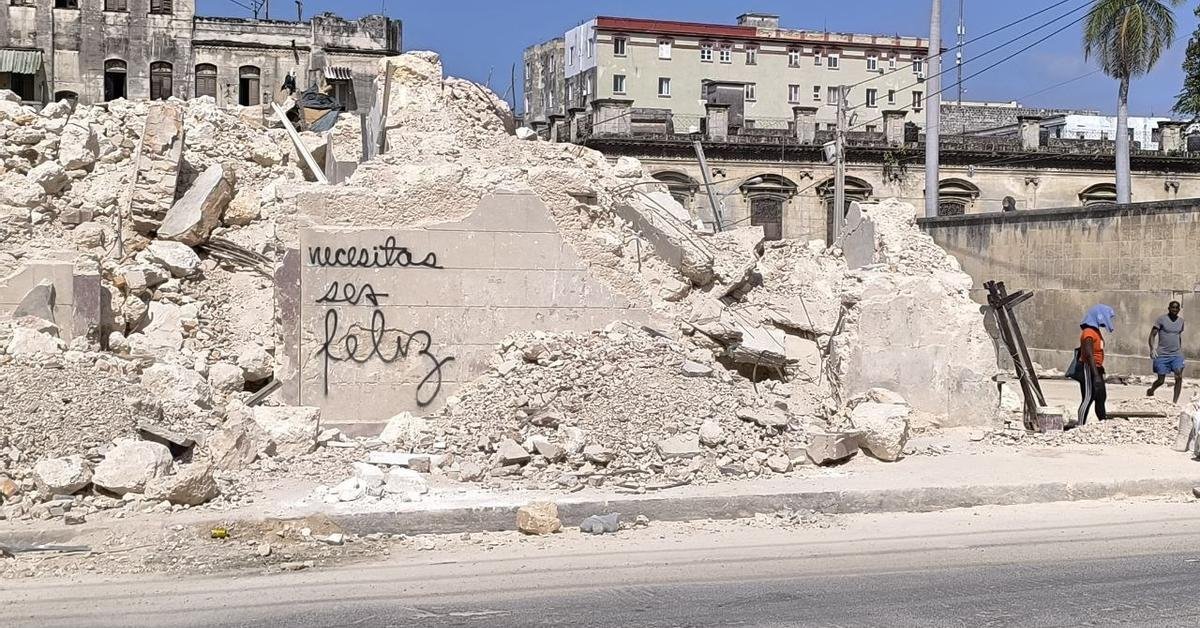
The most recent can be seen in the rest of a wall that was part of the Higher Institute of Industrial Design (ISDi), reduced to rubble last month and converted, immediately, into a kind of illegal quarry of construction materials. Why that phrase? Why those places? What moved this 28-year-old artist and photographer, born in Bauta (Havana) and graduated in History, to carry out this initiative? Via audio messages, Echevarría responds to 14ymedio.

/ 14ymedio
Ask. Why did you choose ISDi?
Answer. Because it’s a safe place, no one bothers, they’re not going to come looking for me for having painted there. Beyond that, I am also interested because it is a place that is disappearing little by little and the collapsed School of Design is a symbol. A symbol of collapse, of fall, of decomposition, of carrion. In that sense, putting the phrase there means that suddenly if it disappears, it will become stone dust for someone’s house. There is a phrase from Karl Marx that I have been thinking about for a while: “the people feel the punishment, but they do not see the crime”… My phrase has little by little become a pen of these yellow ones to stand out in the books. The idea is to highlight the obstacles that may exist to happiness. For me the ISDi has become that, in a certain way. The University of Havana is stopped. They are supposedly working outside of it, but that is a lie. The university is stopped and that is crazy in the history of Cuba, and nobody remembers that. I have experienced the ISDi up close because I live around here and I pass by quite a bit, and I have seen the entire process, since They declared it uninhabitable until people started coming inuntil the frames were taken, the beams were taken away when it fell. It is an important symbol of the fall, something is falling here, even literally. (He pauses briefly, and continues without being interrupted) I don’t know if the Government is really going to fall, I don’t think so. I think they will find their ways to negotiate as happened in Venezuela, as happens everywhere. Here no one falls anymore, everyone negotiates, those ideals from before, until the last drop of blood, that is a lie, here everyone is going to negotiate and put together their movie.
/ 14ymedio
Q. Did you paint it during the day or at night?
R. During the day, painting at night is a risk, because then I would be hiding from something. I always paint during the day, and almost everyone paints during the day. I am not hiding from anything, nor am I writing anything that I have to hide from. Everyone understands that I’m talking about other things, I’m not even talking about politics. Clearly also I talk about politics, because “you need to be happy” of course refers to human happiness and everything that affects or influences it falls within that discourse – it is an infinite discourse – but politics itself is not my topic. “You need to be happy” does not talk about a specific thing, it is a mirror where people see themselves, where people can see what obstacles in their life are preventing them from being happy.
Q. Have you received feedback from people?
R. Yes, of course, people contact me, tell me about their lives, thank me. I have met from university professors who are depressed because their life has no meaning and suddenly feel encouraged, to people who were going to their appointment with State Security and saw the sign on the way and that gave them strength. People who have told me about suicide attempts and who have seen the phrase and have decided not to do it, who have regained the will to live after seeing the phrase. People who have spoken to me who have come out of the closet, who have reconciled with their mother… When people meet me in person, they thank me. But not everyone knows or sees the phrase. People also have their blinders on, and even though it is in many places, not everyone sees it, not everyone dedicates their time to it. Because it takes minimal time. Most of those who don’t see it drive by car; I write in the street, for people who are sweating under the sun dog. I write for everyone, but more for those people.
/ 14ymedio
Q. Besides this graffiti, have you done other types of graffiti, with different messages?
R. I started doing another type of graffiti, in which I chose a phrase from popular slang, gave it an object and represented it as if it were propaganda from the 1920s. I studied history at university, and my conclusion as a student was that in Cuba there is a central identity crisis, always, and that is one of the biggest problems there is. My objective at that time was to try to contribute a little to the strengthening of that identity through art and work in the streets, and I chose slang as a genuine element of Cubanness, and objects very typical of the Island, to try to revitalize that identity that I saw in crisis. At first my project was also to make sweaters and caps and things that people could use in their daily lives, but that part never came, due to money issues.
After a crisis process with Cuba, with society, with the people, with the Government, with Havana’s own cultural circles, I decided to keep only this phrase, to limit myself to having a social and spiritual function in the city. I stopped seeing the point of the other project and it seemed to me that it was an overexertion without results. As there are people who do not see the “you need to be happy”, imagine another more complicated phrase with a drawing. I stayed with those three words, also with a font chosen to be recognized from afar and also activate the unconscious there, because it is the calligraphy they teach us in schools. I don’t write like that. It is chosen with an aesthetic that stands out, that is inevitable, so that whoever looks around recognizes it instantly and draws a lot of attention.
/ 14ymedio
Q. When did you start writing this message?
R. I made the first ones around 2018 or 2019, it was one of the many phrases. I was left alone with it about four or five years ago. Occupying public space is an important responsibility, and even more so with the political risk that this entails in Cuba, where you can be classified as doing counterrevolutionary propaganda and I don’t know what. If I’m going to do it, I have to do it because it’s really going to be worth it, and for me this phrase is worth it, beyond any aesthetic need. It’s not just a drawing, “oh, how pretty,” but people can draw fruit from it. It also allows me my range of defense against any situation with State Security, which of course I have had, and that is why it is important that this be clear: I am not talking about the Cuban Government, I am not talking about the Cuban leaders, I am not talking about the blockade or the United States, but about a basic human need. That basic human need, which is happiness, in Cuba is at constant risk, it can even seem like a luxury. Cubans who read this phrase, of course, think how I am going to be happy today, but it is a phrase that equally impacts people from all countries in the world. If I left Cuba, I would continue painting it. Maybe I would make other phrases as well, but I would continue writing that, because I think it speaks of humanity, of basic human needs, and it is like the beginning of fulfillment, seeking that happiness, which of course we are not talking about going to Disneyland or having a car, but something else. But that is another interview, it is a question that is not here.
/ 14ymedio