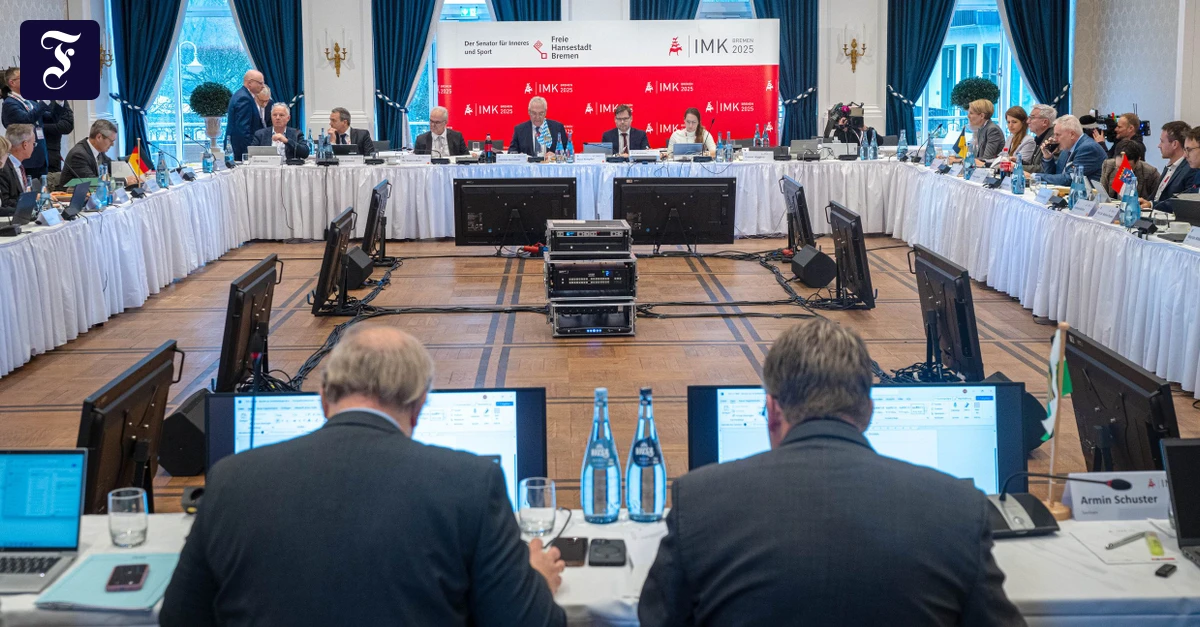
The Interior Ministers’ Conference begins in Hamburg on Wednesday, and it could be the last without AfD participation. In September, new state parliaments will be elected in Saxony-Anhalt and Mecklenburg-Western Pomerania. The AfD In surveys there it stands at 42 and 36 percent. It cannot be ruled out that an AfD minister will be at the table for the first time at the 226th Conference of Interior Ministers (IMK) in December. Right-wing extremists are also active in the party and it is under surveillance by the Federal Office for the Protection of the Constitution. Are the interior ministers preparing for the scenario?
In any case, the topic is not on the agenda, which contains 80 points. “The AfD is not our ‘white elephant’ in the room,” says the Hesse Interior Minister Roman Poseck (CDU) of the FAZ The party will not be an issue. We will deal with issues that are central to the security of people in the country. According to Poseck, there is no need to deal with purely speculative political developments. This time the focus is on civil defense capability, which is why the Defense Minister is taking part for the first time. Other topics include social benefit abuse, left-wing extremism, cybersecurity, asylum law and explosives law.
The Bavarian Interior Minister Joachim Herrmann (CSU) also does not want to take part in what he sees as speculative scenarios; he considers the “what if” discussion to be completely out of place, according to his ministry. The political goal of all real democrats must be to ensure a strong result for the democratic parties. The interior ministries of other countries, especially those governed by the CDU, also make similar statements.
A wish from the East
It is reported from their circles that party friends from the East have asked that the AfD issue not be put on the agenda. The AfD should not be given the opportunity to portray itself as a victim along the lines of: “You see, they are already planning to exclude us.” The Western ministers would have agreed to this. But the topic could play a role in the fireside gathering. Ministers and senators traditionally gather for this informal meeting before the plenary sessions in order to be able to discuss explosive matters without the public and minutes.
The SPD-led states disagree when it comes to how the IMK should deal with the AfD issue. Thuringia, for example, would have liked to see the issue on the official agenda, as otherwise the interior ministers would not come to regulations that would quickly take effect in the event of an AfD election victory in Saxony-Anhalt or Mecklenburg-Western Pomerania. Mecklenburg-Western Pomerania is said to be strictly against dealing with this officially. Prime Minister Manuela Schwesig apparently shares the concerns of some Eastern CDU government leaders that the AfD could exploit this in the election campaign. Also Hamburg Interior Senator Andy Grote, who currently chairs the circle of SPD interior ministers, is said to be against an official discussion of the issue.
Behind the scenes considerations
However, the interior ministers are already considering how to react in the fall if an AfD politician becomes interior minister. In such a case, the current practice of the IMK making its decisions unanimously could be abolished as early as September. However, this rule has not yet been made binding by the interior ministers. One scenario is to abolish the unanimity principle without a personal meeting by circular resolution.
Another consideration is that the information provided to the interior ministers by the security authorities, which has so far been an integral part of the IMK, will be canceled in the future or that an AfD minister will be denied access to it. But the decisive factor for the assessment would be who becomes minister. “Is it a tough right-wing extremist? Then the matter is very clear,” says one West German state. But if the AfD nominates a non-party, the decision must be examined carefully because the procedure must also be examined legally.
But even outside of the half-yearly IMK conferences, it would be a problem if a right-wing extremist party came close to security-relevant information after an election victory. The security of Germany depends on the close and trusting cooperation of the federal and state security authorities.
North Rhine-Westphalia’s Interior Minister Herbert Reul (CDU) made it clear how great the helplessness must be at the end of May when he was asked about the topic at the Düsseldorf state press conference. If the AfD appoints an interior minister, it will get information that it would be better off not getting. “But how do you want to prevent that when they are elected government representatives? I don’t have an answer to that, if I’m honest,” said Reul.
Political access to police data is limited
However, other countries point out that state governments’ access to sensitive data from other countries is by no means unlimited and that differentiation must be made. In the police sector, ironically, it would be the lame digitization that would suit the security authorities: In 2016, the IMK decided to bring together the information from the German police authorities in a common data room under the heading “Police 20/20”. However, creating the necessary interfaces proved to be so complicated that the project is still not completed ten years later. The shared data room will not be available until 2028 at the earliest. For this reason alone, an AfD-led state government could not easily access police data from other countries.
Political access to police data is limited anyway. In the ranks of the Saxony-Anhalt police, for example, there are no political officials that an AfD state government could replace at will. The Saxony-Anhalt Ministry of the Interior is not itself a police authority and does not have its own access to the police system, in which every query is logged. Important events are transmitted by the police to the ministry, but in an anonymous form.
Things get more difficult when it comes to the protection of the constitution. The head of the Office for the Protection of the Constitution is a political official and could be replaced. However, all employees of the Office for the Protection of the Constitution, unless they work as gatekeepers, must undergo the highest level of security checks (Ü3). The AfD couldn’t simply infiltrate right-wing extremists there who could then penetrate data. State secretaries would also have to undergo a security check, but this does not apply to ministers.
An island of uncertainty should not arise
Nevertheless, in the case of an AfD state government, there would be a risk that sensitive data would flow informally through the party channel, it is said. Evaluations of the AfD itself, the right-wing extremist scene and Russian activities are considered particularly sensitive. Preventing this would be difficult, especially within a country governed by the AfD.
However, accessing the findings of other constitutional protection authorities is not so easy. The federal government plays a crucial role in the intelligence sector. The Federal Constitutional Protection Act does not say that the Federal Office for the Protection of the Constitution acts “in agreement” with the state authorities, but only “in consultation”.
If an AfD-led state government fails to monitor right-wing extremism, the Federal Office would have the opportunity to step into this breach. The office could choose higher levels of secrecy when sharing information with state authorities. However, the interior ministers agree that it is not possible to remove a country from the security architecture and thus create an island of insecurity.
Unlike the Prime Minister’s circle, politicians from the Greens or the Left have never made it into the IMK. A few years ago, when Green integration ministers tried to be allowed to take part because of their responsibility for a central domestic policy issue, this was rejected. The high level of collegiality and confidentiality also has to do with the fact that the CDU, CSU and SPD stayed among themselves, according to an interior department.
Nevertheless, the SPD-led states (so-called A states) and the Union-led states (B states) organize themselves similarly to the Bundesrat. But how about an AfD interior minister? This question, it is reported, has already been raised on the sidelines of an earlier one Conference of Interior Ministers treated. The Union interior ministers made it clear that in such a case the AfD minister would “not be part of our group”.