“We don’t work with slugs in these experiments because they eat everything anyway,” says Christine Sheppard, almost laughing, about the experiments Boku-Gardens on the Türkenschanze in Vienna Währing. The Swiss-born researcher has been in Vienna for almost a year after working in New Zealand and Germany. She took over the Boku Chair for Botany and Vegetation Ecology in September and has headed the Institute of Botany since January 2026. In the conversation, she explains the ecosystem consequences of the invasion of alien plants. In addition to disrupting the species community and displacing native plants and animals, other consequences of the establishment of new species include their impact on food webs and larger connections in a meadow or forest system.
The first project that Sheppard is supervising at Boku is investigating how climate change affects invasions of semi-arid grasslands, but also how herbivores, i.e. herbivores, react to newly introduced species. The herbivores planned for the test series are not goats or slugs, but rather caterpillars, snails and similar plant pests in our region, which do not uniformly eat everything that comes into their mouths.

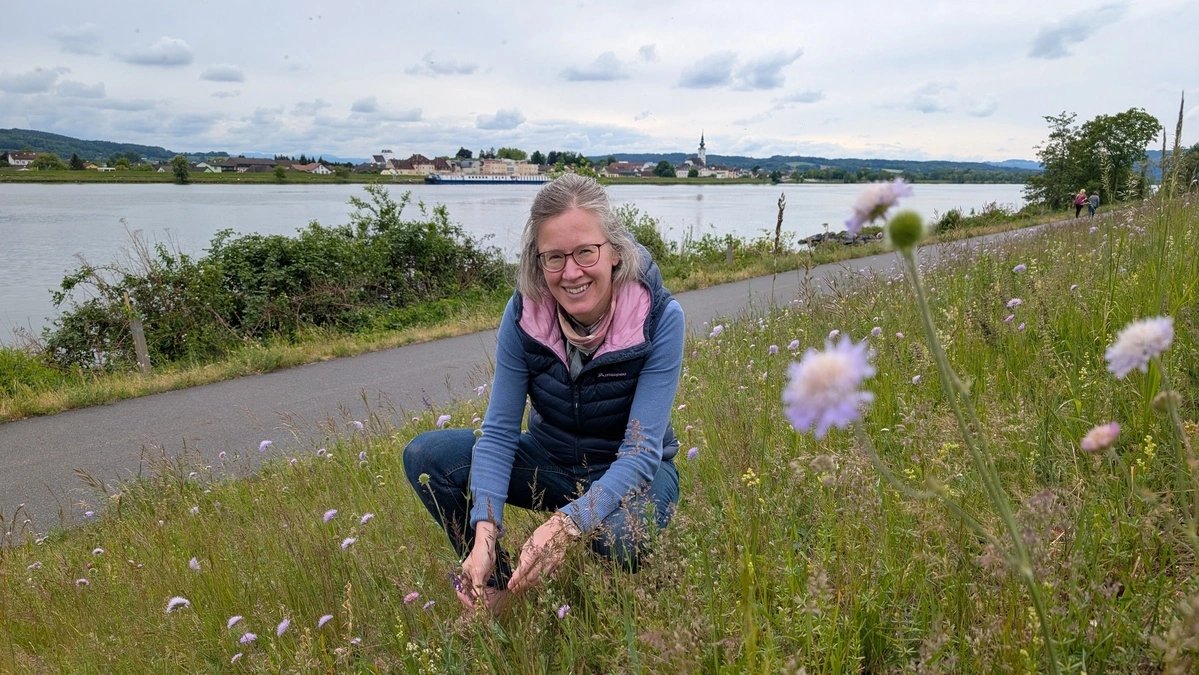
Christine Sheppard in one of the jewelweed experiments. Sheppard
Sheppard has been researching the short- and long-term dynamics of plant diversity since her master’s and PhD thesis. Not only climate change and global warming play a role in the spread of alien species, but also humans with travel, global trade and decorating gardens with alien species.
Plant invasions and their interaction with other species, be they animals, plants or fungi, which can act in symbiosis or as a pest, are Sheppard’s specialty. In the experimental gardens, her team is now checking how herbivorous snails or caterpillars behave when they look for food in species communities with alien plants and in those that correspond to the original native ecosystem. The next step will be large-scale outdoor tests near Groß-Enzersdorf in Boku’s experimental farm.

The experimental station at the University of Hohenheim near Stuttgart: Here, how invasive plants and native pollinators react to each other was tested. Sheppard
In previous experiments, Sheppard’s team, which until last summer was based at the University of Hohenheim in Stuttgart, was able to find out how pollinators react to alien species. In the experimental gardens, the glandular balsam, which has been spreading immensely across Central Europe for several years, was allowed to grow with native plants. “We also checked this in field locations, comparing invaded and original species communities,” says Sheppard.
So far, the results suggest that invasive plants like balsam are also influencing the relationship between pollinators and native plants. For this purpose, different species of bees were placed in net cages on test areas. “These were the mason bees, a solitary wild bee, and nests of the earth bumblebee,” says Sheppard. Both types of bees can be purchased for agricultural or scientific purposes. Like 700 other species in Austria, they are native wild bees. The researchers do not use honey bees in experiments on plant-pollinator interaction because such colonies kept by humans are not part of the original species community.
“Some people underestimate the great ecosystem services that insects provide to us as pollinators,” emphasizes the ecologist. In the experimental areas with a high density of glandular balsam, low-growing native plants received significantly fewer visits from wild bees than in purely native species communities. The large flowers of the invasives with rich nectar and pollen attract those pollinator species that fly to numerous flowers as generalists. As a result, native flowers that may be more inconspicuous or those that offer less nectar receive fewer pollinator visits.

The glandular balsam (Impatiens glandulifera) comes from the Indian region and is considered an invasive species in Europe that displaces others. Sheppard
A clear damage to biodiversity: The species diversity of pollinators was much lower in the invaded locations – probably because the insects, which specialize in a few flowers, found fewer native plants where they were displaced by the competitive jewelweed.
“For some plants the quality of the seeds was also reduced, probably because the pollinators were full of jewelweed pollen and this mixture does not lead to good seed quality.” What was surprising was that those plants whose flowers look completely different from those of the glandular balsam ultimately had higher seed quality: “They do receive fewer pollinator visits. But the pollen that lands on the native plants is not contaminated and therefore leads to good seed quality.”
Incidentally, the glandular balsam is like ragweed, the tree of heaven, the Canadian goldenrod or the needleweed that grows in ponds EU-List of “Alien Species” collected. “This official collection is known as the List of Union Concern, with all the invasive species that are causing the biggest problems in Europe,” says Sheppard, who always emphasizes that not all alien species automatically cause harm. We hardly notice those immigrated or introduced species that are not yet considered invasive. “Everything that we notice as alien is usually already invasive because it is spreading so much that it is displacing or negatively affecting native species.”
From their specialist area of Asteraceae (asteraceae plants), for example, the decorative basket is not native to Europe, but is not yet an invasive species; However, the Canadian goldenrod is invasive in Central Europe. Sheppard had already researched the spread of these plants in her dissertation at the University of Auckland in New Zealand: “Species from subtropical regions in particular migrate into ecosystems where they were not originally native.”

The Canadian goldenrod (Solidago canadensis) proliferates in the Swabian Alb. Sheppard
Sheppard finds the focus on medium-term changes particularly exciting: “Evolutionary adaptations are possible on short time scales: the invasive species adapt to their new regions over relatively few generations.” Such changes over time are relevant if one wants to take conservation measures.
Sheppard also addresses the plea for more biodiversity and the protection of native ecosystems to agriculture and agricultural research. “I work with wild herbs, the diversity of which has a direct influence on the quality of the crops and the harvest yield.” Sheppard vehemently defends herself against the term “arable weeds”: “Arable weeds are enormously important for agriculture and ecosystem services.” A variety of plants along fields and fields attracts more pollinators, regulates the water balance in the soil and ensures an expanded habitat for predators: “Various insects that can eat pests settle here.”

This is what a series of experiments looks like: Tests with invasions at the University of Hohenheim. Sheppard
And in conclusion, Sheppard emphasizes: “The cultural ecosystem service should not be underestimated either: people simply enjoy being out and about in natural areas and seeing such beautiful, colorful plants.” Sheppard also introduces the Boku students to the ecology of meadow communities on excursions: The upcoming course does not go far from the lecture halls, directly to the Pötzleinsdorfer Schlosspark in Vienna Währing.
→ The list of 1388 classified as invasive Plant species in Austria was recently updated. “Checklist of Austrian neophytes”: www.preslia.cz/article/11584
LEXICON
Alien species are animals, plants or fungi that, due to human influence, settle in regions where they do not occur naturally.
Invasive species are a group of alien species: These are those animals, plants or fungi that are spreading rapidly and demonstrably causing damage (ecological, economic, health). For example, through the displacement of native species or changes to habitats. Invasive species do not fall under classic species protection, but rather attract the focus of prevention, containment and management.
In the EU There are currently 114 species listed as invasive: 65 animal species “of Union concern” and 49 plant species.