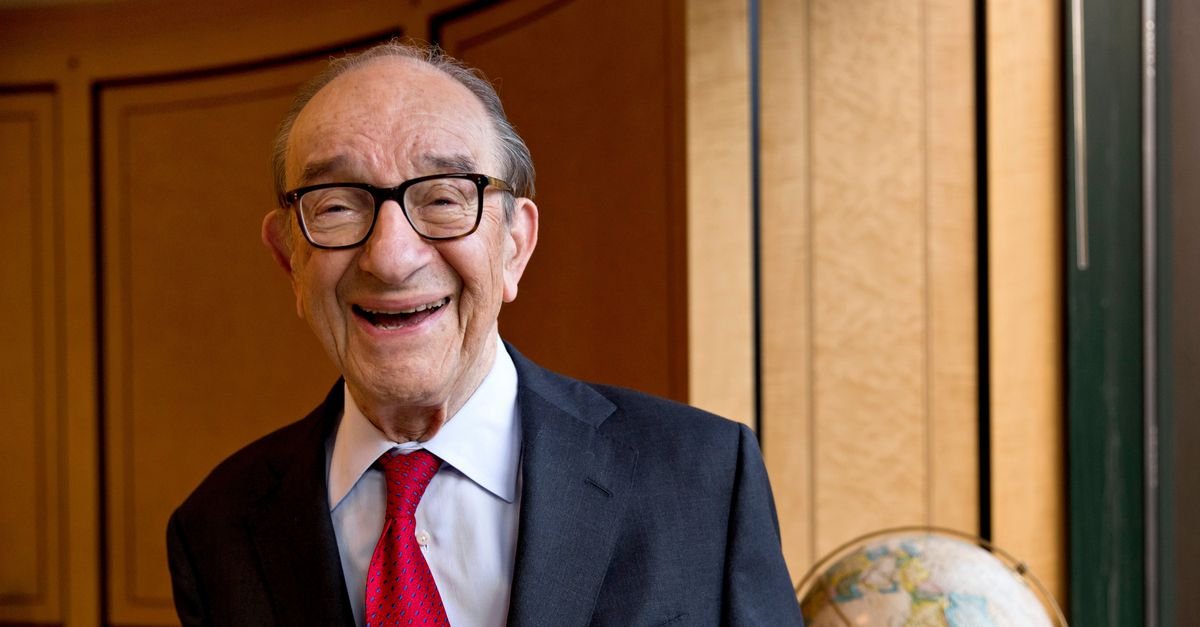
A journalist once asked Bill Clinton what it was like to be the most powerful man in the world. The then-sitting president pointed to the present NBC reporter Andrea Mitchell, the wife of Federal Reserve Chairman Alan Greenspan. Clinton: “Ask her. She married him.”
Greenspan was the highest boss of the American central banking system under no fewer than four presidents. With a total term of nineteen years (1987-2006), he was the second-longest serving Fed president ever. “We’ll have to carry him away in a coffin,” Clinton joked when Greenspan was reappointed for the third time.
The American economist, who died on Monday at the age of 100, was the most influential Fed chairman of the last century. The self-proclaimed libertarian initially had no interest in regulation and intervention in the market. As head of the central bank, Greenspan found a middle ground. But when the American mortgage crisis broke out shortly after his resignation and the global economy fell into a years-long financial trap, his lack of action was also harshly criticized.
Supporter of Ayn Rand
If it had been up to Greenspan (New York, 1926), he would never have ended up in the financial world. The American dropped out of high school and attended the prestigious Juilliard music conservatory at a young age. He then traveled around the country as a clarinetist with a group.
At the age of nineteen, however, he saw that others were better and found that he also enjoyed filling out band members’ tax forms. It therefore became a study in economics at New York University. After completing his studies, he started working in 1953 at a consultancy firm that bore his name a year later: Townsend-Greenspan. The American excelled in making economic analyzes practically applicable for companies.
At that time, Greenspan also fell under the spell of writer Ayn Rand, who set him on the path of libertarianism. In this movement, the freedom of the individual is central, and this should be hindered as little as possible by the state. In a lecture in the late 1950s, Greenspan made the ironic statement that the creation of the Fed was “one of the biggest mistakes in American history.”
:format(webp)/s3/static.nrc.nl/wp-content/uploads/2026/06/22135400/220626ECO_2031301310_.jpg)
Alan Greenspan in 1974, as chairman of the Council of Economic Advisers.
Photo Bob Daugherty/AP Photo
The economist showed himself to be a fierce opponent of, among other things, bank rescues and legislation that imposed anti-competitive measures on the market, as Sebastian Mallaby described in the Greenspan biography The Man Who Knew.
However, his desire to gain influence over presidential policy won out laissez faire-vision. In 1968 he joined Richard Nixon’s campaign team. He later became chairman of the Council of Economic Advisers under Gerald Ford. In 1987, Ronald Reagan nominated him to succeed Fed Chairman Paul Volcker.
With a major stock market crash that same year, Greenspan immediately underwent his first stress test. The Fed supported the financial system by purchasing government bonds and adjusting interest rates. The bursting of the internet bubble at the beginning of this century and the attacks on the WTC also took place under his chairmanship.
Also read
‘I was born in the wrong century’
:format(webp)/s3/tark/NH/200709/17/717343.jpg)
Greenspan partly to blame for mortgage crisis
Greenspan’s leadership of the Fed coincided seamlessly with the rise of neoliberalism. A time of privatization, room for market forces, deregulation and a government that interfered less directly with public affairs. Despite several crises, it was fertile ground for the libertarian that Greenspan was.
He showed himself to be a pragmatist: only intervene where necessary. The smart economist was helped by a good antenna for how the markets were moving. In 1996, when companies reported big profits but productivity growth remained essentially flat, Greenspan suspected something was wrong. By showing through research that productivity had grown faster than official figures showed, he managed to settle the argument about interest rate adjustments. The Fed did not intervene.
What Greenspan had less control over was combating the situation that led to this century’s mortgage crisis. According to him, this was because a central banker is capable of adjusting the market through interest rates, but that directly intervening in people’s wallets – for example by tampering with rising house valuations – would be tantamount to political suicide.
He stated that there was a perception among Americans that the Fed would save the economy no matter what, causing them to take greater risks than was justified. He called it ‘irrational exuberance‘ (irrational exuberance). “Historiography has never been lenient on the aftermath of prolonged periods of low risk perceptions.”
‘Bespectacled cuttlefish’
It turned out. The financial crisis erupted shortly after the end of Greenspan’s last term in 2007, tarnishing his legacy. Low interest rates had helped people take out more expensive mortgages, but the Fed did too little to combat the overheating that arose. Greenspan was accused of letting the market take its course too much. The American had to testify about it in Congress. He spoke his typical ‘Fed speaks‘: using a lot of words to say nothing.
Nobel Prize winner in Economics Robert Solow compared Greenspan’s congressional appearances to those of a “bespectacled cuttlefish.” “Someone who, when in danger, floods his environment with black ink and then moves silently.”
Before Congress, Greenspan acknowledged that he had underestimated the effects of the mortgage bubble. The American did not want to blame the relatively low interest rates that had encouraged this phenomenon or the insufficient regulation of companies. It was bankers who, according to him, had caused the crisis with irresponsible behavior.
He continued to comment on the American economy well into his old age. Although his omniscient status had cracked, his nineteen years as – unofficially – the most powerful man in the country had left a lasting impression. The financial magazine Moneyweek wrote in November 2025 about the Fed’s still relatively flexible attitude towards the markets: “We still live in the shadow of Greenspan.”
After his first press conference, recently appointed Fed Chairman Kevin Warsh was accused of the same inscrutability as his distant predecessor. The economic-political website Axios called it one Greenspanesque approach: “A central bank that wants to say more by speaking less often.”