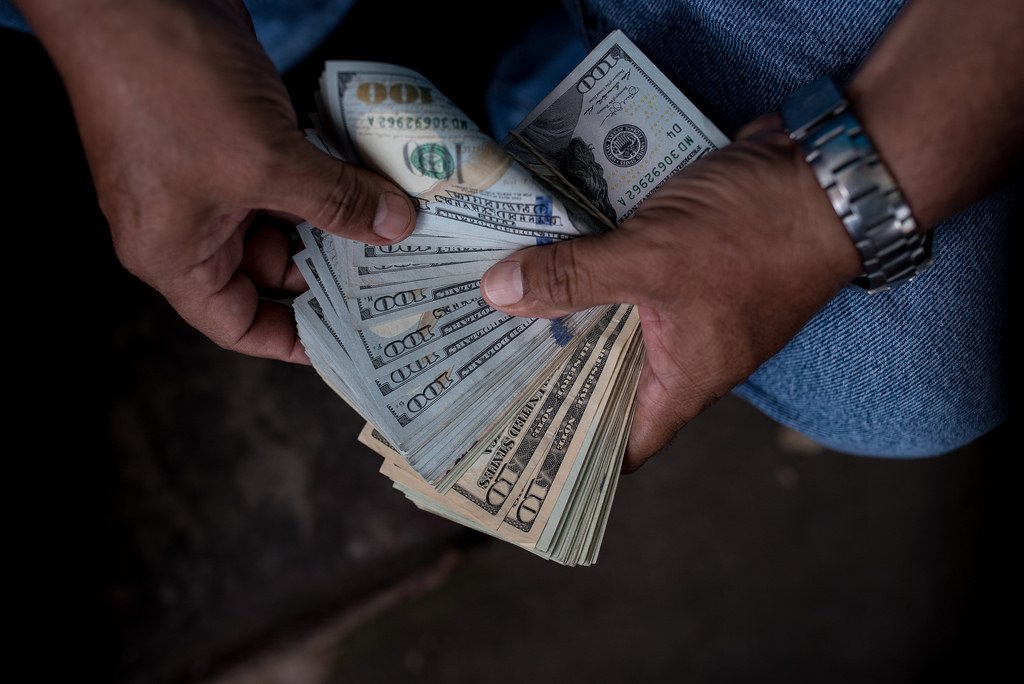
Every week, Christina He takes advantage of a small window of time to go to a bank branch to withdraw the $30 that a friend sends him from the United States. With the money, she uses any other free moment or an early leave from work to buy food for herself, her mother and her daughter at the Mercado Oriental in Managua.
The Nicaraguan is grateful for this small weekly lifeline, but regrets that it is increasingly difficult to stock the family pantry with food. Especially because the 1098 córdobas that it receives nominally buy less and less, since —in January 2024— The Central Bank of Nicaragua (BCN) froze the sliding rate of the córdoba against the US dollar.
The pocket of Christina —and thousands of families throughout the country—resent the effects of inflation that does not let up. Although BCN data indicate that it was significantly reduced (2.84% in 2024 and 2.7% in 2025, for a accumulated 5.6% in the sum of both years), the problem is that the reality of the markets does not coincide with that of the regime’s official reports.
Christina He uses the remittance he receives weekly to buy food, but feels that “the money is no longer enough.” He says this by mentioning how the prices of rice, beans, tomatoes, or cheese have evolved. That is, “the basic things,” he points out.
In similar terms it is expressed Michelangeloresident of Ciudad Sandino.
He receives a monthly remittance from Costa Rica, which ranges between 100 and 150 dollars “to buy food and pay for basic services.”
Although “the dollar has been stable for about two years,” he makes the observation that “things are more expensive, so we end up buying less.” When he says “the things,” he means rice, oil or beans.
Inflation is close to 7.7% according to INIDE
Nicaragua is a country that lives on remittances. Only in 2025, a calculation by remittances and development expert, Manuel Orozco, indicates that the country received around 6,167 million dollarswhich is equivalent to 27.7% of the country’s gross domestic product for that year.
In total, more than 21.4 billion dollars were received between 2021 and 2025. An astronomical sum that families used, mostly, to eat. As Orozco points out, Remittances have given a strong boost to private consumption in recent years. The expert estimates that about 900,000 of the 1.6 million households in the country receive remittances.
On January 1, 2024 it came into effect the BCN’s decision to set the slippage rate at zero percent of the national currency. At that time, the total basic basket (using the December 2023 data as a base) cost 19,801 córdobas ($540.7). 28 months later (in April 2026), its cost amounted to 21,246 córdobas, which represents about 580.1 dollars and an increase of 7.3%, according to data from the National Institute of Development Information (INIDE).
In the case of the segment of the basic basket that measures only the “food” component, its price was 14,123 córdobas, that is, 385.6 dollars. At the end of April 2026, that figure had risen to 15,207 córdobas (equivalent to $415.2), reflecting an increase of 7.67%.
These numbers—all official figures—validate the arguments that the economist Enrique Sáenz has put forward for yearsin the sense that the nominal growth of the Nicaraguan economy does not correspond to an improvement in the well-being of citizens. In addition to the combination of ‘zero slippage’ with ‘rising inflation’, the expert adds another element to the equation: the real salary of workers in the formal economy, whose deterioration is permanent.
Strictly speaking, this basically affects the small percentage of the workforce (less than 30%) that has a full-time job in a formal company. That is, a company registered with the Treasury and its respective mayor’s office; that pays taxes, enrolls its workers in the Nicaraguan Social Security Institute, and maintains proper accounting. The rest, that is, about the remaining 70% of the workforce that works in the informal economy, have even worse conditions.
The result is that the inability of the vast majority of salaried workers to acquire the basic basket is perpetuated. Even if it is measured by the evolution of salaries, which were revalued by 4% as of March 2026according to the agreement read by the sanctioned Minister of Labor, Johana Flores, but they are still insufficient to acquire that basic basket.
In the words of Enrique Sáenz, the worker who did not receive an adjustment to his income in a proportion that allowed him to compensate for the cost of living, “paid for it with less gallo pinto, cheese and tortilla on the table at home.”
Reduce consumption
Christina, Michelangeloand their respective families are some of those workers.
In addition to the remittance he receives weekly, Christina She has her own income of 2,000 córdobas per week, which she obtains from her job as a dispatcher and biller in a shoe store located in the Eastern Market.
The sum of both amounts should serve to cover the expenses of the three women in her home located in Nejapa, if it were not for the fact that prices are a variable that she cannot control, and because there are objective needs of her daughter, which cannot be postponed. When it comes to health, you cannot leave caring for your mother until later.
In the ‘food’ variable, at least in what she and her mother consume, the strategy is simple: buy less. “You buy less rice, less beans. It cooks less. “Only what we are going to eat ourselves or a visitor.”
To avoid shocks in the family budget, “we don’t eat a lot of meat or chicken, but we do eat more beans and rice. Cheese? It depends on what the price is at that moment. Sometimes we can eat a chicken, because maybe chicken is expensive and one can’t afford those luxuries,” he acknowledges.
Michelangelo He also has a permanent job: he is a telephone and network technician. Although the remittance you receive helps a lot in the task of making ends meet, it is consumer decisions that determine whether they last until the next payment date.
This implies thinking carefully about when you are going to consume beef, especially seeing that its price ranges between 150 and 180 córdobas. It’s the same with cheese. Depending on the time of year, you can find it for 70 córdobas, but some months it has cost more than a hundred. The same thing happens with tomatoes, which “previously were bought for five córdobas, and now each one costs 10 córdobas,” he explains.
Where he feels that he no longer has a choice is in luxury to buy a roast chicken. “Before it was easier to buy it, because it cost 200 córdobas; now it costs 340. Almost ten dollars. I can’t pay that price anymore,” he laments.