The International Monetary Fund (IMF) is urging the government of St. Vincent and the Grenadines (SVG) to preserve its value-added tax (VAT) base, warning there is “no room to lower the VAT standard rate” and recommending that the special VAT rate for tourism be brought in line with the standard rate.
This put into question a key campaign promise of the New Democratic Party, which came to office on Nov. 27, promising to address what it described as a “cost-of-living crisis” affecting the country.
Speaking at a press conference in Kingstown on Tuesday, five months after the NDP came to office, Sergei Antoshin, the IMF mission chief for SVG, said protecting tax revenues is central to reducing SVG’s mounting public debt and high fiscal deficits.
“Tax revenue needs to be preserved and tax administration further strengthened,” Antoshin at the conclusion of the IMF’s 2026 Article IV consultation.
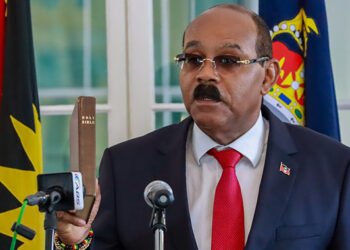
“There is no room to lower the VAT standard rate. Instead, the special rate for tourism should be brought in line with the standard rate,” Antoshin said at a joint press conference with Prime Minister and Minister of Finance, Godwin Friday.

Antoshin also welcomed ongoing work by the government to extend VAT to digital and remote services, and to reform real property taxation, saying these steps would support a more growth-friendly and equitable tax system.
As regards public finances, Antoshin highlighted the large and rising debt, persistent fiscal deficits, and heightened vulnerability to shocks.
“The country has demonstrated a remarkable economic resilience in the face of repeated shocks, but fiscal vulnerabilities unfortunately remain significant,” he said, adding, “Large deficits and high and rising public debt underscore the need for decisive policy action to reduce debt.”
The IMF official said SVG’s debt ratio has risen by 45 percentage points of GDP since 2019, with about half of that increase occurring in the last two years, reaching 113% of GDP in 2025.
“The fiscal situation has continuously deteriorated since the pandemic,” Antoshin said.
“In the past six years, the country has suffered from the pandemic and two major natural disasters, and is now facing the oil price shock from the war in the Middle East, which would, once again, unfortunately, particularly hit the vulnerable.”
He said the 2026 budget, passed in February, envisages a deficit of 19% of GDP, but IMF staff project a smaller, though still large, deficit of 12% of GDP in 2026, assuming lower capital expenditure in line with past under-execution.
Antoshin warned that without a change in policies, public debt would continue to rise.
“Under the baseline with no change in policies, fiscal deficits are projected to remain large, propelling the debt ratio to 145% of GDP by 2031 and gross financing needs to 26% of GDP.”
He recalled that SVG has been at high risk of debt distress since 2016, while also being highly exposed to natural disasters.
To address these vulnerabilities, Antoshin said the IMF is proposing an “active policy scenario” that would change the debt trajectory within three years and eventually bring public debt down to 60% of GDP over the long term.
“The goal is to reduce deficits and debt. The high risk of debt distress calls for urgent fiscal consolidation,” he said. “Staff and the authorities agree on the need to promptly implement an ambitious fiscal consolidation to avoid the prospects of a disorderly fiscal adjustment.”
Under this scenario, the primary balance — the fiscal balance excluding interest payments — would need to improve by 11 percentage points of GDP during 2027–29, Antoshin said.
“The scenario aims to change the debt trajectory within three years and achieve the original debt target of 60% of GDP over the long term,” he said.
“The primary balance would have to improve by 11 percentage points of GDP during 2027–29 to achieve a reduction in debt. This implies reaching a 3% of GDP primary surplus in 2029.”
He acknowledged that such a surplus would be “high by the country’s standards”, but pointed out that it has been accomplished by others in the region and would need to be maintained over the long term.
Antoshin said the IMF welcomes the government’s work on their debt reduction strategy and noted that the government has already prepared a comprehensive strategy to put debt on a downward path.
“The next step would be to identify and quantify concrete measures,” he said.
Antoshin added that a comprehensive expenditure review could help identify areas for streamlining while protecting the vulnerable, and that the authorities have expressed interest in technical assistance from the IMF in this area.
Antoshin pointed to the public wage bill and the need for careful expenditure management as key elements of the consolidation effort.
“Expenditure measures should prioritise streamlining while protecting the vulnerable, especially amid the oil price shock,” Antoshin said.
“The public wage bill is high based on the country’s own historical record and international comparisons, and could be reduced through natural attrition and wage moderation.”
At the same time, he stressed the importance of maintaining social protection, but making it more efficient and better targeted.
“Social support programmes need to protect the vulnerable, but digitalisation of assistance could help better identify and target beneficiaries and limit leakage,” he said.
Antoshin also supported the government’s plans to review investment policies and strengthen public investment management, highlighting critical infrastructure and resilience to natural disasters as priorities.
“Key priorities will be critical infrastructure and investment in resilience to natural disasters,” Antoshin said. “Public investments in marketable assets can have distortionary economic effects and are discouraged.”
Delivering the budget in February, Friday had said that his government had deferred to later this year a decision on reducing the VAT.
The NDP had promised that within 60 days of coming to office, the VAT would be reduced from 16% to 13%.