Senior Reporter
Residents living near the Immigration Detention Centre (IDC) in Aripo are calling for tighter security at the centre after 14 men escaped on Saturday afternoon.
According to police, around 3.40 pm IDC officers smelled smoke coming from the male housing unit. When they entered, they were ambushed and overpowered.
During a scuffle, 14 men forced their way out of the facility, some heading to the western side of the compound and others to the southern fence.
After raising an alarm, four of the men were held, two while trying to climb the fence and another two outside the compound.
A fifth man was held yesterday morning around 6.40 am by ASP Rampallard of the Air Support Unit along with officers of the Northern North Task Force along the Eastern Main Road, Wallerfield.
Police warn that anyone assisting the escapees is committing a criminal offence and is subjecting themselves to prosecution.
A media release by the TTPS said officers of the Northern North CID, Northern North Task Force, Pinto Police Station, Malabar Police Station and IDC officers, spearheaded by Deputy Commissioner of Police Suzette Martin and led by ACP Vena Butler and Supt Steve McKenzie, are continuing the hunt for the remaining men.
They are being supported by the Air Support Unit, Inter-Agency Task Force (IATF), Canine Unit, Trinidad and Tobago Prison Service K-9 Unit, Trinidad and Tobago Defence Force (TTDF), Special Investigations Unit (SIU), and the Guard and Emergency Branch.
Speaking with Guardian Media, a resident of Trinidad Road, Wallerfield, said the fact that escapees were found in the area on Saturday and have been seen in the surrounding areas in the past following previous escapes has him worried about his safety.
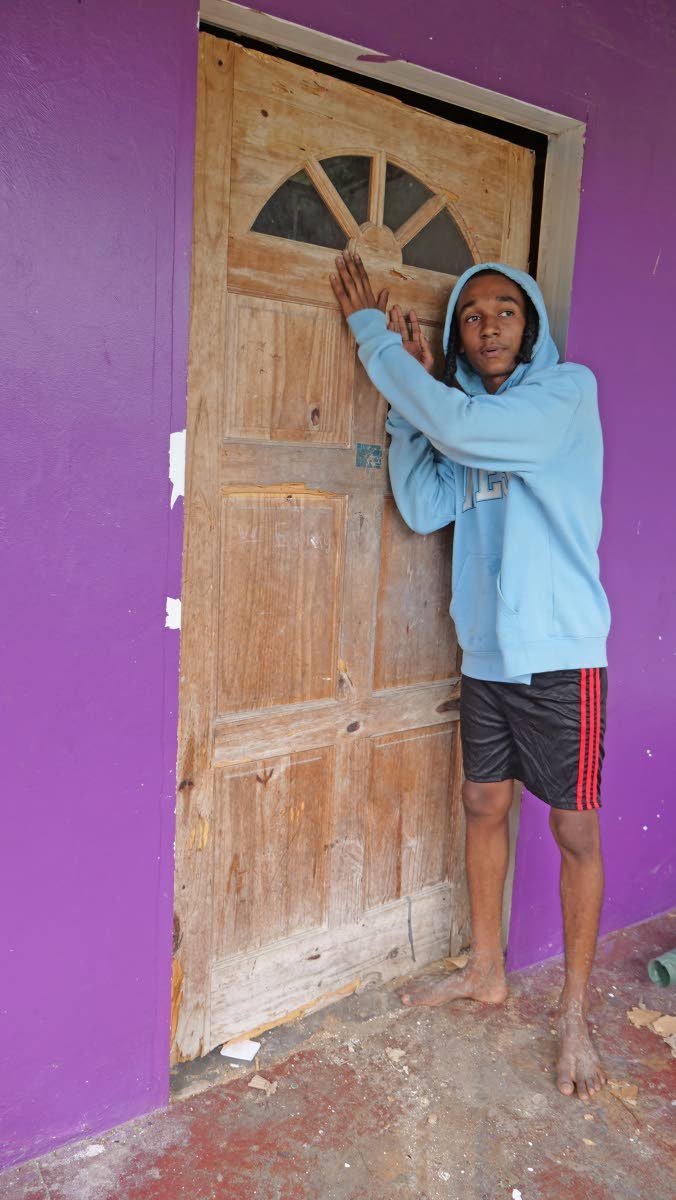
Under 15 national footballer Achilles Nelson recalled one of the detainees literally kicking down the door to his home seeking refuge.
Trying to assure him he was no threat, the detainee reportedly told those at home: “No trouble, no trouble” before fleeing.
“He just started kicking down the handle of the door, and he broke it straight off the edge. And then he threw the door down and fell on top of it. When he come in the house, he started to walk up to my sister and when my big sister saw he walking up to my little sister, she just took her arrow because she was looking for a knife; she just took her arrow and started to tell him, ‘Come out of the house.’ And then he actually come out and he run.”
Nelson said this was not his first encounter with escapees from the detention centre. Some four years ago him and his brother had to run out of a forested area behind their home.
In June last year, five people escaped, while in 2019, a total of 19 people escaped from the facility in three separate incidents.
In November last year, Homeland Security Minister Roger Alexander said there were issues faced by IDC workers which he hoped to address. He said one is the roof at the facility.
“There seems to be an issue with the roofing area where persons would have made their escape before. We intend to fix that to prevent such a thing from happening again” he said then.
IDC officers told Guardian Media that those housed there are awaiting deportation and have been complaining about the conditions for some time.
“This could have been worse, because the sentry on duty was not armed. If he had a gun, they could have overpowered him, and things could have been much worse,” the officer said.
Detention officers are Special Reserve Police officers who received special training to work at the IDC. The term “Detention officers” is not named in any of the subcategories of the National Security, however, they are subject to the rules governing police officers.
Guardian Media called and messaged Defence Minister Wayne Sturge on the escape and plans to prevent further escapees; however, up to press time, there was no response.
The officers told Guardian Media that there are housing issues that inmates have raised repeatedly in the past regarding insufficient ventilation.
During a Joint Select Committee on Human Rights, Equality & Diversity in 2018, the panel was told that the IDC was created in 2009 in response to the country’s human rights obligation as a member of the international community committed to the observance of the fundamental human rights of every individual.
It was agreed then that the IDC would facilitate foreign nationals found in breach of our immigration laws instead of using the Maximum Security Prison as was done previously. The committee was told that the IDC was in keeping with international best practices as required by the United Nations International Covenant on Civil and Political Rights, the International Covenant on Economic, Social and Cultural Rights, and the Universal Declaration of Human Rights.