In Slovakia, the Hungarian Alliance’s opening toward the left-wing Progressive Slovakia (PS) is causing discontent among potential voters of the largest party representing the Hungarian minority. Critics also accuse the extra-parliamentary formation led by László Gubík of patronage politics and lacking cooperation with regional representatives of the Hungarian community.
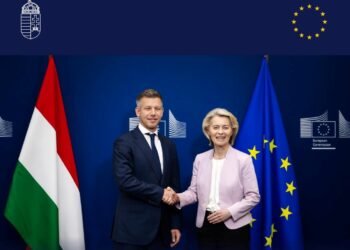
The demonstrative turn toward the largest opposition party, PS, culminated in a joint press conference in the lobby of the parliament in Bratislava (Pozsony). In a deliberately jovial atmosphere, the two party leaders presented the pillars of their future cooperation. As Michal Šimečka and László Gubík explained, these include the economy—especially the economic development of southern and eastern Slovakia—values of the rule of law, in particular strengthening the rights of national minorities, and finally fostering mutual reconciliation between Slovaks and Hungarians. For now, it is only about coordinating shared interests, not about forming an electoral alliance, the PS leader clarified. For his part, Gubík cited the so-called “gag law” connected to the Beneš Decrees and expropriations carried out by the Slovak Land Fund as reasons why the Hungarian Alliance rules out cooperation with the governing SMER party.
The two party leaders agreed that the current government must be voted out in 2027. They did not commit themselves regarding a possible coalition at the national or regional level, but
even this joint appearance before the press set alarm bells ringing among predominantly conservative Hungarian voters.
However, the left-wing radicals retain a trump card: the already existing Hungarian platform within PS will be maintained, and—as before—they will continue to rely on its work, according to Šimečka.
Meanwhile, the head of the Slovak liberals (SaS) finds clear words for Gubík’s policy of delaying decisions; he, in turn, is relying on cooperation with a smaller Hungarian party, the Hungarian Forum. In Branislav Gröhling’s view, the joint appearance with the leader of the left-wing radicals cannot offset Gubík’s hesitant distancing from the governing coalition. He also accuses the leader of the Hungarian Alliance of being close to the ousted government in Budapest.
I see Mr. Gubík as someone who changed his stance only after Viktor Orbán’s defeat. To me, this clearly looks like opportunism,”
said the SaS chairman.
Gubík’s Hungarian Alliance is facing a serious internal strain precisely in the southern part of Žitný ostrov (Csallóköz), where ethnic Hungarians form the majority of the population. While the Hungarian Alliance continues to try to legitimize its policy at the national level under the slogan of a “unified Hungarian representation,” dissatisfaction in the regions is becoming increasingly evident, the news portal Körkép reports. There is unrest at the grassroots level.
Local representatives of the Hungarian community are outraged at the Alliance’s unilateral personnel decisions in light of the upcoming regional elections.
The party leadership is said to have pre-assigned positions on candidate lists and, in practice, have not treated the strongest local independent actors in the region as partners.
Discontent is growing not only in the Komárno (Komárom) district, but also in Levice (Léva), a district that is strategically extremely important for the Hungarian community. According to information from Körkép, an alternative team with a Hungarian background is currently forming in the Levice district, potentially relying on several locally well-known and established figures. In behind-the-scenes talks, names are being mentioned of actors who previously cooperated with the Hungarian Alliance but have recently been pushed out of decision-making processes or have had no chance within the district structures.
The erosion of trust is also reflected in numerous statements by potential voters of the Hungarian Alliance, who are venting their frustration.
Critics speak of the “last nail in the coffin” of the party, of a future puppet government in the Hungarian style, of squandering the last chance for parliamentary representation of the Hungarian minority, and of the need for a more pragmatic policy that does not instrumentalize Hungarian votes for internal political power struggles.

Via ma7.sk, korkep.sk; Featured image: Pixabay