Fruit, footwear and housing have become relatively cheaper for wage-earners in recent years, despite steep inflation since 2020.

Since the Covid pandemic began in early 2020, prices in Finland have risen cumulatively by roughly one fifth. In other words, you now have to dig up around 120 euros to pay for a basket of goods that would have cost you 100 euros at the beginning of the decade.
Average wages have also risen for most employees during that period – but has that been enough to offset higher prices for most consumers?
To find out, Yle studied purchasing power since the beginning of 2020.
The answer? It’s complicated.
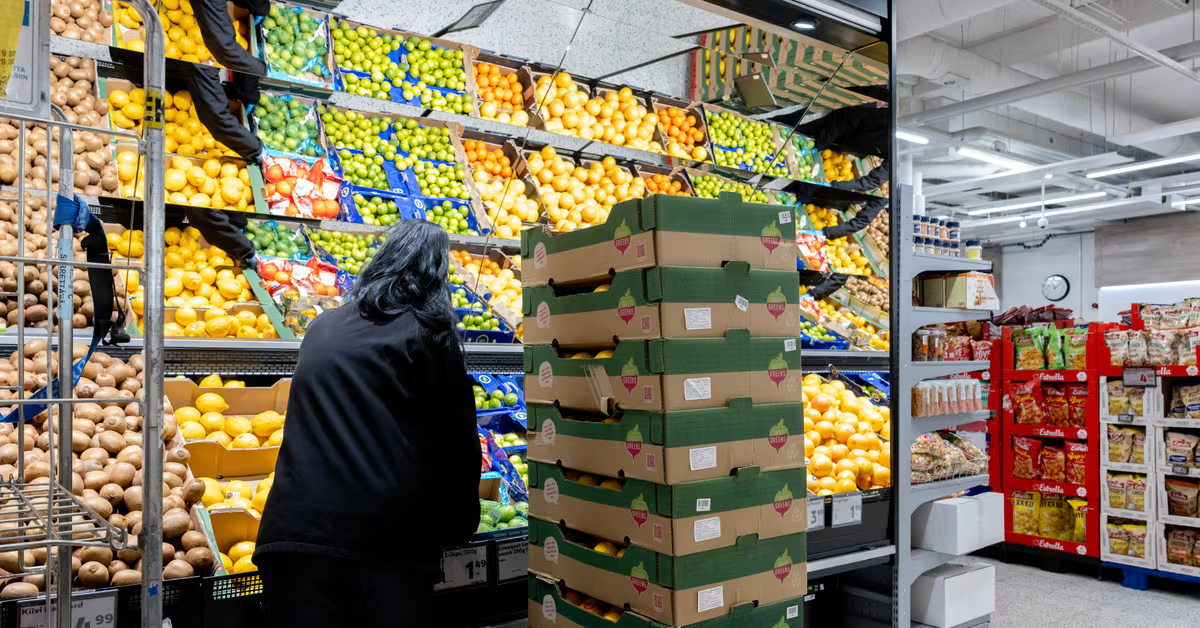
Perhaps surprisingly, the prices of many products and services have become cheaper in proportion to average salaries.
Relative to wages, prices for housing, footwear, plant-based milks and fruit have now fallen. On the other hand, vegetable oils, chocolate and beef have trended upwards.
The price of petrol and diesel is high now, whereas a few years ago their price dropped significantly compared to wages.
Domestic flight prices have also been rising sharply of late, while during the pandemic years, their prices fell sharply in relation to salaries.
And while this comparison indicates the purchasing power of wage-earners, it does not necessarily correspond to the shopping reality for the self-employed or people living on pensions, student subsidies or public support, for example.
Long-lasting shockwaves from war with Iran
On average, wages have risen by just over 19 percent this decade. However, in several years, wage increases lagged behind price rises, meaning purchasing power weakened.
The highest annual inflation rates in recent history were in 2022 and 2023, when prices climbed by 7.1 percent and 6.3 percent respectively. In contrast, last year average prices barely rose at all.
The Finance Ministry now predicts that wages will rise by 3.6 percent this year, outpacing prices by 1.6 percent.
However, forecasting has become dicier due to the US-Israeli attack on Iran and its knock-on effects, which are reverberating throughout the global economy, led by rising prices for energy and fertiliser.
Energy prices are now edging down again, as markets expect oil and gas traffic to resume through the Strait of Hormuz, which has been shut down for nearly four months. Still, prices remain well above pre-war levels.
Food prices may rise again next autumn
Expensive energy affects all transport, and therefore naturally the price of food. Crucial raw materials for agricultural fertilisers have also been blocked from passing through the Strait of Hormuz.
Sari Forsman-Hugg, Research Director at Pellervo Economic Research (PTT), says that the Gulf crisis that began in March has not had much impact on this year’s agricultural production, because most farms had already bought fertilisers for this growing season in the northern hemisphere.
Although energy prices are now falling, Forsman-Hugg notes that the crisis has already spilled over into the food chain. Higher oil prices have raised costs for farmers to run equipment and transport their goods, for instance.

She predicts that food prices will rise next autumn, but not by as much as previously feared.
“The current positive situation is easing upward pressure on prices, but some of the spring situation has already spilled over into agricultural costs, logistics and, for example, packaging materials. We may see a small price increase during the autumn,” she tells Yle.
Pricier soft drinks in Finland
Meanwhile, the Finnish government’s decisions are also affecting some grocery prices. For instance, non-alcoholic beverages have become pricier due to a tax that came into effect in April.
That soft drink law increased the tax on sugar-free drinks to 20 cents per litre while the tax on drinks containing sugar rose to 59 cents per litre.
Partly because of this, the prices of non-alcoholic beverages rose by more than eight percent in April and by more than seven percent last month.