The ombudsman of the Ukrainian army, Olha Reshetylova, will appear on a screen around noon on Monday in the Prins Bernhardzaal, on the De Zwaluwenberg estate in Hilversum. “I hope you don’t ever find yourself in a situation like we did,” she says, “the invasion, the war.”
But if so, she has tips. For example: involve partners, children and parents of soldiers before the time comes, before it becomes critical. “Make sure that family members know and trust the commander.” Reshetylova talks about missing and injured soldiers, about units that were surrounded by Russians. “There are family members who want to prosecute the commander of ‘their’ soldier. If things go wrong and trust is lacking, family members want to see blood.”
We have been hearing warnings from intelligence agencies about the threats for some time now. We don’t know if that will become true, but it is conceivable
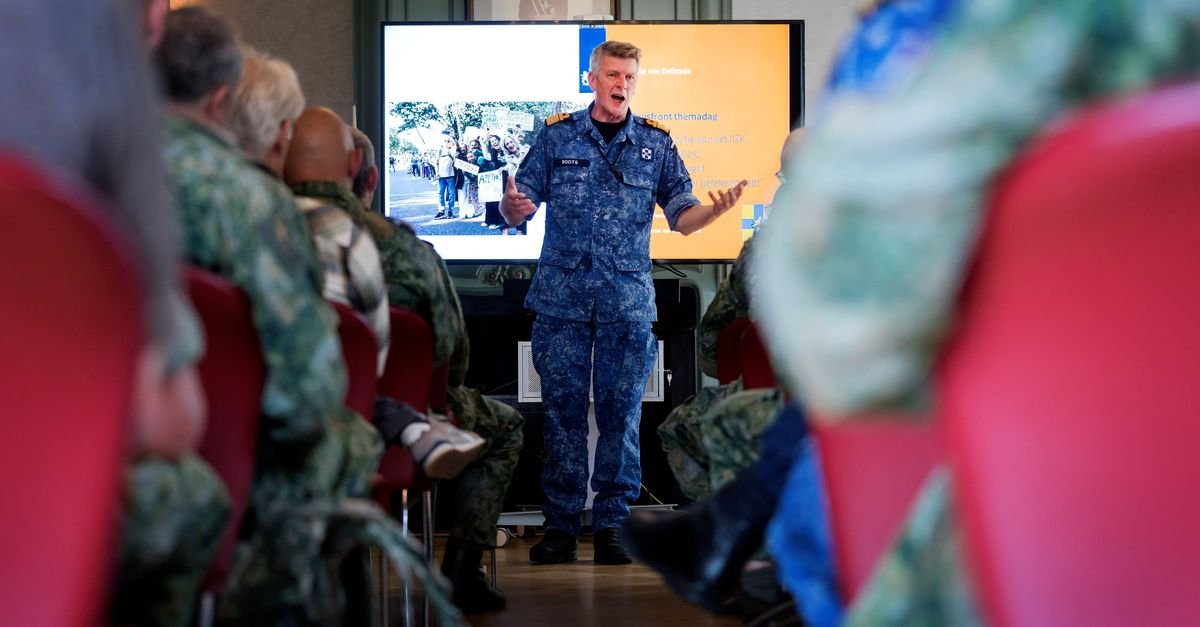
The approximately fifty defense employees in the room came to the estate to talk to each other about the mindset of soldiers and their home front. Defense is preparing for a new kind of war. The planned and defined missions to Lithuania or Afghanistan are known. The family will then receive a children’s book at home Lots of kisses is called, about a turtle going on a journey, and a turtle cuddly toy. There are family days at Efteling, pampering days, home front days, commander letters with updates, telephone circles, contact persons for spiritual and practical help and an annual youth bivouac for children between eight and fifteen years old.
But with all the geopolitical tensions, defense may be the priority own defend territory, or that of an ally. It is the main task of the armed forces and can mean: leaving hastily, not knowing when or if you will return home, not knowing whether your family is safe. “We have been hearing warnings from intelligence services about the threats for some time,” says the Inspector General of the Armed Forces, Vice Admiral Boudewijn Boots – he and his staff organized the meeting. “We don’t know if that will become true, but it is conceivable.”
Also read
Defense power cables and pipelines are crucial for security, yet the government hands them to them on ‘a silver platter’
:format(webp)/s3/static.nrc.nl/wp-content/uploads/2026/04/24161050/300426OND_2032705064_foto1.jpg)
‘Legitimate target’
No one in this room expects that Russian tanks will suddenly enter the Netherlands one night or that rockets will fly around everyone’s ears. But, says Boots, “according to the laws of war, a barracks or an intelligence service is a legitimate target.” Their own workplaces and also those of, say, caterers and administrative staff, employees who never took into account that they were in immediate danger.
A soldier in the room also mentions Rotterdam, or the Eemshaven as a target, “The Americans are arriving there.” The fact that “his wife and children could be bombed in Zwolle” concerns someone else.
Defense has been pouring in billions for such a war for four years now, people are being recruited and trained at an accelerated pace, weapons orders are being placed and locations are being expanded. But there is still insufficient attention for what they call ‘the moral component’ on this estate.
Are Dutch soldiers ready to fight? Do they talk about this at home, what keeps them awake at night and what can the defense do to help? In May, State Secretary Derk Boswijk (Defense, CDA) spoke at an international conference in Amsterdam about the importance of “the will to fight, the inner conviction that keeps a unit together when things get difficult.”
That is why the Inspector General commissioned an investigation into that moral component last year, which resulted in a report with the subtitle You know what you signed up for. This shows that many soldiers still do not know what exactly is expected of them in such a new war – let alone that their home front knows. More than half of the 430 defense employees who answered the questionnaire also said they did not know what task to perform in a large-scale conflict.
Regulatory pressure and inertia
Every day they hear from the top that the armed forces must be ready for a large-scale conflict and that they are working hard on this. Military personnel have been away from home more often and for longer periods of time due to exercises.
But they also experience work pressure, regulatory pressure and slowness, a shortage of colleagues and equipment and they do not always trust the qualities of new recruits who received a shorter education and sometimes speak “another language”.
Seven in ten family members interviewed in the study indicated that they ‘never or sometimes’ talk at home about how a war can affect the home front
Reshetylova also warns about this. Her husband is fighting at the front and she herself has been fighting for the rights of soldiers since the beginning of the Russian invasion. First as an activist, now as an ombudsman, appointed by President Volodymyr Zelensky of Ukraine. “After mobilization, the armed forces will never be the same again,” she says. Commanders then suddenly have to deal with a mix of long-term, well-trained soldiers and what she calls ‘citizen soldiers’. The latter do not simply take orders or leave their positions on the battlefield, says Reshetylova. “That causes a lot of problems.”
The defense employees in the room do not know exactly where the organization is moving and what that means for them. That also makes it difficult to talk about it at home. Janneke Huisman, Medical Service officer with the Army, does not yet know how she will arrange things at home if that happens, she says during a break. Her husband is a chief guard at the military police and they have a one-year-old son. If both are called up, their parents or in-laws will have to take care of him. Did they discuss it that way? “I don’t want to worry them now.”
:format(webp)/s3/static.nrc.nl/wp-content/uploads/2026/06/09101754/090626BIN_2034089215_2.jpg)
The meeting about how to deal with the home front.
Photo Olivier Middendorp
‘Unplug’
Military couples are now able to rely on an exceptional position or tailor-made arrangements to ensure that one of the two can stay at home to care for children or sick parents, soldiers say. And later? Huisman: “That is not yet known.” Seven in ten family members interviewed in the study indicated that they “never or sometimes” talk at home about how a war can affect the home front.
Military personnel have no choice when the Netherlands is at war, she says. “I can still decide to take off my suit, or my partner can do that. If we are called up later, that will no longer be possible, then you will be a deserter.” It can be heard on the estate that some soldiers are already making such a choice. “Experienced NCOs are now pulling the plug,” says someone present in the room. The research shows that some employees leave because of the threat, but also that many now feel empowered to fight.
There are also varying responses in the audience to the statement ‘We deploy staff even without a home front’:
“Yes, eventually we will have to do it.”
“Whether he doesn’t run away afterwards is the next question.”
“If the home front does not want someone to go, there will be friction.”
“I think many people will still choose home.”
“I don’t think so.”
“My wife is also a soldier,” says commander Sander Donker of the 43 Mechanized Brigade of the Army, in a group session later that afternoon. He said to his parents: “When we are called up, you are with the children for a while. That frightens them.”
:format(webp)/s3/static.nrc.nl/wp-content/uploads/2026/06/09101954/090626BIN_2034089215_4.jpg)
One of the report’s two researchers addresses a group.
Photo Olivier Middendorp
:format(webp)/s3/static.nrc.nl/wp-content/uploads/2026/06/09102012/090626BIN_2034089215_5.jpg)
Lunch inside on the estate.
Photo Olivier Middendorp
:format(webp)/s3/static.nrc.nl/wp-content/uploads/2026/06/09102022/090626BIN_2034089215_6.jpg)
Lunch outside on the estate.
Photo Olivier Middendorp
:format(webp)/s3/static.nrc.nl/wp-content/uploads/2026/06/09102041/090626BIN_2034089215_8.jpg)
A breakout session.
Photo Olivier Middendorp
122,000 people needed
At the end of the afternoon it will be about a definition of home front, which has not yet been given. The researchers heard: my street, the church, a brother, children, the football club, my dog. Are they also ex-partners? And should defense consider more people as a home front? With just over eighty thousand employees (professional soldiers, civilian staff, reservists), Defense is already the largest employer in the Netherlands. She estimates that a large-scale conflict will require around 122,000 people.
In the PeopleSoft personnel system, soldiers can now specify two contact persons who will be alerted in the event of a disaster. But these are not always the ones who see the military as a home front. “In Afghanistan I gave up my brother as my contact person, because I didn’t want my wife to be the first to hear if something happened to me,” says a soldier in a navy suit during a break.
One of the conclusions of the meeting: in a large-scale conflict, defense not only needs the home front, but the entire society
They should keep talking about it with each other, is one of the conclusions today. Everyone works on this in their own department. Another: in a large-scale conflict, defense not only needs the home front, but society as a whole. And then there is the concern that family members are being unburdened too much. They are used to being able to text their loved ones every ten minutes, but expectations need to be adjusted.
Not every family member wants to know everything. And there is already a lot. The inspector general, as he ends the day: “When my son was twelve and I went on a mission for the umpteenth time, he sighed, ‘Do I have to go to Efteling again?’
Also read
There is enough money for defense, but still no armored car or periscope
:format(webp)/s3/static.nrc.nl/bvhw/files/2022/06/data87442003-f2b4fc.jpg)