In the coming months, municipalities will make choices that will remain visible for decades. Where will homes be located? How much room is there for greenery? How is traffic organized? And how much space do children get to play, meet each other and explore independently?
The right of children to play, rest, leisure and cultural activities is enshrined in Article 31 of the UN Convention on the Rights of the Child. Yet in practice, this right is often overshadowed by interests surrounding housing construction, mobility, safety, healthcare and finance.
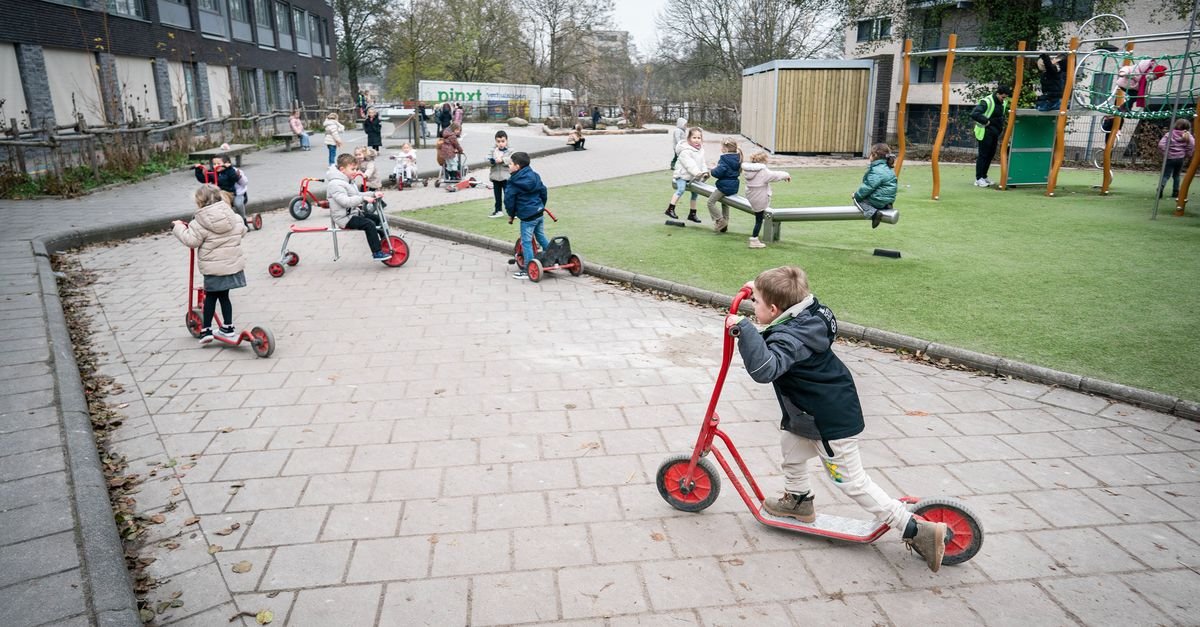
That’s where the problem lies. Although almost everyone recognizes that play is essential for the healthy development of children, this is rarely a starting point for policy decisions. From research from the Jantje Beton foundation, it appears that an estimated four hundred thousand children in the Netherlands hardly play outside. In densely built-up neighborhoods there is often no safe space to play and heavy traffic is an obstacle. Children stay indoors, where the screens beckon.
That’s remarkable. Because playing is not a luxury, but a necessity of life.
Take playing outside. There is little debate about this: exercise, being outside and going out independently are good for the physical and mental health of children.
Health risks
At the same time, not every child is equally welcome in public spaces. Research shows that many teenage girls avoid play and meeting places because they do not feel safe there or because these places are dominated by boys. Play facilities are often insufficiently accessible for children with disabilities. Anyone who takes the right to play seriously must therefore also think about inclusion.
The implications are visible. Too little exercise increases health risks, while long-term screen use is associated with sleep problems, headaches and a sharp increase in myopia. Daylight and distance vision are important for healthy eye development. Playing outside is therefore not only pleasant, but also an investment in public health.
A second development deserves attention: the digitalization of the game. Digital technology offers children new opportunities to learn, discover and connect. But many online environments are not designed with the interests of the child in mind, but with commercial objectives. Children are approached as consumers, while their privacy and well-being are not sufficiently protected.
For children in asylum seeker centers, play, exercise and creative activities are not a priority, while they often have to deal with stress, uncertainty and major life events
In addition, playing is more than just exercise. It also includes participation in arts, culture and creative activities. Research shows that cultural participation contributes to health, resilience and empathy. However, not all children benefit equally from this. Children from families with a lower income participate less often in art and culture activities, partly due to financial barriers and a lack of accessible options. As a result, they miss opportunities that can contribute to their development.
The same applies to children growing up in asylum seeker centers. For them, play, exercise and creative activities are not self-evident, because they are not a priority, while they often have to deal with stress, uncertainty and major life events. Organizations like War Child show how much difference play can make for their mental well-being. In 2025, they offered asylum seekers at 58 locations of the Central Agency for the reception of asylum seekers program ‘TeamUp’ where play and exercise are used to work with children in asylum seekers’ centers on their mental well-being.
Shore and ship
The question is therefore not whether playing is important. The question is why we still make policy about it as if it were a side issue.
As long as spatial planning, health, education, sport, culture and youth care each continue to work according to their own principles, the right to play will continue to fall through the cracks. In that case, a playground disappears more easily for a parking space than the other way around.
Children do not need even more policy documents. They need space, time and opportunities to be children. This is a task for the government. This requires more cooperation between policy areas and administrators who explicitly take the importance of play into account in their choices.
Anyone who invests in play not only invests in the well-being of children today, but also in a healthier and more resilient society tomorrow.