April 21, 2026 – 01:00
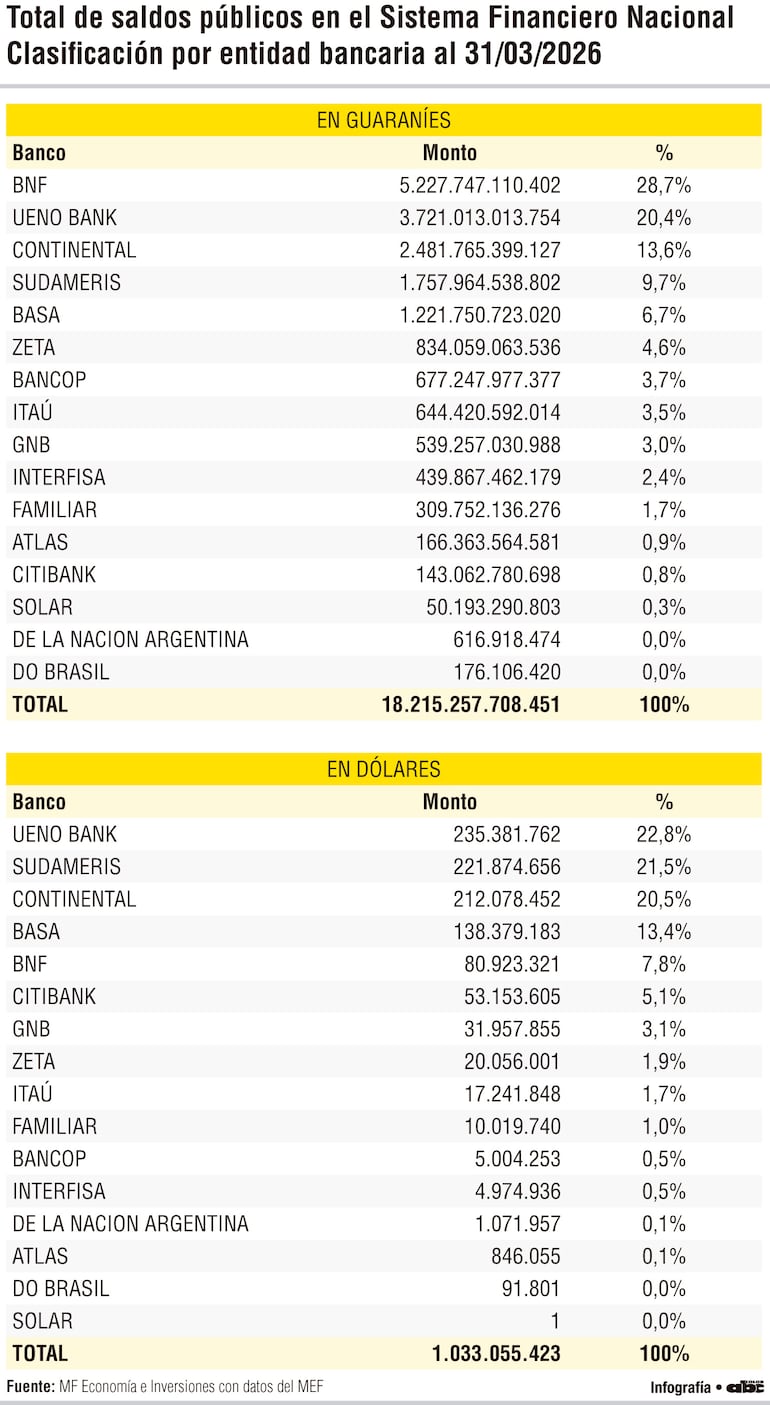
The total bank balances of State Organizations and Entities (OEE) in the national financial system amounts to US$ 3,840 million, of which G. 18.2 trillion are in national currency and US$ 1,033,055,423 in foreign currency. The structure by currency shows a relevant distribution in both denominations, which suggests a management that combines liquidity in local currency with positions in dollars linked to external obligations, imports or forecast of international payments.
In Guaraní, the distribution presents a significant concentration in a few entities. He National Development Bank (BNF) leads with G. 5,228 billion, equivalent to 28.7% of the total. It follows Ueno Bank with G. 3,721 billion (20.4%) and Continental with G. 2,482 billion (13.6%). Together, these three entities concentrate 62.7% of deposits in local currency.
For its part, Sudameris occupies fourth position (9.7%), followed by BASE (6.7%). The rest of the system has more limited participations that range from around 5% to 2%, such as Zeta (4.6%), Bancop (3.7%) and Itau (3.5%).
GNB reaches (3.0%) and Interfisa (2.4%). The minor shares correspond to Familiar, Atlas, Citibank and Solar, each below 2%. Foreign entities such as De la Nación Argentina and Do Brasil have a marginal presence in this currency, as shown in the infographic.
In dollars, the concentration pattern is also high, although with a different distribution between entities. Ueno Bank leads with US$235,381,762, which represents the 22.8% of the total.
Sudameris occupies second position with US$ 221,874,656 (21.5%) and Continental is third with US$ 212,078,452 (20.5%). These three entities concentrate 64.8% of the balances in foreign currency, which indicates a strong centralization of foreign currency resources.
Read more: Three banks concentrate 61% of public funds in guaraníes and 58% in dollars
BASA is in fourth position (13.4%), followed by BNF (7.8%). From this point on, the shares are markedly reduced: Citibank (5.1%), GNB (3.1%) and Zeta (1.9%).
Itaú, Familiar, Bancop and Interfisa register percentages of less than 2%. Foreign entities again present marginal participations, with values less than 0.1% in some cases.
The data reveals three relevant elements. First, there is a high concentration in a small number of banks, both in guaraníes and in dollars. Second, leadership differs by currency: BNF dominates in local currency, while Ueno and Sudameris have greater prominence in dollars. Third, the presence of international banks is limited.
Finally, concentration can facilitate operational coordination and the administration of large volumes of resources, although it also entails risks in terms of diversification.
Read more: BCP “hides and hides the truth” regarding Ueno, deputy denounces
In this context, the distribution of public fund balances not only reflects public treasury decisions, but also influences the dynamics of deposits, liquidity and positioning of entities within the national financial system.
* This material was prepared by MF Economía e Inversiones