Havana/Madrid/It’s been almost two weeks since the Anatoly Kolodkin docked in Matanzas with 750,000 barrels of Russian crude oil, and the Ñico López refinery in Havana, which must convert the oil into even more precious products, such as gasoline and diesel, remains out of operation. Its unlit chimney gives it away, visible across the bay from any high point in the city, and a dozen tanker trucks stopped in its vicinity.
Asked about this, Cuban specialist from the University of Texas Jorge Piñón suspects that the plant, located in the municipality of Regla, “is inoperable as a result of a technical problem or lacks reliable and uninterrupted electrical energy to operate.” Refineries, it continues, “burn oil for high-temperature heating and steam; however, they depend on electricity to power essential equipment, such as pumps, compressors, fans and automation systems.” Electricity, in addition, “also powers critical safety systems, sensors and pumps that transport fluids during the refining process.”

/ 14ymedio
He adds that it is possible that this incapacity is due to the fire suffered in the facilities last February 13whose “damage caused to logistics,” he says, “has not been repaired.” The large column of black smoke that was produced then, visible from numerous points in Havana, caused alert in the population, but the authorities immediately minimized the incident, explaining that it occurred in a warehouse that contained “an unused additive product” and that it did not spread to other areas, so the flames did not reach the fuel tanks.
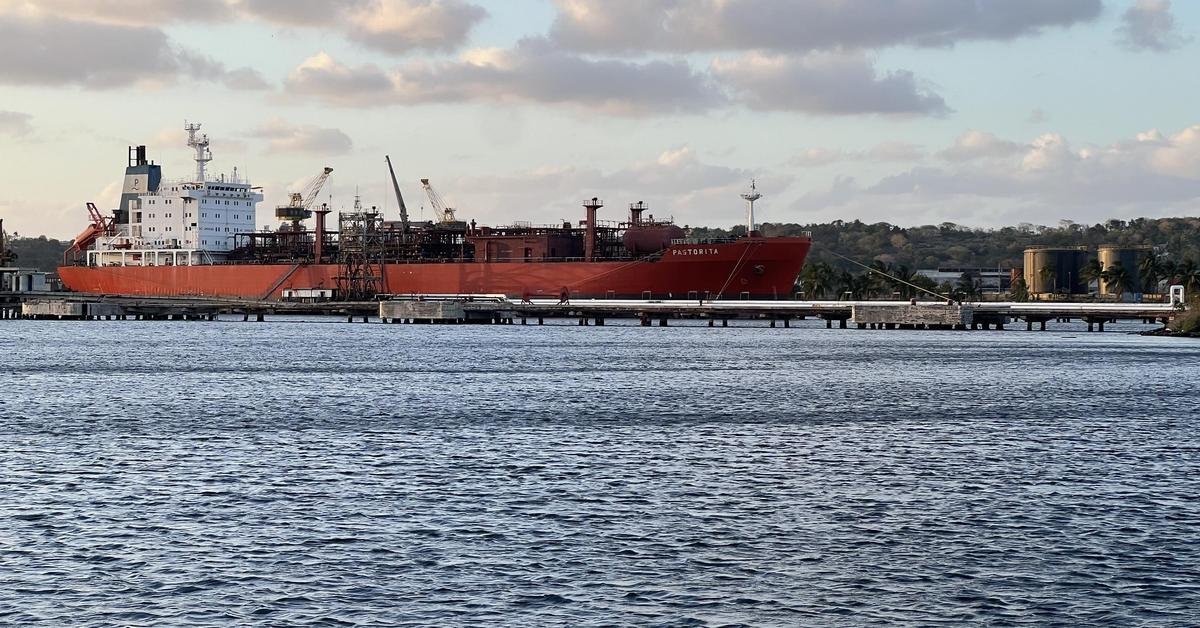
What is a fact is that the ship geolocation services have not detected any movement from the port of Matanzas to the port of Havana – “just 52 nautical miles” (a little more than 96 kilometers), highlights Piñón –, and that in the bay of the capital, in front of the refinery, there were only two liquefied gas ships, the Pastorita and the Emily. The latter left on March 12 towards Cienfuegos, where it will probably load the LPG produced from Russian oil.
Where two oil tankers also left from Matanzas since the Anatoly Kolodkin It set sail, once the crude oil it was transporting had been unloaded, on April 4, to Cienfuegos, although it is much further away, 125 nautical miles (more than 230 kilometers). One is the Vilma –with the Cuban flag–, which, according to Piñón data based on its draft, received from the Russian ship “a ship-to-ship transfer” of 414,000 barrels and which arrived at the Cienfuegos refinery on April 8.
/ 14ymedio
The other is the Nicos IV –with flag of Saint Vincent and the Grenadines–, which carries, the University of Texas expert estimates, 227,000 barrels of crude oil from the Urals and which is currently located off Cape San Antonio, in Pinar del Río. The 109,000 barrels that are missing to complete the 750,000 that the Anatoly Kolodkin They may well be on board one of the other Cuban tankers moored in Matanzas: the Maria Cristinahe Lourdes and the Alice.
The problem with the Cienfuegos refinery, Piñón points out, is that “it does not have a vacuum tower or a catalytic cracking unit like the Havana refinery” and, therefore, it is more susceptible to generating lower quality fuel oil – which is used for distributed generation engines – and less “high value products, such as gasoline and diesel.” The expert indicates that it has been docked in Cienfuegos for two days, just after the Vilma, the cabotage ship, departed. Primulaand speculates that it is “ready to transfer refined products as soon as possible from the Cienfuegos refinery to a Cuban oil port yet to be determined.”
On the other hand, the agencies maritime tracking show the russian tanker Universal –sanctioned by the US and the European Union, just as the Anatoly Kolodkin–, loaded with 320,000 barrels of fuel and coming from the Baltic port of Vysotsk, in the North Atlantic and bound for Cuba. The expected arrival date is April 23.