
“It is absolutely not designed for today’s use,” a ministry employee told Telex about the Poszeidon document management system, which, with a few exceptions, is mandatory in all ministries, government offices and state-owned companies. According to the ministry worker, “those who can use it are practically considered demigods”. Another former ministry employee reported that Poseidon is a nightmare: poor quality, not at all modern, not flexible, not user-friendly, and programs have been developed that are not necessary at all.
According to the reports, neither modern nor user-friendly software is required to be used for document management in the majority of ministries. Poseidon in 2023, by a non-public government decision made it mandatory at hundreds of government agencies. Although the state bodies received the license for the software for free, they have to cover the costs of implementation and maintenance from their own resources. With the software, documents are managed not only at the MÁV, the National Asset Management and government offices, but also in most ministries.
The final owner of SDA DMS Zrt., the developer of Poszeidon, is through Nexius Informatikai Zrt. Zoltán Fauszt, who was previously the former innovation minister László Palkovics was his business partner. Between 2000 and 2014, Fauszt and Palkovics, among others, were the owners of Informin’ Informatikai Tanácsadó Kft. Palkovics earlier, still as Secretary of State for Education he said that Zoltán Fauszt is indeed his friend, but that has no role in what kind of public procurements the businessman wins. Fauszt, by the way, between 2019 and 2020 was a member to the National Communications and Information Technology Council, which was the opinion and advisory body of the Orbán government. Among other things, the council analyzed the decision-making, management and authorization process of government IT procurement.

Viktor Orbán and Zoltán Fauszt in the Carmelite monastery, March 7, 2019 – Photo: Prime Minister’s Press Office / MTI
Faust’s companies they won a lot of public procurements worth tens of billions of forints under the Orbán governments. In addition to the document management software used by the majority of ministries, it was developed in public education institutions by companies related to the entrepreneur with an unclear legal basis an administrative system that has become dominant, a Chalk and Hungarian universities increasingly expensive Neptune too.
Free license, use at a horror price
In 2024, Átráltszó wrote that based on a framework agreement, the introduction of Poseidon in the public sphere, despite the free license, could even 82 billion forints can also be avoided.
By the way, about the fact that the Poseidon license is given to the organizations involved for free Antal Rogán decided. According to the information on the website of the Digital Government Agency (DKÜ), which is responsible for the coordination of the IT procurement of state bodies, institutions, companies, and foundations, they received the Poseidon license for perpetual use in December 2021, after the previous government asked the prime minister’s chief of staff to handle this.
Starting in early 2025, almost all ministries must use Poseidon. Exceptions are the Ministry of National Defense, where the Mercurius electronic document management system is used, and the Ministry of the Interior, where Robotzaru is used for this. Poseidon costs not only ministries, but also state companies a lot of money. Already after the election, on April 22, the results of the public procurement procedure were published, according to which the company developing Poseidon, SDA DMS
along with the 30 percent option more than 30 billion concluded a HUF three-year framework contract In September 2025 with 22 state bodies and companies, including such as the Hungarian State Treasury or the General Directorate of the National Hospital.
The latter procedure was carried out by DKÜ. This is the agency whose CEO, Lenkei Mirtill he was fired at the end of May from his position. Lenkei was succeeded by DKÜ’s economic deputy director general, Miklós Kovács, who wrote in a letter sent to Telex that two state audits are currently underway at the organization.
A product, but it brings in billions
Between 2022 and 2024, SDA DMS Zrt., the developer of Poszeidon, achieved an extremely high profit-to-income ratio. According to Opten’s company database, in 2024 the net sales revenue was 6 billion 264 million, the profit after tax was 2 billion 529 million. In 2023, it closed with a taxed result of HUF 1 billion 227 million, with an income of HUF 4 billion 2 million. In 2022, its revenue was HUF 3 billion 899 million, and the profit after tax was HUF 953 million.
In 2025, however, the company’s numbers turned out very differently, at least in terms of the after-tax result. Although their net sales increased by 387 thousand HUF compared to 2024, their profit after tax was only 776 million 522 thousand HUF – this is almost two billion HUF less than what they managed to achieve the previous year.
Among other things, we asked SDA DMS about the latter numbers and whether the company has any other products at all than the much-criticized Poszeidon document management software, which was made mandatory by government decision. From the company’s response, although this was not stated categorically, it turned out that the company lives solely on Poseidon, no other specific product was mentioned at all. “SDA DMS Zrt. builds on the company group’s more than three decades of Hungarian software development knowledge and the development history of Poszeidon, which started in 2005,” they wrote in the answer.
We also asked them how it is possible that SDA DMS achieved less than a third of the 2024 after-tax profit in 2025, despite higher net sales compared to the previous year. “In the 2025 business year, the company’s result was not affected by the drop in revenues, but by a planned and conscious change in the cost structure,” the company wrote in its response. They justified the fact that their after-tax result in 2025 was so much worse than in 2024 with long-term developments and technological investments for future growth.
We were also curious as to how they managed to realize almost half of their net sales in 2024 as a profit. According to them, it is due to the operation of software development companies that “the sales and support phases following product development and investment phases lasting even years can show a higher than average profit ratio in a given business year”. “The year 2024 was a year with a favorable project composition and high operational efficiency for SDA DMS Zrt. However, the data for 2025 clearly show that the profit ratio can change from year to year as an industry characteristic, especially if the company undertakes significant development and operational expenditures for future product development.”
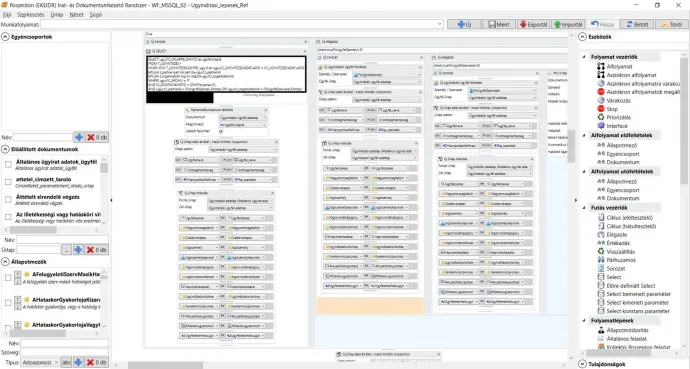
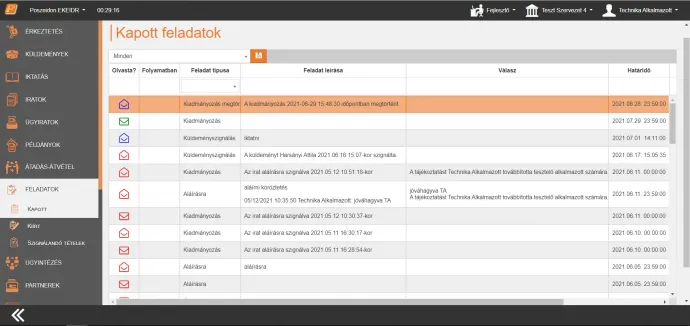
Different interfaces of the program – Source: Poseidon
We also asked how much Poseidon has cost the state in total so far, but also what the company thinks, whether they could make a living from the market without state orders. They gave an evasive answer to one of the questions, saying that they do not have “comprehensive, aggregated data on the customer’s side about the total costs incurred by the state, state bodies or state companies in connection with Poseidon and its related modules”.
On the other hand, they confidently answered that “the professional and technological preparation of SDA DMS Zrt. is fully competitive in the market environment, and its solutions and modules are currently used by many market and competition players”. “The company consciously specializes in a segment where legal compliance, information security, large-scale operation, integrability and long-term support are of utmost importance,” the company wrote. According to them, the service of bodies and institutions performing public duties
“not an operational weakness, but a specialized competitive advantage”.
Finally, we also asked them how they react to the fact that, according to several ministry workers, the software is of very poor quality, many people in the ministries cannot even use it effectively. We also wanted to find out if there is any possibility for users of the system to give feedback on the quality of the system.
They wrote that the company “handles user and customer feedback related to Poseidon in contractual support, customer relations and development processes”. According to them, user comments, error reports, development proposals, and operational experiences can be reported and evaluated in a structured manner in these processes.
Ministry employees who spoke to Telex responded to Poseidon’s claims by saying that “in the case of such a system, the user experience cannot be separated from legal, document management, organizational and procedural constraints”. “SDA DMS Zrt. takes usability feedback seriously; the company supports the customer’s use with up-to-date e-learning materials, train-the-trainer training and, if necessary, additional training, since the common goal is to ensure smooth and legal institutional operation,” wrote the company.
What could be his fate?
Council Zoltánthe Minister of Science and Technology of the Tisza government posted at the beginning of June that they are building a “modern, transparent and efficient digital state”, a public administration that “really serves the common good and the Hungarian people”. “Instead of artificially created monopolies based on outdated technologies, we are building modern, interconnected systems based on open standards that everyone can use safely and comfortably,” wrote the minister.
We sent questions to the Ministry of Science and Technology to find out what the ministry’s plan is with Poseidon, whether the minister hinted that they want to remove the file manager of the company linked to Zoltán Fausz from the public administration. “There are currently 3 dominant document management systems operating in the Hungarian public administration: Poseidon, Robotzzaru, which works for law enforcement agencies, and DMS One, used by local governments. I think that the market for document management systems can benefit from greater, more transparent competition, because it would lead to a reduction in the price of services and an improvement in quality,” wrote Zoltán Tanác to Telex. Their aim is not to force any system out, but to ensure the
“fair market competition and efficient, user-friendly document management”.
We also asked about the fate of Crete, a system developed by another Fausz-related company, used in public education institutions, under the new government. “Like Poseidon, Crete was also made mandatory centrally by the previous government, i.e. it immediately excluded the possibility of market competition for these systems. I can say here that the goal is not to implement any system, but to have adequate, efficient, modern IT support for education,” the minister wrote.