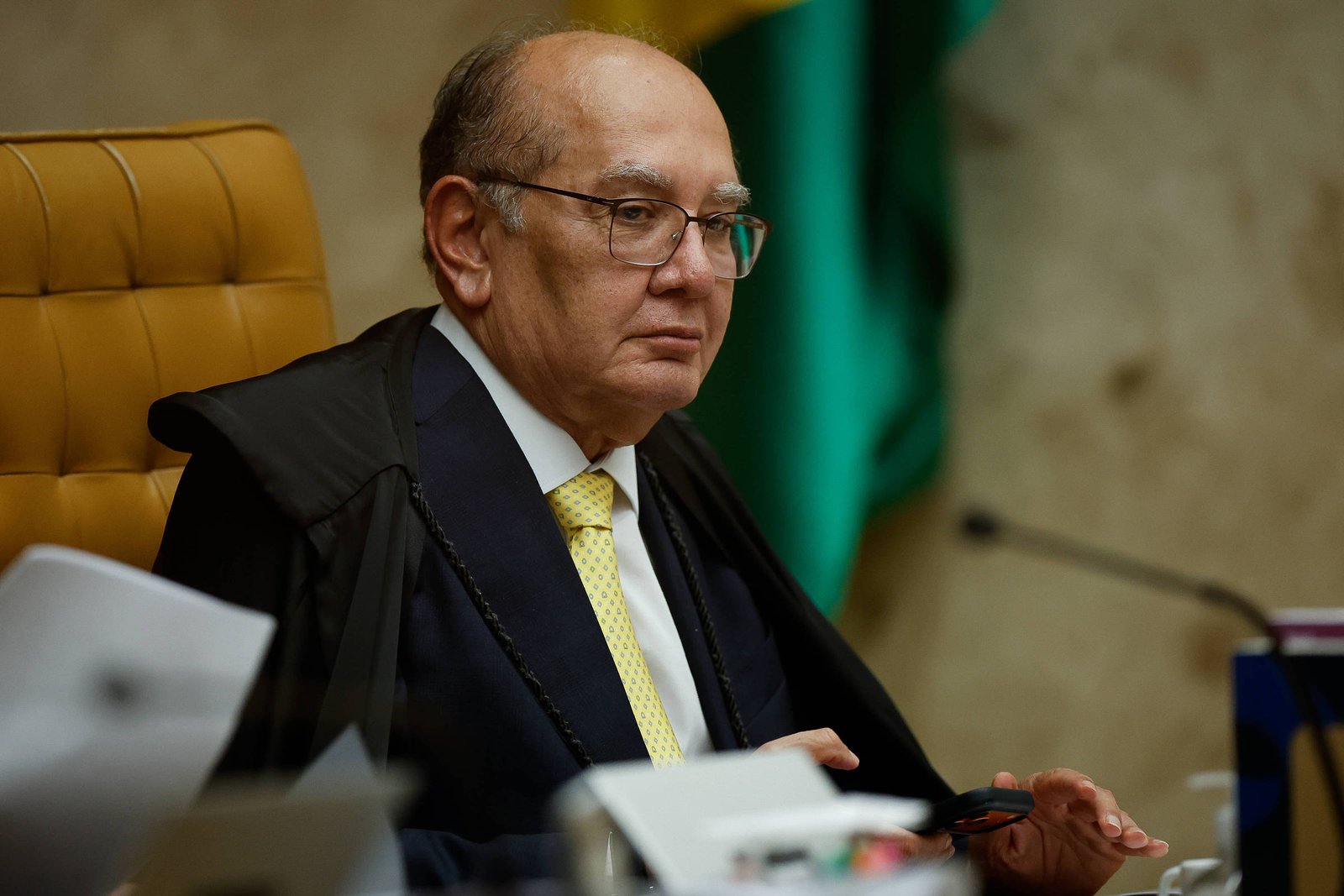
The minister Gilmar Mendesfrom STF (Supreme Federal Court), cited this Monday (4) the scandal of Master Bank and stated that there is a “myopic view” that the problems of Brazilian institutions are concentrated in the Judiciary and that the court would be the only one to be improved.
Next to the president of the court, Edson FachinGilmar defended a broader and deeper reform, “something like a new republican pact or perhaps a pact for state reform”.
“It is necessary to advance in the rationalization of parliamentary amendments, in the improvement of the electoral system, especially the proportional model, in the discipline of the powers of the CPIs (parliamentary commissions of inquiry), in the protection of digital sovereignty, in the improvement of the system of checks and balances, in transparency and supervision of the exercise of Powers and in the review of remuneration distortions that still persist in various careers in public services”, said the dean of the court.
The statements were made during a public hearing at the Supreme Court called by Flavio Dino to discuss the oversight capacity of the CVM (Securities Commission), in the midst of bank fraud Daniel Vorcaro.
According to Gilmar, Master’s case has generated “fair perplexity and indignation” among the population and “eroded the reputation” of institutions. The minister cited data from Datafolha that shows that 75% of people believe less in the STF now than in the past.
“We therefore have a situation of widespread discredit driven by the difficulties that the Brazilian State has faced in meeting the basic demands of citizens. In this sense, intending to resolve the crisis of confidence by targeting only the Federal Supreme Court is, at the very least, naive, but more likely deliberate myopia and obscure intentions,” he said.
The dean also declared support for Judiciary reform proposal exposed by Dino in an article published in ICL Notícias, which, among other points, proposes the creation of more rigorous criminal offenses for crimes committed by judges and advocates regulating remuneration for legal careers.
Dino, when indirectly commenting on the Master case, said that “elephants painted blue” parade along the Esplanada dos Ministérios and questioned how no one noticed what he classified as “absurdities” of the Three Powers and the financial market.
“I’m impressed, and it’s not new, I’ve been in Brasília holding office since 1999, I’ve never seen so many elephants painted blue parading around this Esplanade. So many absurd things. And my question as a civil servant of the Brazilian State is: nobody saw it? How come nobody saw it? The elephant is big, it’s painted blue parading in front of everyone”, he stated.
As shown by SheetDino’s initiative to propose a reform of the Judiciary opened a new front of conflict with the court president’s group around an ethical and moral agenda for the judiciary.
Fachin has been defending the development of a code of ethics since last year and designated Carmen Lucia to report a proposal. The discussions take place amid the court’s exhaustion with the investigations into the Master, which raised suspicions about the ministers Alexandre de Moraes and Toffoli Days.
The CVM hearing was summoned by Dino, rapporteur of a direct action of unconstitutionality presented by Novo. The party requests the suspension by means of a precautionary measure (provisional decision) of sections of the law that changed the way in which the commission’s inspection fee is calculated.
Without directly citing the Master, Fachin, when participating in the opening of the event, said that recent scandals show “the exact harmful consequence” of the lack of control limits by competent bodies and the need to debate the topic.
“The court is aware, as it should be, that, when judging the presentation, its interpretation of the law will generate effects that will affect the entire Brazilian capital market, the agents that operate in it, the investors that depend on it and the regulatory capacity of the State”, he stated.
The Master scandal also affected STF ministers. A company in which Dias Toffoli is a partner sold its stake in a resort in the interior of Paraná to a fund linked to the bank. The bank also paid R$80 million over two years to the law firm of minister Alexandre de Moraes’ family.
UNDERSTAND WHAT IS UNDER DISCUSSION
According to the Novo party, the amounts collected from police fees are “disproportionately greater” than all CVM expenses and are being “systematically appropriated” by the National Treasury.
The party pointed out that, from 2022 to 2024, the autarchy raised around R$2.4 billion, of which R$2.1 billion came from fees, but the budget allocation allocated to the autarchy was R$670 million – around a third of the amount collected as fees.
“The astonishing discrepancy between the amounts charged as a fee and the municipality’s expenses fully demonstrates the confiscatory nature of the fee and its distortion and transformation into a tax, which is constitutionally prohibited, leading to the violation of the constitutional provisions mentioned”, says the document.
In the decision that called for the public hearing, on March 30, Flávio Dino stated that the sophistication of criminal organizations has reached regulated environments, such as the capital market, and that the Master case illustrates that there is growing regulatory and oversight difficulty.
The minister cited a statement by the interim president of the CVM, João Accioly, who admitted at CAE hearing (Economic Affairs Committee), of the Senate, that the municipality knew of possible irregularities by the Master since before 2022 and that the investigations could have been faster if there had not been an accumulation of cases by people.
“This serious phenomenon reveals a qualitative change in the modus operandi of these criminal organizations, notably operations aimed at integrating resources of illicit origin into the formal economic circuit, a strategy that has challenged current control mechanisms, which includes the CVM together with the Central Bank, the Financial Activities Control Council (Coaf) and the Federal Police”, wrote Dino.
“With this factual framework, the plaintiff’s theses gain relevance, in the sense that there would be no proportionality between the collection and the cost of the CVM’s activity, with the attribute of reasonable equivalence of the rate not existing, violating the principle of efficiency”, he added.
WHAT IS THE CVM
The CVM is an agency linked to the Ministry of Finance responsible for monitoring and creating standards for the securities market in Brazil.
Today, the commission has 482 employees, 7% less than in 2015, and more than 130 vacant positions. Part of the inspection fee charged by the municipality goes to the National Treasury, which limits its capacity to invest in structure and personnel.
The CVM closed last year with drop in case numbers sanctions and punishments for irregularities in the financial market. The stock of processes, on the other hand, increased.
As a result of the trials carried out in 2025, the CVM sanctioned 65 people and acquitted 67, numbers also much lower than the 176 and 150 registered in 2024. The fines applied to people sanctioned in 2025 totaled R$511 million, almost half of the previous year.