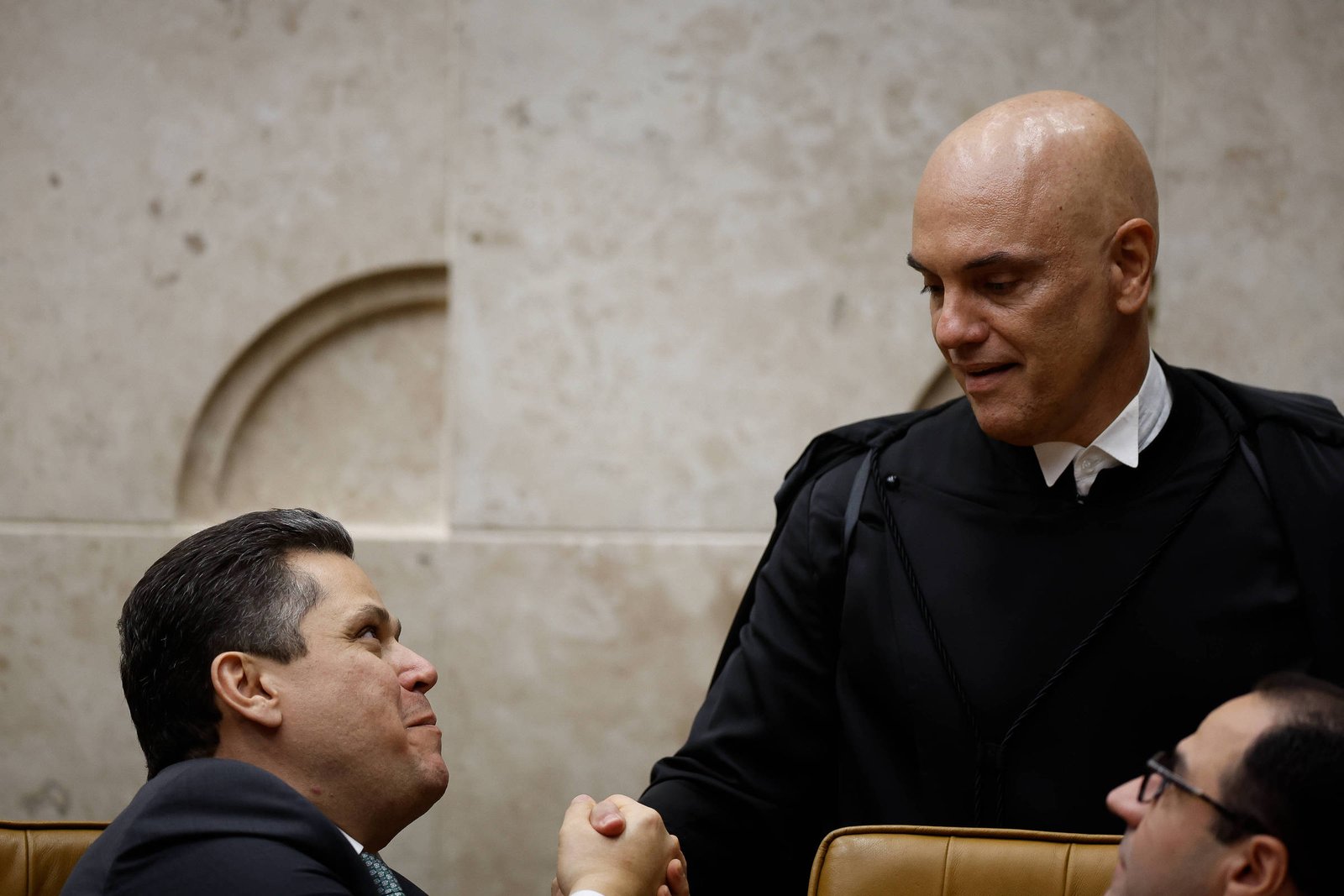
The minister of STF (Federal Supreme Court) Alexandre de Moraes sought interlocutors from Lula to say he didn’t work to defeat Jorge Messias in the vote of the Senate which barred the name of the Union’s attorney general from the Court.
Moraes is close to the president of the Senate, David Alcolumbre (União-AP), which imposed a resounding defeat on the government on Wednesday (29) by rejecting Messias’ nomination by 42 votes against and 34 in favor.
In the understanding of Palácio do Planalto, the STF minister gave the senator the necessary support to confront the government.
One of the messages was sent by Moraes to Messias himself, who until the weekend had not responded to the magistrate. In it, the minister said he regretted the defeat of the Union’s attorney general.
The other messages and conversations were sent or maintained by Moraes with members of Lula’s top echelon with whom he maintains dialogue.
The judge’s tone was contradictory to reports that stated that, in Lula’s understanding, he would have helped Alcolumbre to defeat Messias.
At least one STF minister and two members of Lula’s ministry sought out the president after the defeat to defend Moraes and say that Planalto’s assessment was unfair.
They said that it is not possible to point to a single act or even a phone call from the magistrate to senators asking for a vote against Messiah.
STF ministers and Moraes’ interlocutors told the column that, even if he wanted to, the magistrate would not even be able to campaign against the Union’s attorney general, since his prestige in the Senate is low.
They claim that the battle against Lula and Messias belonged to Alcolumbre and that, as Moraes is a first-time ally of the president of the Senate, he was drawn into a dubious position: he did not charge against, but neither did he make an effort to support Messias, avoiding contradicting the president of the Senate.
Magistrates consider that Moraes even participated in the attempt to place cotton between the crystals when attending a lunch at the minister’s house Cristiano Zanin who brought Alcolumbre and Messias together to talk. Despite the Senate president’s denials, he went to the meeting knowing that the Union’s attorney general would be present. At the time, he did not guarantee support and signaled that it was unlikely to be approved.
In the conversations, Lula did not hide his belief that Alexandre de Moraes participated in the articulation against Messias.
The assessment of the president and direct interlocutors is that, with Alcolumbre’s victory, he would have the benefit of seeing a first-time ally strengthened, and with a chance of being re-elected to the presidency of the Senate in 2027.
Alcolumbre in command of the Senate for at least another two years would be a guarantee that any impeachment attempt against Moraes will not be considered.
Until then, Moraes, now supported by the law that reduced the sentences of those convicted of a coup d’état, could review the punishments, even alleviating the situation of former president Jair Bolsonaro.
The dosimetry law, which allows the review of sentences, was endorsed by the Senate following Messias’ defeat. Alcolumbre also commanded the session that overturned Lula’s veto of the new rules.
A third effect, in Planalto’s view, is that Alcolumbre and Moraes would have sent a powerful message: that the STF minister André Mendonçawho is the rapporteur of the Master case, which affects both of them, is isolated in the Court and has less power than it would seem until then.
The column contacted Minister Moraes through the STF advisor, but received no response.
with DIEGO ALEJANDRO, JULLIA GOUVEIA and KARINA MATIAS
LINK PRESENT: Did you like this text? Subscribers can access seven free accesses from any link per day. Just click the blue F below.