Humanity tested by negative consequences
of a deceptive development model
he needs to hear the Gospel of hope
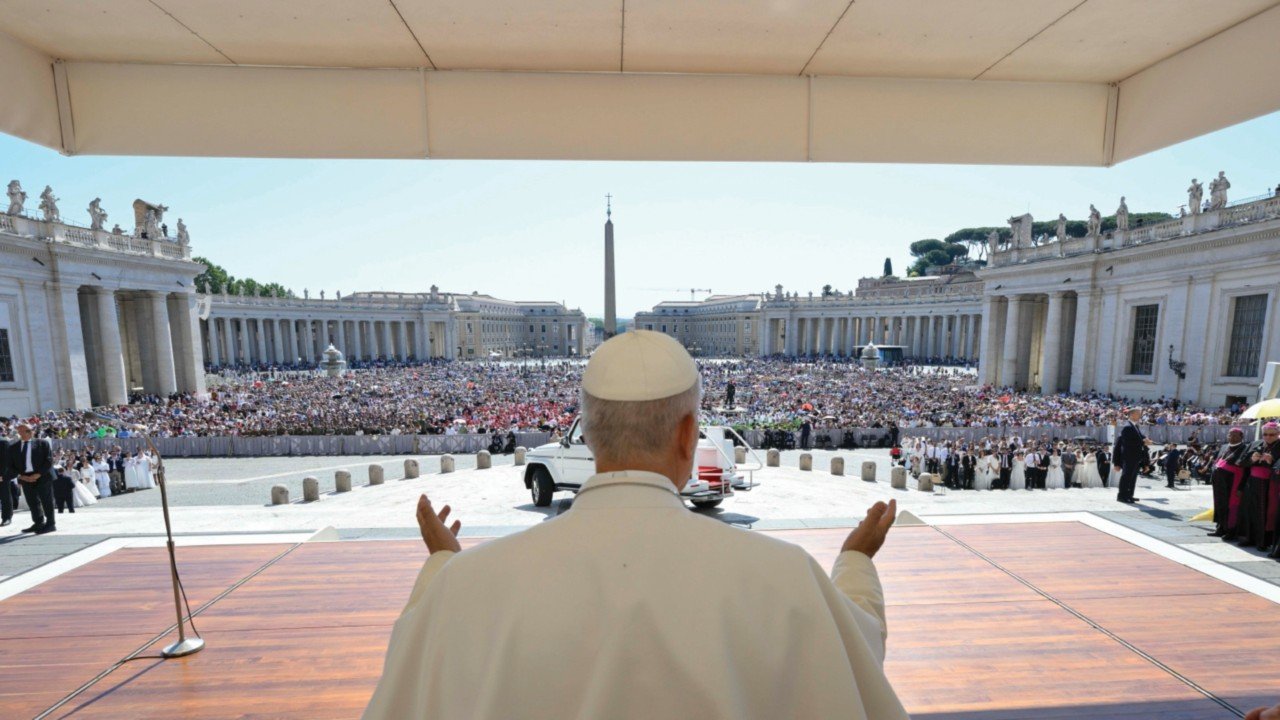
The large participation of the Spanish people in the Pope’s visit to Spain is a sign of faith and expression of the “widespread need to find ourselves united on a true and profound foundation, not ideological or partial interest”. Leo XIV underlined this at the general audience this morning, Wednesday 17 June, in St. Peter’s Square. Interrupting this week’s reflections on the documents of the Second Vatican Council, the Pontiff focused his catechesis on the apostolic journey undertaken from 6 to 12 June in the “European country of ancient and very rich Catholic tradition”, which welcomed Peter’s successor with “enthusiasm and openness to listening”. Here are his words.
Dear brothers and sisters, good morning and welcome!
Today I would like to propose some reflections on the apostolic journey I made last week in Spain, visiting Madrid, Barcelona, the Abbey of Montserrat and the Canary Islands.
After the long trip to four African countries, this time I found myself immersed in a European country with an ancient and very rich Catholic tradition. And it became clear that in today’s Spain, which has experienced notable social and cultural changes, the Pope has been welcomed everywhere with enthusiasm and openness to listening. For this I thank God and all the Spanish people, the King and the civil authorities, the Bishops and the ecclesial communities.
The people of God comforted me greatly with the festive manifestation of their faith and affection. In turn, I confirmed the faithful and, as Bishop of Rome, I encouraged them to overcome every form of division and opposition by always cultivating communion, dialogue, unity in diversity. This is the specific service of the Successor of Peter, a service which finds a specific expression in the apostolic journeys, each time suited to the ecclesial and social situations of the countries visited.
In the case of Spain, I was able to note with joy how much people, of all ages and conditions, were awaiting the Pope’s visit: everywhere I found multitudes welcoming me with great warmth. This fact was not obvious, and deserves reflection. Naturally, this participation expresses first and foremost, as I was saying, the faith of the Spanish people; at the same time, I believe that it manifests the widespread need to find ourselves united on a true and profound foundation, not ideological nor of partial interest. That foundation that only Christ, ultimately, can ensure, and that the Gospel, through the necessary “inculturations”, can transmit into the lives of peoples. He can do this because his message fully responds to both of these needs: the search for truth and the thirst for justice.
In Madrid and Barcelona we gathered in the great cathedrals as well as in the very modern stadiums. We prayed the Holy Rosary in Montserrat Abbey. We celebrated in the Sagrada Familiamajestic symbol, symphony of stone and light that speaks to everyone of the Christian mystery. This meeting of ancient and modern, of Catholic tradition and contemporary culture made me perceive firsthand the character of Europe, its inestimable richness, as a current, unsurpassed reality. This is a heritage to be carefully safeguarded, in order to be able to invest in today’s global world with its epochal challenges: peace, integral ecology, fair and sustainable development, respect for human dignity. These are challenges that the Second Vatican Council had already clearly recognized and to which the subsequent Magisterium returned, up until my recent Encyclical Magnificent humanitywhich aims to safeguard the human person in the time of artificial intelligence.
Through the various meetings, I understood the need to listen to the Gospel of hope in the Pope’s voice for our humanity today, severely tested by the negative consequences of a deceptive development model. This need, which found expression in the many testimonies that I was able to listen to – sometimes moving, sometimes edifying testimonies -, I also recognized and above all in the faces of the little ones and the poor that I met: of the child who read his letter to me in the parish; of some victims of abuse, who ask to be heard; of the inmates who were waiting for me in the prison; young people full of restlessness and plans; of migrants in the first reception centers in the Canary Islands.
Right there, in the Canary Islands, the last stop on our itinerary, I was offered an overall understanding. They offered me, on the one hand, the same geographical position of that archipelago; and, on the other, the reality of a local Church that welcomes a large number of forced migrants, especially coming from Africa. We know that the migration phenomenon is complex and that it requires organic and concerted action plans. But this interpretation opens up a different and broader perspective: it makes us understand how we are called to reread the Gospel in today’s world, exchanging the gifts of our respective cultures, and in particular the fruits produced in them by the fruitfulness of Christ’s message. And one of these fruits is precisely the dialogue between people and between peoples, the meeting in a spirit of brotherhood, which allows us to discover and mutually appreciate the values that the other bears. This path is not easy, it requires good will and God’s help, but it is the path that leads to the civilization of love.
Dear brothers and sisters, the motto of this Apostolic Journey was “Raise your gaze”, “Look up!” (see John 4, 35). They are words of Jesus, addressed to his first disciples, to teach them to see in people and crowds the desire for life, for truth, for fullness. The Lord repeats those words to me first, and with his grace I also experienced them during the Journey. Today I would like to share this invitation with you: let’s raise our gaze! We learn from Jesus to look at others, people, the world “with the eyes of God”, that is, with love, respect and compassion.
Finally, I want to thank all those who prayed for the success of this Apostolic Journey, in particular the communities of contemplative nuns, who in Spain, thank God, are very numerous. Continue to pray, so that, with the intercession of the Virgin Mary, the seeds I have sown may bear abundant fruit. Thank you!