Synopsis: Diplomatic activities and performances showcase shared heritage to foster mutual understanding and future cooperation.
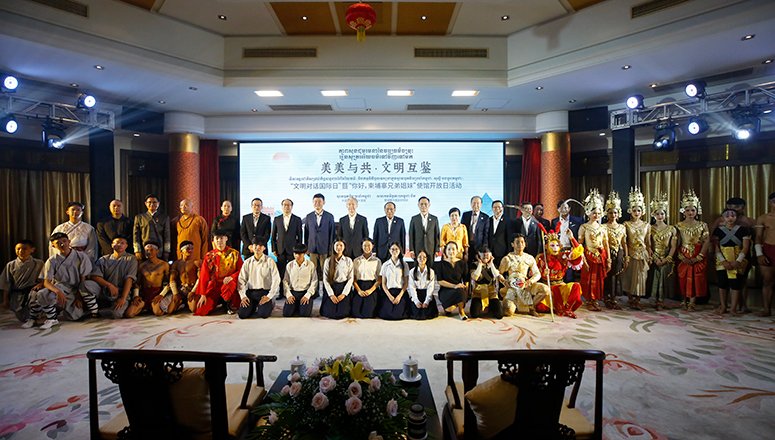
Cultural ties between Cambodia and China were the highlight over the weekend as the Chinese Embassy hosted an Open Day to celebrate International Day for Dialogue among Civilisations. The UN General Assembly adopted the global event in June 2024 following a proposal co-sponsored by more than 80 countries.
Chinese Ambassador Wang Wenbin and Cambodian-Chinese Association President Ek Sam Ol led the June 13 event. The Open Day drew teachers and students from the Royal University of Phnom Penh, the Royal University of Fine Arts, Princess Buppha Devi Dance School, Duon Hoa School, and the Cambodia-China University of Technology and Science.
The opening ceremony featured a video message from Chinese Foreign Minister Wang Yi, who called on nations to improve understanding and foster mutual trust through dialogue amid unprecedented global challenges. He said that countries should promote unity and seek consensus through exchanges while strengthening foundations for a shared future.
The Foreign Minister also highlighted the role of emerging technologies, including artificial intelligence and social media, in promoting cultural exchange, while reaffirming China’s willingness to deepen international cooperation on governance and modernisation.
Separately, Chinese Ambassador to Cambodia Wang Wenbin said historical links between the two cultures can be traced back nearly 2,000 years.
“More than a thousand years ago, ambassadors from the Chenla Kingdom arrived in Chang’an, China. Many eminent monks travelled to China to spread Buddhist teachings,” he said.
“The travel records of Zhou Daguan during China’s Yuan Dynasty documented the prosperity of the Khmer Empire. During the Ming Dynasty, Zheng He also conducted several friendly visits to Cambodia.”
Ambassador Wang said the peoples of China and Cambodia are closely connected through mutual respect and civilisational learning.
“Recently, a joint survey conducted by the Royal University of Phnom Penh and the School of Foreign Languages at Peking University found that more than 99% of Cambodian youth respondents believe that Chinese is the most important language for obtaining an ideal job,” he said. “As many as 92% of respondents regard China as their most desired travel destination.”
Ambassador Wang said Chinese citizens also have a growing understanding of Cambodia.
“Many Chinese students are also studying the Khmer language or Khmer literature,” he said. “At the Chinese Embassy, there are also many diplomats specialising in the Khmer language and culture.”
Meanwhile, Cambodian-Chinese Association President Ek Sam Ol commended the embassy for organising the event to preserve bilateral friendship for future generations.
“Today’s event allows us to proudly witness the cultural wealth of both Cambodia and China, especially our traditional arts and crafts,” he said. “It fully reflects the prosperity and diversity of our long-standing cultures.”
Student arts performances anchored the Saturday celebration. The most popular showcase was “Hanuman Meets Wukong”, a crossover between the legendary monkey kings of Cambodian and Chinese literature.
The event also featured traditional Cambodian bokator and Chinese Shaolin kung fu.