The election of the new vice prefect of Guayasplanned for this April 22will mark a turning point in provincial politics. Not only will the vacancy left by the resignation of Carlos Serrano be filled, but it will define who will assume the Prefecture in less than a month, when Marcela Aguiñaga leaves office on May 14.
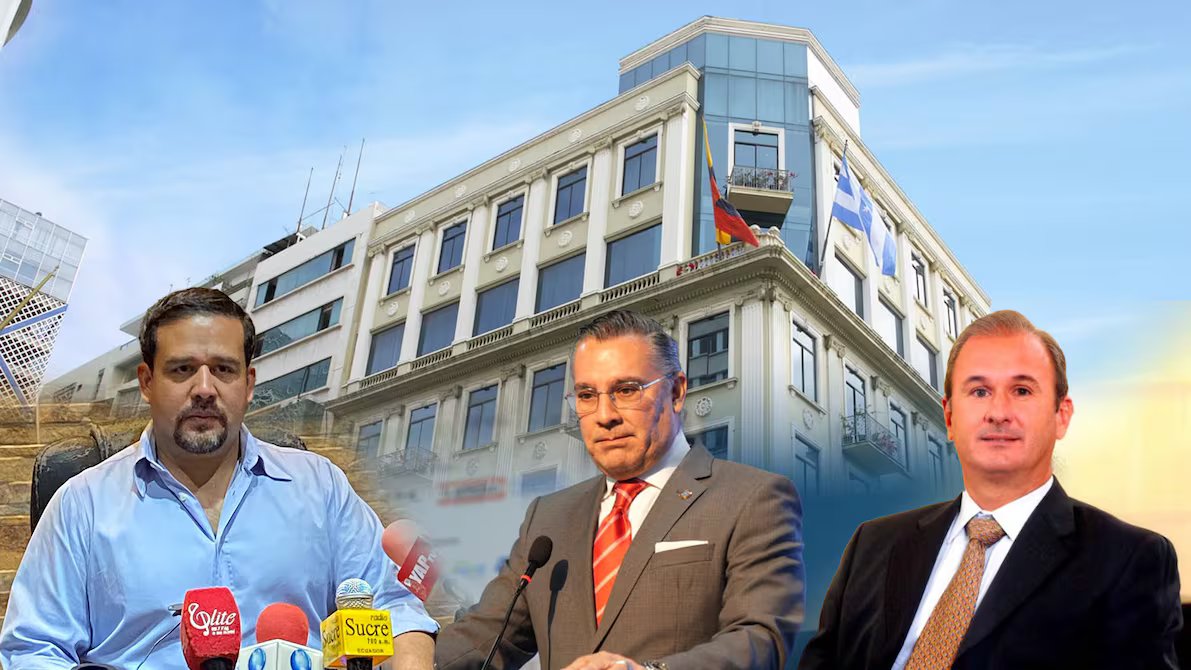
The new vice prefect, who will become prefect in a few days, will come from the shortlist presented by the prefect and made up of Carlos Encalada Villacís, Otton Lara Pincay and Gustavo Heinert Musellothree profiles from the business and technical field, linked to sectors such as agribusiness, construction and administration.
In this context, there are coincidences among the analysts consulted: the process is legal and is contemplated in current regulations, but at the same time it opens a debate on the design of the replacement system in provincial governments and on citizen representation for voters.
Process follows the legal framework
The mechanism for this renewal is established in the Organic Code of Territorial Organization, Autonomy and Decentralization (Cootad). The norm provides that, in the definitive absence of the vice prefect, the prefect must present a shortlist and the Provincial Council elect, from outside its ranks, who will occupy the position. This regulatory design, as analyst Andrés Ortiz explains, responds to a practical logic linked to the time remaining in the period.
Ortiz maintains that they were the ones who established that people who were not elected by popular vote can hold the position of prefect and vice-prefect only if there is less than a year until the end of the period. From their perspective, this provision is reasonable, since calling elections for a period of less than one year is neither efficient nor necessary.
Along the same lines, the analyst adds that the Cootad clearly differentiates between scenarios: when there is more than one year left in the period, elections must be called; but when time is less, a designation like the one expected this Wednesday is chosen.
The particularity of the Guayas case
However, the case of Guayas introduces a particularity that had not been seen in these conditions. Serrano’s resignation occurred before Aguiñaga’s announced departure, which first activates the vice-prefect appointment mechanism. But that same vice prefect will be the one who, in a few weeks, automatically assumes the Prefecture until the end of the term.
This generates a chain of replacements that results in an exceptional scenario: the new vice-prefect will be elected by the Provincial Council without having been elected at the polls, then he will become prefect, and subsequently must present a new shortlist so that the same Council can designate the next vice-prefect. That is, the period will end with two authorities who did not come to office by popular vote.
For the constitutional lawyer Carlos de Tomasothis scenario does not represent an irregularity, but rather the direct and full application of the rule. Explain that the way in which they are proceeding responds to the order in which the events occurred. resignations.
“If it had been a simultaneous resignation of the prefect and vice-prefect, we would be faced with another legal norm. But since the vice-prefect’s resignation occurs first, it is appropriate to apply the shortlist mechanism presented by the prefect,” he points out. In that sense, he emphasizes that the current procedure is the correct one within the current legal framework.
De Tomaso also addresses one of the most sensitive points of the debate: the legitimacy. Although he recognizes that for the citizen it may be an atypical scenario, he maintains that there is no decrease in the legitimacy of the designated authorities.
“Legitimacy is given in the law. These authorities have the same degree of power and validity as those who have been elected by popular vote,” he states. From his point of view, the legal system foresees this type of situation precisely to guarantee institutional continuity.
However, he admits that the voter may feel disconcerted. “There may be a feeling of discouragementbecause a pairing was chosen that will not finish the period,” he explains. Even so, he insists that there is no other way than to apply what the regulations establish.
This contrast between legality and citizen perception is also pointed out by Ortiz. In his opinion, the current situation marks a break in the political tradition of the province. “For the first time, the provincial government “It could be left in the hands of officials who have not received the direct mandate of the voters,” he warns.
Ortiz puts the scene in historical perspective. The Prefecture of Guayas has maintained stability based on authorities elected by popular vote or who had occupied political spaces. This occurred in 2020 after the death of Carlos Luis Moralesthen prefect. He assumed his vice prefect, Susana Gonzalezand she put José Yúnez Parra, former mayor of Samborondón, on her shortlist.
“What we have now is qualitatively different,” he explains, and also opens a broader debate on the institutional design of the Provincial Council. Ortiz questions the current model, in which mayors and their delegates act as advisors, instead of having representatives specifically elected for that function.
This changed with the Constitution of 2008. Previously, the provincial councilors were elected by popular vote and the vice prefect was appointed from among them. With the constitutional reform, binomial elections were established through direct suffrage, which reinforced the democratic legitimacy of both authorities.
“It may be an opportunity to rethink this figure,” he says. In his opinion, the most coherent thing would be that, in cases like this, the authorities that take over come from a directly chosen body for the citizens. However, the current model does not allow this possibility, since mayors cannot simultaneously perform functions at different levels.
The decision of the Provincial Council
As this debate progresses, the immediate focus is on the Provincial Council session, where the triple delimits the margin of action, since candidates outside this list cannot be considered. Therefore, the decision will not be open, but will depend on the political agreements that are built around these three profiles.
The Provincial Council of Guayas is a collegiate body with a diverse political composition, in which several forces come together. Although there is a significant weight of Citizen Revolution Within the organism, there is also a significant presence of Christian Social Partyas well as representatives of other organizations, such as Renovación Total, Pachakutik and CREO. This scenario forces the construction of consensus to achieve the necessary majority in the vote.
In total, the Council is made up of 33 members with voice and vote: the prefect, the mayors or their delegates of the cantons and representatives of the rural parish councils. This is the current conformation:
provincial authority
- Marcela Aguiñaga Vallejo – Prefect
Cantonal delegates and local authorities
- Tatiana Coronel Flores (s) – Guayaquil
- Gilmar Gabriel Balladares – Beaches
- Dolores Cabrera – Balzar
- Rodolfo Cantos – El Empalme
- Wilson Cañizares – Daule
- Luis Esteban Chonillo – Durán
- Sandy Gomez – Balao
- Angela Herrera – Alfredo Baquerizo Moreno (Jujan)
- Nery Jaramillo – Pedro Carbo
- Isidro Morán – Lomas de Sargentillo
- Milton Moreno – Salitre
- Katherine Olivares – Yaguachi
- Pedro Orellana – Marcelino Maridueña
- Álex Quinto Castro – Colimes
- Juan Carlos Rivera – Naranjal
- Alejandro Rosado – Bucay
- María Belén Candado – Nobol
- Pedro Solines – Miracle
- Luis Suárez – Palestine
- Cristian Suárez – Naranjito
- Mabel Tenezaca – The Triumph
- Ubaldo Urquizo – Santa Lucía
- María Fernanda Vargas – Simón Bolívar
- Luis Vargas – Isidro Ayora
- Juan José Yúnez – Samborondón
Representatives of rural parish councils
- Walter Carrera – Puerto Nuevo Parishes, El Empalme
- Hilda Castro – Puná Parishes, Limonal
- Kevin Maruri – Posorja Parishes, Los Lojas
- Yolanda Mendoza – Parroquias Vernaza, Juan Gómez Rendón
- Willian Pérez – Parroquias Yaguachi Viejo, Cone, Gral. Pedro J. Montero
- Liliana Simbala – Tenguel and Chobo Parishes
- Alfonso Solís – Santa Rosa de Flandes and El Rosario Parishes
(YO)