Al-Thawra Net| Hashem Ali
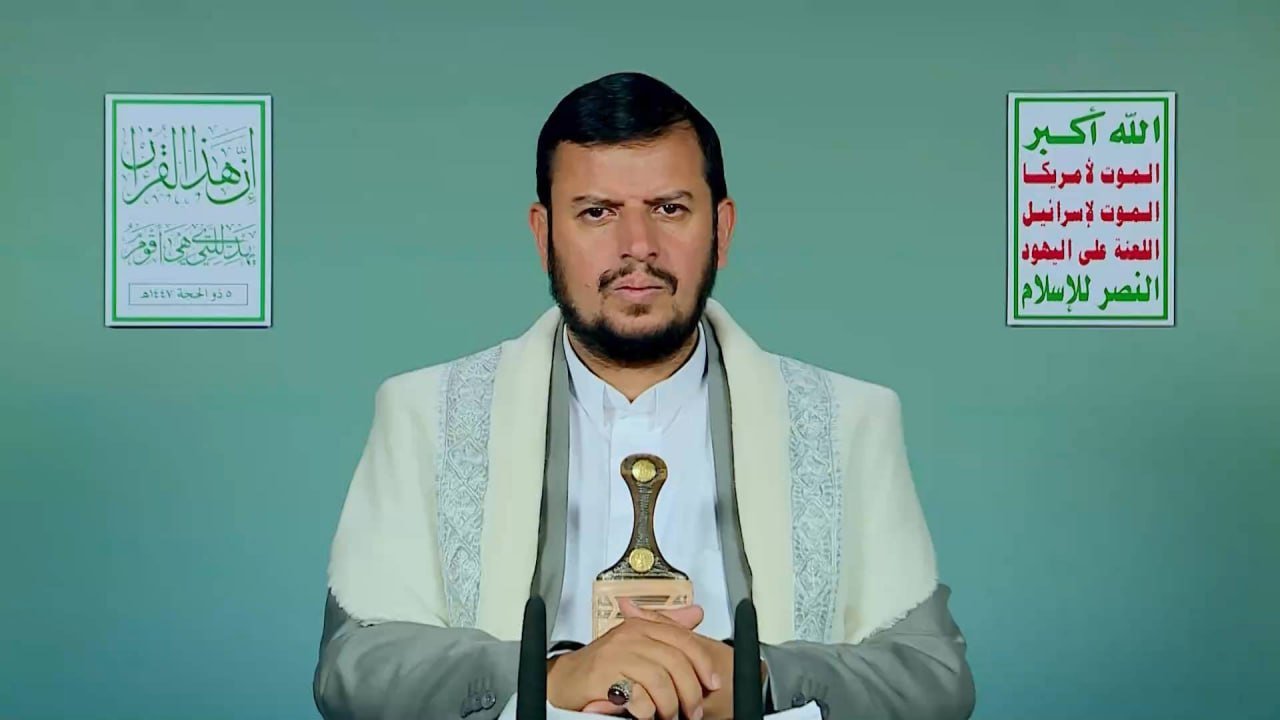
In his fourth lecture of the lessons of the month of Dhul-Hijjah 1447 AH within the series “Indeed, this Qur’an guides to that which is most upright,” the leader of the revolution, Mr. Abdul-Malik Badr al-Din al-Houthi, presented a comprehensive reading of the nation’s reality, linking faith identity and national unity, and between political independence and economic liberation, in a speech characterized by clarity and depth, and touching on the most prominent challenges facing Yemen and the region in light of the rising American and Zionist hegemony.
The lecture came as an integrated intellectual, political and economic diagnosis, in which the Leader laid the foundations for protecting Yemeni unity, revealed the tools of external control, and warned of the danger of economic dependency, calling for building an independent productive economy that liberates peoples from dependency and blackmail.
Yemeni unity… between identity and independence
Mr. Leader began his lecture by talking about the anniversary of Yemeni unity, considering it a “great national entitlement” that should be preserved and consolidated on sound foundations, stressing that experiences since the establishment of unity until today have proven that the real danger to it is represented by two main factors: internal ambitions and external dependency.
He explained that the comprehensive faith identity represents the basic guarantee for the unity of the Yemeni people, citing the noble verse: {And hold fast to the rope of God all together and do not become divided}, as the true title that preserves national cohesion and prevents the tearing apart of society through sectarian, regional and party strife.
He pointed out that external forces, especially America, Britain, Saudi Arabia, and the enemy entity, are constantly working to dismantle and weaken Yemeni society. With the aim of keeping it subject to political and economic hegemony, stressing that the liberal approach and adherence to independence is the second factor guaranteeing the unity and sovereignty of Yemen.
Boycott…a weapon of awareness and confrontation
Mr. Leader moved on to talk about the economic boycott, drawing inspiration from the meanings of the noble verse: “Do not say, ‘Take care of us,’ but say, ‘Look at us.’” He explained that the Qur’an provided a practical model for boycott, even at the level of words and phrases when they turn into a tool from which the enemy benefits.
From this standpoint, he stressed that boycotting American and Zionist goods is not just an emotional position or a political reaction, but rather a religious, moral and humanitarian duty, because it prevents the nation’s money from being transformed into financing tools for aggression, murder and corruption.
He explained that the hostile forces rely mainly on economic power and financial financing to establish their influence and implement their aggressive projects, while the Arab and Islamic markets are turning into a huge source of financing for these forces, whether through consumption or through the depletion of wealth and raw materials.
He stressed that the boycott represents an effective and influential means of pressure, citing cases in which companies supporting the Zionist entity suffered significant losses as a result of popular boycott campaigns in a number of countries.
Looting wealth and impoverishing people
In the context of his talk about economic hegemony, Mr. Leader revealed how Arab and Islamic wealth is used to serve the American and Western economies, while the people remain mired in poverty, unemployment, and living crises.
He pointed out that trillions of dollars of Arab and Islamic money are invested in America and the West, and are being used to save their economies from collapse, at a time when the peoples of the region are suffering from deprivation and backwardness.
He also touched on the systematic plunder of wealth in Africa and the Arab world, citing the systematic depletion that countries rich in minerals and natural resources are exposed to, in exchange for keeping their people in the worst economic and humanitarian conditions.
Regarding the Yemeni issue, he stressed that foreign interventions, led by Saudi Arabia, have worked for decades to prevent Yemen from investing its oil and economic wealth. With the aim of keeping the Yemeni people in a state of permanent dependency and destitution.
Productive economy…the path to liberation
Mr. Leader considered that the most dangerous thing the nation has faced over the past decades is the perpetuation of a culture of “consumption and importation” at the expense of local production, to the point that most Arab countries have become dependent on abroad for their simplest basic needs.
He explained that this economic model has turned people into hostages in the hands of their enemies, who use food, medicine, and basic needs as a weapon of pressure and control.
He stressed that the real solution begins with shifting towards a productive economy, encouraging local agriculture and industry, and investing capital within countries instead of directing it towards foreign markets.
He pointed out that Yemen has tremendous potential for economic advancement, whether in the agricultural, industrial, or natural resources fields, but it needs real will and national economic policies that focus on local production and achieving self-sufficiency.
He also called for enhancing community awareness of the importance of supporting local products, and turning the province into an opportunity to build a strong and independent national economy.
A battle of awareness and sovereignty
The lecture clearly reflected that the confrontation with American and Zionist hegemony is not only a military battle, but rather a battle of awareness, economy, culture, and independent decision-making… At a time when the hegemonic powers are moving toward tightening their grip on peoples’ capabilities, wealth, and markets, Mr. Leader stressed that true liberation begins with building a conscious human being, an independent economy, and adherence to a comprehensive faith identity.
The lecture also carried a clear message that the future of peoples cannot be built on dependence on foreign countries or dependence on imports and consumption, but rather on production, sovereignty and independence, as they are the basis for any true renaissance that preserves dignity, freedom and wealth.