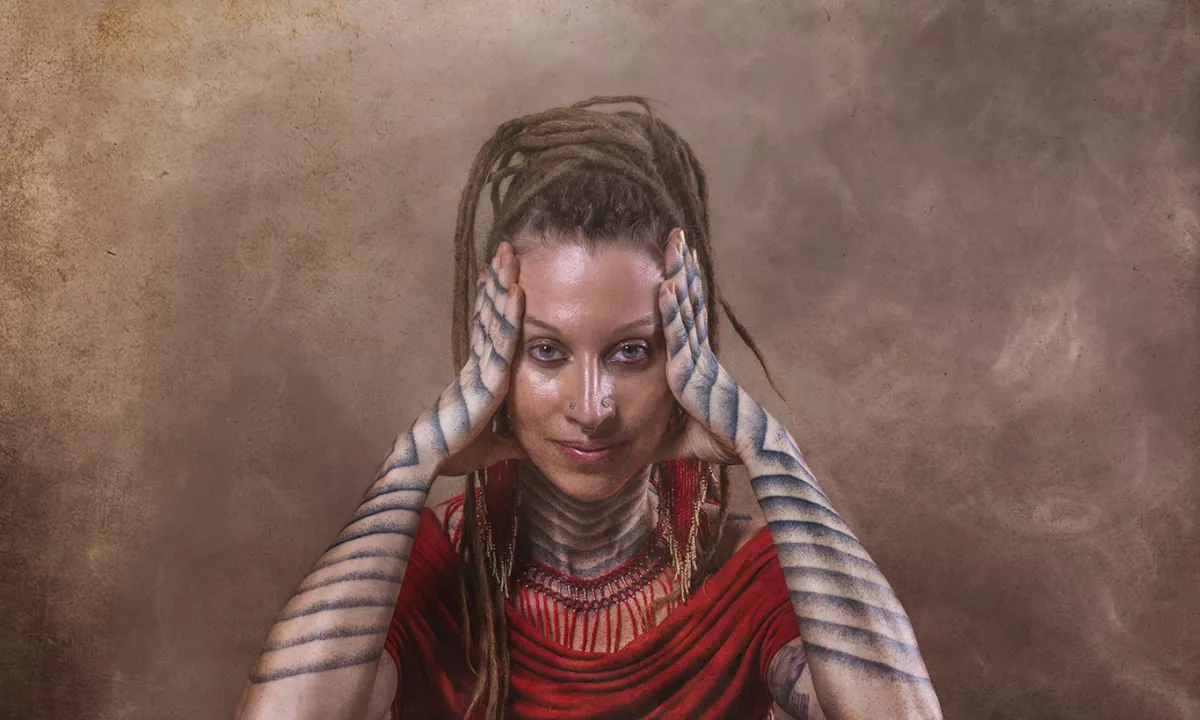
He’s in Mexico Sanya Youalliwho grew up in the Zasava village of Kisovec and spent her student years on the Coast, arrived just over 24 years ago. At first she planned to return to India to deepen her spiritual search, but at the request of a friend, she traveled with her to Mexico for a month. Although her plan was to continue on her way to Peru, circumstances, which she sees as part of fate, led her to stay in Mexico. “When I came to Mexico, I met people who are deeply connected to the Aztec tradition here, which is otherwise very rare, because in modern times only about 10 percent of the population is connected to this heritage. But on my way there were people performing temazcal (ritual Aztec sauna) and traditional dances. I also met a woman who runs a school for children where she teaches Nahuatl (Aztec language) and various pre-Columbian games,” said the interviewee about her Mexican beginnings.
The rich cultural heritage of this land, from the Olmecs, Aztecs, Totonacs to the Mayans and other peoples, completely overwhelmed her. “I have always been attracted to ancient civilizations, tribes and their traditions. It fascinated me that some were still alive, while most of them had already disappeared in the old world.”
In Mexico, she became involved in various cultural projects related to the local heritage, and a year after her arrival, her personal project became tattooing. “I’ve been tattooing with an electromagnetic machine for a few months, but I’ve never been satisfied with its performance. The instability, noise and vibration it emitted caused pain in my arm. This further encouraged me to search for the roots that have always attracted me strongly: ancient tools and techniques.”
In search of this information, she traveled several times to the Mexican metropolis, where she met with local creators. She always got the same answer from them, that the ancient techniques of tattooing in Mexico had disappeared over a century ago and that there was no indigenous group to preserve them. There were no sources available, maybe just some small photo in a magazine. This prompted her to start creating her own tools as she imagined them.
“When I created my first tools, a friend, an anthropologist, appeared very soon, who wanted a sacrificial ritual with tattoos, as practiced by the ancestors. I suggested that we do this in a quiet environment surrounded by nature and that we start with temazcal for cleansing. I didn’t think about what technique I would use; the whole process developed very spontaneously. My practice, however, went much better than the first experience with a hair straightener. I felt like I was doing it before and I was very excited, full of energy, I couldn’t sleep almost all night. I received a message that it was about reviving ancient tattooing techniques and that I should always do it ritually, just like I have done since day one,” explained Sanya Youalli, adding that this is how she started reviving ancient tattooing in Mexico.

Today, after years of research, she has extensive documentation that supports her practice, and she also lectures and educates about the history of tattooing. Each tattoo he creates is done with a purpose and represents an individual’s life transition. It is performed ritually, using copal, the Mayan sacred incense. He tattoos exclusively with charcoal-based black ink.
Sounds and smells of nature
In Mexico, the Slovenian woman has been living on the edge of the jungle for a long time, not far from the Mayan archaeological park of Palenqueaha. “Unfortunately, only about 20 percent of the jungle remains intact in Chiapas,” said the interviewee, who listens and observes monkeys, toucans, parrots, snakes and many insects every day from her home. The jungle orchestra never stops.
Compared to Costa Rica, where during our conversation with her husband she was visiting his native country, nature in Mexico is in much greater danger, according to her. “Mexico is growing and developing rapidly. It’s amazing how many changes, and worrying ones, I’ve seen in 24 years. When I came to Palenque, 30,000 to 35,000 people lived there, today there are around 140,000. In the beginning, I walked through the jungle and explored it, which is no longer possible today, as most areas have been privatized and cut down. Only the area around the archaeological site has been preserved, which is protected, while the rest of the jungle is being cleared for the construction of hotels and houses.”
With the changes in society, which are reflected in the space, the indigenous villages have also changed significantly. The Slovene has many friends in them, and when she met them, many of them lived very aloof. “I have some friends of my generation, born in 1979, who grew up in villages with no road connections.” While, she continued, recently on her way to one of the villages where one of the last guardians of the indigenous heritage lives, to which she drove four or five hours along a dirt road, she came across a truck full of Coca-Cola. “Globalization is amazing. With it, we are losing the knowledge that the elders still have, but the younger generations don’t even want to speak their indigenous language anymore, let alone be interested in preserving the tradition,” she described the world that is disappearing.
In various local communities – among which she also visited Zapatista villages, autonomous communities with Mayan roots – she was always welcomed with open arms. “There is a genuine and pure spirit,” said Sanya Youalli.
Attitude towards nature
In ancient Mexican cultures, the spiritual and ethical attitude towards nature is particularly close to it. “It’s about worshiping her: being grateful for everything that surrounds us and asking for permission before, say, we enter the jungle or cut a plant. This was once a part of many, if not almost all, cultures, but this attitude has been lost and many things have become taken for granted. A conscious attitude towards everything is close to me. We must realize that we are only here for a short time and that many things that we find in stores today are placed before us as if on a golden platter. Most people don’t ask where they come from and who grew or made them,” says Sanya Youalli, who sews most of her own clothes, grows some of her own food, and buys the rest from local organic farmers.
In a house in the middle of the tropical wilderness, equipped with all the necessary infrastructure, he rarely turns to the computer screen. “I have a live National Geographic program here every day. I can’t say that I never watch a movie, but I use the computer mainly for research and work. Otherwise, I prefer to be in harmony with nature and compose songs, sing, play guitar and flute, and paint.”