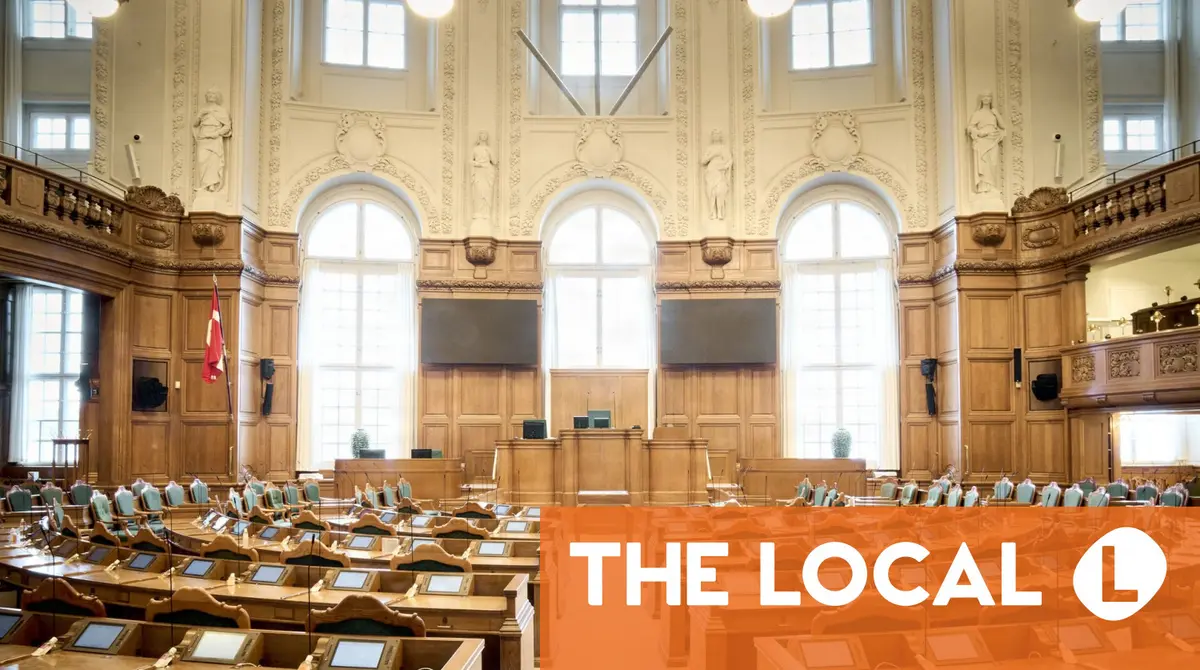
Denmark went to the polls on March 24th, and 175 new members of parliament have been elected (or re-elected, in many cases), plus four for Greenland and the Faroes. What do we know about the new parliament?
More women than ever before
A record number of women were elected in March, with 86 new female MPs set to enter parliament. That means that 48 percent of Denmark’s new parliament is female.
That’s also a five percent increase on 2022, where 43 percent of MPs were female. In 2011, when the country saw its first female prime minister, Helle Thorning-Schmidt, that figure was just 39 percent. The number of women in parliament dropped to 37 percent in 2015 but has been slowly rising ever since.
Denmark’s youngest parliament ever
The average age of Denmark’s new MPs is also lower than ever before, falling to 43.9 from 45.7 last election. Many of the new batch of MPs pulling down the average age are women, according to public broadcaster DR, who reported the average age of Denmark’s female MPs at a lower 41.5 years.
The youngest MP in the new parliament is Sofie Therese Svendsen, 23 years old, who was elected for the Conservatives. She told DR that she was “very proud”.
“I’m humbled to represent a group which is often underrepresented,” she told the broadcaster, referring to her age.
She is not the youngest MP ever to be elected – that was Karina Sørensen who was elected for the Danish People’s Party in 2001 at the age of 19 years, 7 months and 2 days.
Advertising
Record bad election for traditional parties
The Danish parliament’s two traditional rival parties, the Social Democrats and the Liberals, both had historically bad election results.
The Social Democrats had their worst result since 1901, where they received just 17.1 percent of the vote compared to the 21.8 they received this time around, while the Liberals also had their worst result in decades. They got 10.1 percent in 2026, which is even worse than in 1987, where they got 10.5 percent, their previous-worst election performance in recent history.
The 2026 election was also an unusually fragmented one. It is the first since 1903 where no party has achieved more than 25 percent of the vote, and the only since 1990 where only one party has had more than 20 percent of the vote.
Many of the smaller parties, like the Green Left (SF), Liberal Alliance, Danish People’s Party, Conservatives, Red-Green Alliance and the Social Liberals, saw their vote share increase, while the three government parties ‒ the Social Democrats, Liberals and Moderates ‒ all lost voter share since 2022.
Who is the longest-sitting MP in parliament?
Pia Kjærsgaard, who founded the Danish People’s Party, has been the longest-serving MP in parliament for years. She entered parliament on January 1st, 1984 and at the time of the 2026 election had been an MP for 42 years.
Kjærsgaard did not stand in the 2026 election. Number two on the list was held jointly by Hans Christian Schmidt, from the Liberals, and Lars Løkke Rasmussen, from the Moderates.
Schmidt did not stand in 2026, meaning that Løkke is now parliament’s longest sitting MP, entering parliament on September 9th, 1994. At the time of the 2026 election he had been serving as an MP for 31 years and 6 months.
The longest-sitting female MP is Mette Frederiksen, outgoing prime minister and leader of the Social Democrats, who has been in parliament since September 2001.
Advertising
Who got the most personal votes?
Voters in the Danish election can choose to either vote for a party more generally or place a vote for a specific candidate, also known as a personal vote.
The MP who received the most personal votes was Morten Messerschmidt, leader of the far-right Danish People’s Party. He got 50,819 votes, which was far better than the 6,722 he received in 2022.
Next up was Mette Frederiksen, who got 41,721 personal votes, which was a substantial drop from the 60,837 she received in 2022.
In third place was Alex Vansplagh, leader of the Liberal Alliance, with 38,487 personal votes.
The record for most personal votes in any election is held by Messerschmidt, who received more than 465,000 personal votes in the EU election in 2014.
The MP with the fewest personal votes to be elected in 2026 is also from the Danish People’s Party – Jan Herskov, who stood in the Zealand constituency, received just 460 personal votes, taking the party’s fourth seat in that constituency.
The party leader with the fewest personal votes is Lars Boje Mathiesen, from the Citizens’ Party, with just 8,408. His party is the smallest in parliament, just scraping over the 2 percent threshold at 2.1 percent.