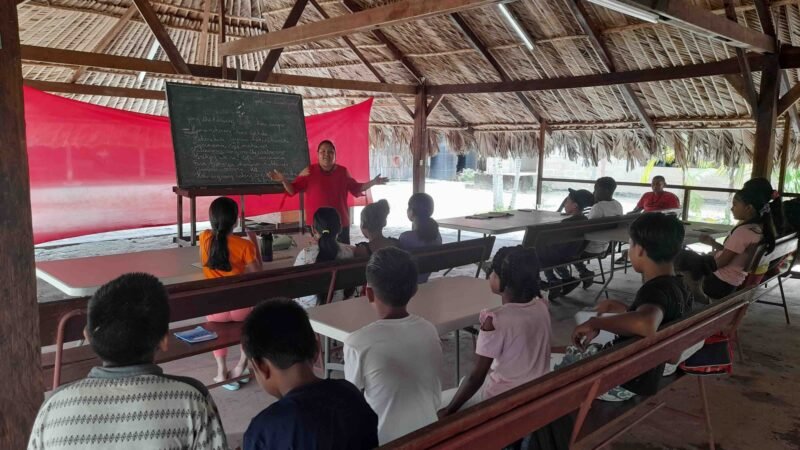
I did not miss a call for a workshop to learn the language of the indigenous Kari’na, also known as the Caribbean. I registered quickly and arrived at class on time. I don’t really know anything about the indigenous language or individual words, although I am indigenous on my mother’s side. So for me this was an opportunity to learn a little more about my people.
Text and image Kevin Headley
Many young people participate, including from the Social-Cultural Association Paremuru. Charles Maleko, one of the course leaders, is happy that young people want to engage with the language. “The groups in Suriname have different dialects. In South America, the different groups also speak different dialects,” Maleko tells the True Time. According to it bassline report on the situation of indigenous peoples in Suriname of 2020 from the Association of Indigenous Village Heads (Vids) in Suriname, the four most well-known and largest groups in number are the Kari’na, the Lokono or Arowaks, the Trio and the Wayana.
“If we don’t capture this knowledge now, it will disappear with the elderly”
Harriette Peaceful
Maleko points out the challenges of speaking the language well. The Kari’na language is influenced by the native languages spoken in Suriname, including Dutch and Sranan. There is also tension between the scientific approach and the Indigenous way of thinking: pronunciation and writing do not always match. For example, the letter ‘d’ does not officially occur in Kari’na, but can sometimes be heard in the pronunciation.
Language is dying
The language, the weaving of fibers to make huts and hammocks and the music: indigenous heritage is special, but it is threatened because the elderly die with their knowledge and many young people have little interest in it. This gap is increasing due to the many temptations, such as social media.
It is important to safeguard indigenous heritage through research, recording and sharing. However, the challenges are the lack of money and capable people to make this happen. This is a struggle that is also part of the recognition of land rights, because indigenous heritage is strongly linked to the habitat. The lands that indigenous people have inherited from their ancestors and, they say, borrow from their children.
“We distinguish tangible and intangible indigenous heritage,” says Lloyd Read, chairman of the Indigenous Collective Suriname and village head of Pierre Kondre Kumbasi. the True Time. “For the camps of the indigenous people, the wickerwork with which they build their huts, with materials from nature, such as rope made from plant fibers, requires an enormous amount of knowledge. Huts are built without planks, nails or concrete. That is material heritage.”
Intangible heritage includes language, spirituality and knowledge of nature, Read explains. “There was a time when we had a lot of knowledge about the plants and trees in the forest. Much of it was passed on orally and not written down. That knowledge is now much less due to the death of the elderly.”
Restrictions, such as the obligation to speak Dutch at school, have led to a gradual decline of indigenous languages, especially in the coastal plain. In the vast majority of villages there, the language is disappearing.
“The Lokono Diai language is slowly disappearing in the coastal plain,” says indigenous activist Sharmaine Artist. “My research in Powakka shows that mainly older people over the age of seventy still speak and understand the Lokono Diai. Young people often understand the language, but no longer speak it. The only village where the indigenous language is still well spoken is Galibi. There they still speak a lot of Kari’na with their young people and they try to preserve that language. In Bigi Poika, efforts are also being made in that direction.”
In the villages in the south of Suriname, on the other hand, indigenous languages are still widely spoken. According to Artist, language lessons are being introduced into the school system in Matta to teach young people the language. The elderly of the village also provide language lessons to the young people.
Recording indigenous heritage is a necessity
As a culture bearer, Harriëtte Vreedzaam considers it her responsibility to preserve knowledge. She grew up in an environment where traditions and customs were self-evident, but later noticed how quickly that knowledge can come under pressure. That experience forms the basis of her commitment: recording, protecting and passing on what is in danger of disappearing. “The land belongs to our ancestors. There are rules for how we treat it and they have been passed down orally for generations.” For example, for certain actions, the entire village must be asked for permission.
Vreedzaam also worked on the exhibition ‘The Penard brothers in the spotlight’ that opened last year in the Surinamese Museum. The exhibition highlights the cultural heritage of the Kari’na, which was documented decades ago by the Penard brothers and is preserved in the Wereldmuseum Leiden (then the Museum of Ethnology in Leiden).
What Vreedzaam captures goes further than just traditions: it is knowledge about how people, community and nature remain in balance. She documents, among other things, traditional rules regarding land use, such as when a piece of forest may or may not be cut down and who decides about this.
She also records rituals, storytelling traditions and social agreements within the village. She also collects stories from elderly people about how people lived, worked and governed in the past. “If we do not record this knowledge now, it will disappear with the elderly,” Vreedzaam warns. This means that not only cultural heritage will be lost, but also a way of thinking and living that was in balance with nature for generations.
Initiatives such as language workshops, language lessons and exhibitions ensure that knowledge about the different elements of indigenous heritage is shared. On the one hand, understanding is created for the culture of the indigenous people, on the other hand, they become more visible in society. What started as a workshop grew into a realization: ‘the question is not whether indigenous heritage will disappear, but how quickly’, unless action is taken now.