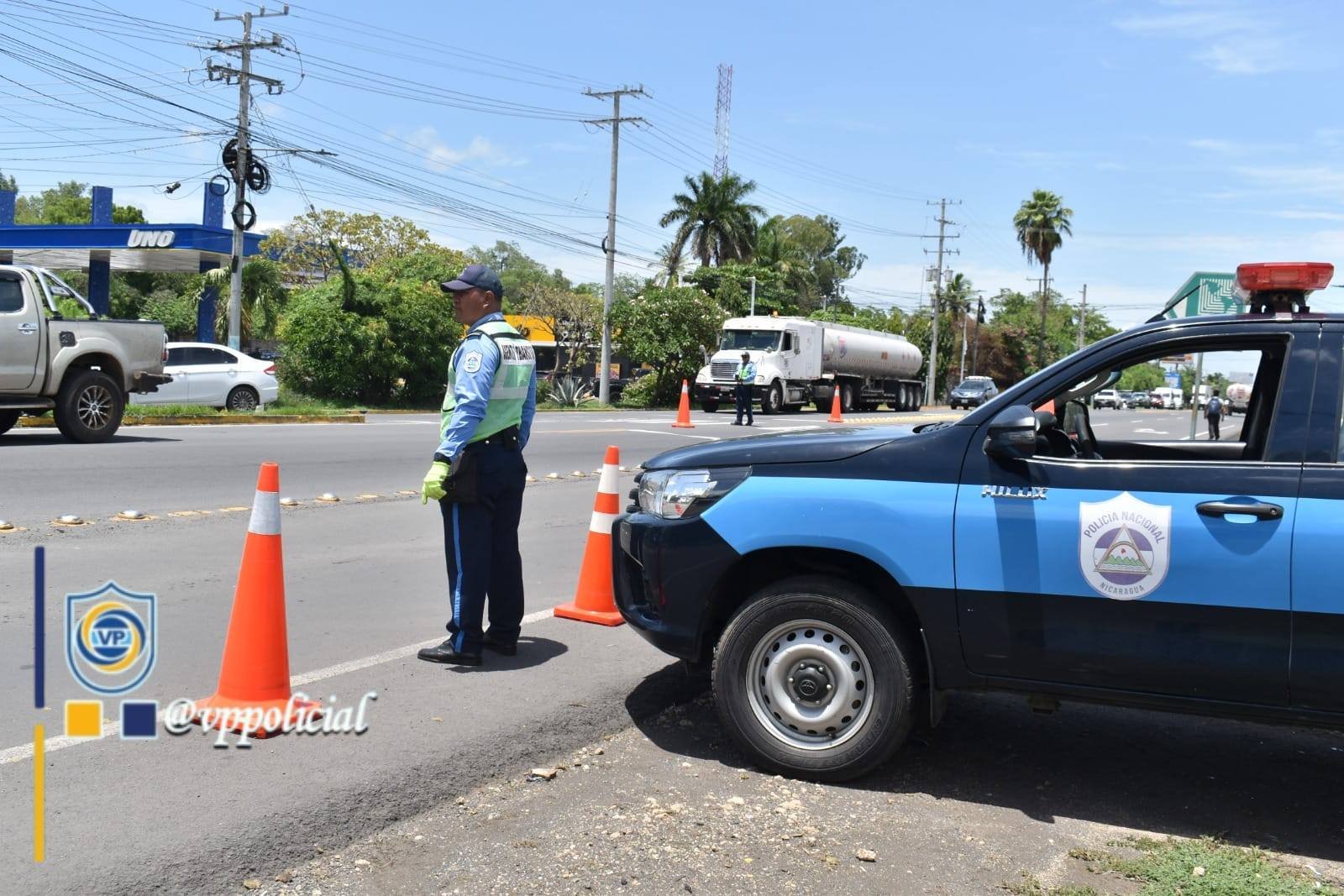
The recently concluded Holy Week left a balance of 21 deaths in traffic accidents in Nicaragua, according to a report from the National Police. The figure represents an increase compared to the Greater Week of 2025, when there were 15 dead on the tracksaccording to data reported that year.
Holy Week in 2026 was the first to be experienced with the speed limit of 50 kilometers per hour (km/h)a measure that the dictatorship imposed in June 2025 to supposedly reduce deaths on the roads.
Despite the measure, the Police recognize in their report that “excess speed” was the main cause of traffic accidents with fatalities, with nine cases recorded. This is followed by drunk driving (five), lane invasion (three), failure to keep distance (two), cutting off (one) and lack of skill (one).
Of the total victims, 15 were motorcycle drivers, three were passengers—one of a minibus, one of a motorcycle, and one of a truck—and three were pedestrians.
Dead in Matagalpa and Managua
According to the official media, accidents with fatalities were recorded in: Matagalpa (six), Managua (six), Jinotega (three), León (two), Estelí (two), Carazo (one), Madriz (one), Granada (one) and Rivas (one).
An analysis of the data reveals that Excessive speed is not the main cause of accidents that occurred in Nicaragua during Holy Week. The causes of the accidents in this period were:
- Hit: Four
- Loss of control: Four
- Driving while intoxicated: Four
- Speeding: Two
- Frontal collision: Two
- Lane invasion: Two
- Rear-end collision: One
- Bad maneuver: One
- Mechanical failures: One
- Overturn: One
- Advantage: One
Motorcycles were involved in the most fatal accidents with 14 collisions.
Did the heavy hand fail?
The general commissioner, Fernando Borge, of the co-headquarters of the National Police of Managua during the presentation of the summer plan, stated that the institution had “sufficient radars to guarantee compliance” with the measure, which also established a maximum of 40 km/h for motorcycles.
A security expert, who spoke anonymously, told CONFIDENCIAL that the strategy of lowering the speed limit is to “have legal and legitimate arguments for higher fines.”
The National Police mobilized 13,000 agents nationwide and monitored 19 stretches of highway with the highest incidence of deaths and injuries. During the launch of the plan prior to Holy Week, The authorities promised a “strong hand” and fines to all drivers.
Although there was police deployment and stricter controls were established, the number of deaths remained at similar levels to previous years, which suggests the limited effectiveness of the restrictions to prevent accidents.
The “road deaths” in 2026 are similar to those recorded in the Holy Weeks of 2022, 2023 and 2024, when 24, 26 and 24 deaths were reported, respectively.