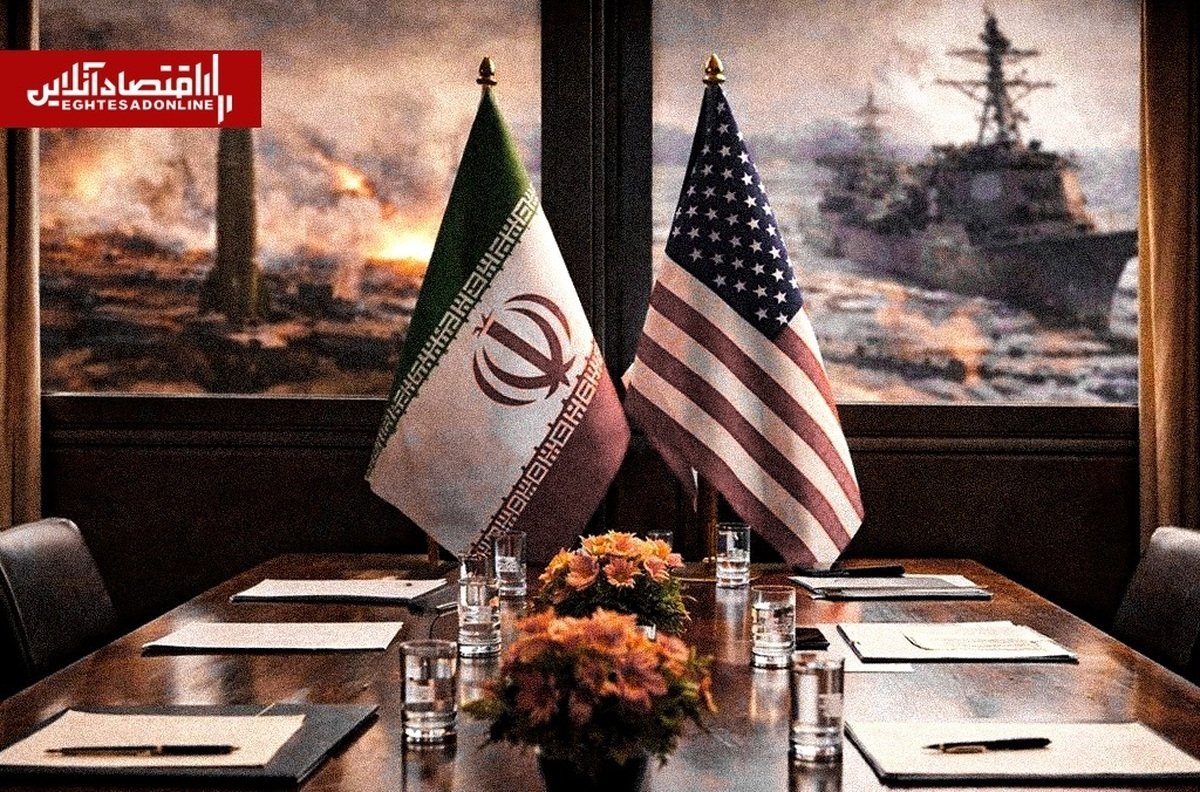
Economy Online, Amir Mohammad Hosseini: On Wednesday morning, the sky of the Persian Gulf once again witnessed the collision of missiles and drones. The exchange of fire in which the IRGC attacked Kuwait, Erbil and Bahrain in response to the attacks of the US Central Command (CENTCOM) on oil tankers linked to Iran.
Nevertheless, at the same time when alarm bells were ringing in Kuwait and Bahrain and Qeshm Island was witnessing explosions caused by American attacks, Washington and Tehran were sending different signals to the capitals.
This means that, as fire is exchanged in the middle of the ceasefire, neither side is willing to go to full-scale war, but at the same time, the ability to draw a definitive end line to the confrontation has also become difficult.
Trump’s pulses on the agreement
In the midst of these military tensions, the words of Donald Trump, the President of the United States, in a media podcast, revealed new dimensions of the puzzle of the negotiations.
By directly mentioning Ayatollah Seyed Jutabi Khamenei, Trump emphasized that he is 100% involved in the dialogue process and will issue the final decision. Trump then expressed his desire to meet with the leader of Iran. A claim that was in complete contradiction with his previous threats and claims.
Trump tried to make himself appear victorious in the negotiations by claiming that Iran initially agreed not to acquire nuclear weapons. Meanwhile, the authorities of the Islamic Republic of Iran repeatedly emphasized that in the initial understanding of the war, there is no discussion of the nuclear program and that this issue will be postponed to the next stages.
Nuclear Blind Spot and Deep Gap of Expectations
On the other hand, the statements of Marco Rubio, the US Secretary of State in the Congress, clearly reveal the fundamental difference in the views of the two sides.
Rubio talks about the possibility of an agreement in the short term, but considers Washington’s terms to be tough and conditional; From the need to immediately and unconditionally reopen the Strait of Hormuz to the removal of high-enriched uranium.
On the other hand, Tehran’s view of this deal is completely different. For the Islamic Republic of Iran, any nuclear compromise or opening in the Strait of Hormuz should be accompanied by the permanent lifting of economic sanctions, the lifting of the naval blockade and the guarantee of non-aggression.
Some analysts believe that Trump is looking for a short-term memorandum or an interim agreement to use it as a political trump card on the eve of mid-term congressional elections and international events such as the World Cup; A special strategy that leaves Washington’s hand open for new military attacks after stabilizing the political situation.
Lebanon and the conflict on the Washington-Tel Aviv front
Another of Tehran’s main preconditions is to link any ceasefire to the cessation of war on all fronts, especially in Lebanon. Iran insists that an understanding cannot be reached in the Persian Gulf while Israel’s war machine continues to advance in southern Lebanon and Beirut.
In the meantime, there are signs of disagreement between Donald Trump and Israeli Prime Minister Benjamin Netanyahu. While Trump tends to resolve the Persian Gulf and Strait of Hormuz crisis faster due to economic costs, energy crisis and oil prices. But Netanyahu sees the continuation of the state of war as vital for his political survival and may even welcome a long war with Iran. This strategic break has caused America to not be able to provide the necessary regional guarantees to Tehran, and as a result, the final decision on the memorandum will be postponed once again.
Obstacles of war; From the World Cup to the mid-term elections
Time is not going in favor of either side. On the one hand, the approaching world event of the World Cup of Football and on the other hand, the mid-term elections of the American Congress, have put pressure on Trump to restore stability to the energy market. Because the consequences of the war with Iran have included the economy of Europe and even Oceania.
The closure of the Strait of Hormuz as the world’s main oil transportation artery, although it has not yet led to the apocalyptic predictions of $400 a barrel price, but its continuation could stimulate the inflation rate in the United States. For this reason, the US foreign minister claims that no country, not even China and Russia, supports the blocking of this waterway. A claim that, of course, has many doubts, but it shows America’s need to reopen the Strait of Hormuz.
Washington is trying to put Tehran in a weak position and force it to accept written concessions by using the lever of naval blockade and point pressures, but Iran’s insistence on its strategic positions has turned this period into a diplomatic erosion battlefield.
Fragile understanding or stable impasse?
Trump’s one-week delay in making a decision shows that the process of development is difficult despite initial optimism. But the one-week period has passed too soon and it is not unlikely that the negotiations will continue in suspension again.
The realities on the ground show that America and its allies in the region, except Israel, do not want to enter into a new full-scale war in the Middle East, and Iran does not want to exhaust its military assets in the battle again. Especially, Iran’s economy was facing many challenges even before the war.
Therefore, the most likely scenario in the short term is to reach a fragile and temporary understanding; An incomplete ceasefire that might temporarily unlock the Strait of Hormuz and give limited access to Iranian assets would leave the core roots of the crisis, including its nuclear program, intact.
However, the current standoff could quickly give way to a larger explosion in the region if the gears of diplomacy fail under the influence of wider Israeli attacks on Lebanon or a miscalculation in the exchange of fire between CENTCOM and the IRGC. where other channels of mediation and diplomacy will simply not be able to contain it.