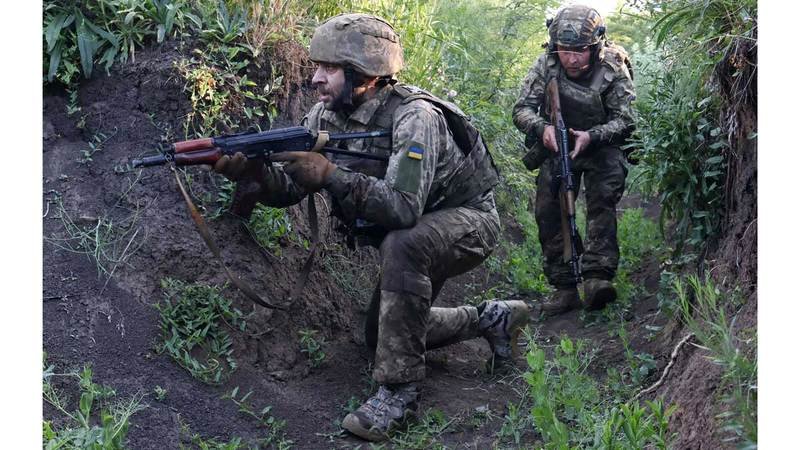
Ukraine is subjected to regular Russian bombing with hundreds of drones, in a daily display of great firepower, but the condition of the clash fronts shows, according to analysts, indications of the Russian army being exhausted after more than four years of fighting.
Recently, the pace of Russian statements about controlling areas on the contact lines has declined.
On some fronts, Ukraine is sometimes able to regain previously lost positions, and according to what the American Institute for the Study of War says, Ukraine regained control of areas from the Russian army in April and May, a first since the fall of 2023.
It is true that the Ukrainian forces’ recovery of some areas is very limited, so that it does not affect the balance of the battle, but it at least reflects the increasing difficulties facing the Russian army deep in Ukrainian territory.
Although the Russian army outnumbers its Ukrainian opponent, the constant flight of drones makes any progress costly and risky, and leads to the emergence of a “dead zone” several kilometers long around the positions of both parties.
Russian military expert, Alexander Khramchikhin, told Agence France-Presse: “The Russian army’s attack is progressing at a very slow pace,” but “it may accelerate if there is a complete depletion of Ukrainian resources.”
The Ukrainian army is considered today to be in a better position than it was a year ago, thanks to the reforms and also the focus on drones, but despite this it faces major challenges, including the human element and heavy dependence on Western support.
“The situation has stopped deteriorating for us,” Ukrainian analyst Mykola Belesko told Agence France-Presse, speaking of growth in the Ukrainian defense sector that “allows us to confront Russia effectively.”
However, the Ukrainian army does not have the resources to launch large-scale attacks, and its main goal is “to push Russia into a situation where it is forced to negotiate.”
In the absence of the possibility of launching large-scale attacks, Russia, which controls 19% of Ukrainian territory, is adopting a military plan based on infiltrating small groups of soldiers behind enemy lines, in preparation for launching an attack.
These plans succeeded in controlling several areas, but they require many months to achieve results.
Russian President Vladimir Putin constantly says that “Russian goals in Ukraine will be achieved, but these goals have become much lower than what was announced in 2022, as Moscow is no longer talking except about controlling Donbass, the industrial region in eastern Ukraine.”
On the other hand, the head of the Ukrainian presidential administration and former head of intelligence, Kirilo Budanov, considered in early June that it was “realistic” to expect the end of the war by next winter, and Ukraine’s goals have also diminished, as Kiev is no longer talking about returning to the 1991 borders, nor even the 2022 borders, but rather about stopping the fighting at the current lines of contact. Away from the battlefront, the two sides are exchanging blows that strike deep into the other country.
After the destruction that Russia inflicted on the Ukrainian energy network last winter, it is now threatening to launch widespread “systematic” attacks, and is carrying out daily attacks with large numbers of drones and missiles.
As for Ukraine, it regularly strikes the oil sector and other sites in Russia, and intensifies attacks on supply routes in its occupied territories, as in recent days it has struck bridges feeding the Crimean Peninsula, which Moscow annexed in 2014.
The United Nations said in a report on Monday that the war is entering a more extensive phase, because the escalation of strikes “expands the battlefield far beyond direct combat.”
She warned that this is what makes the conflict “today bloodier than ever before.”