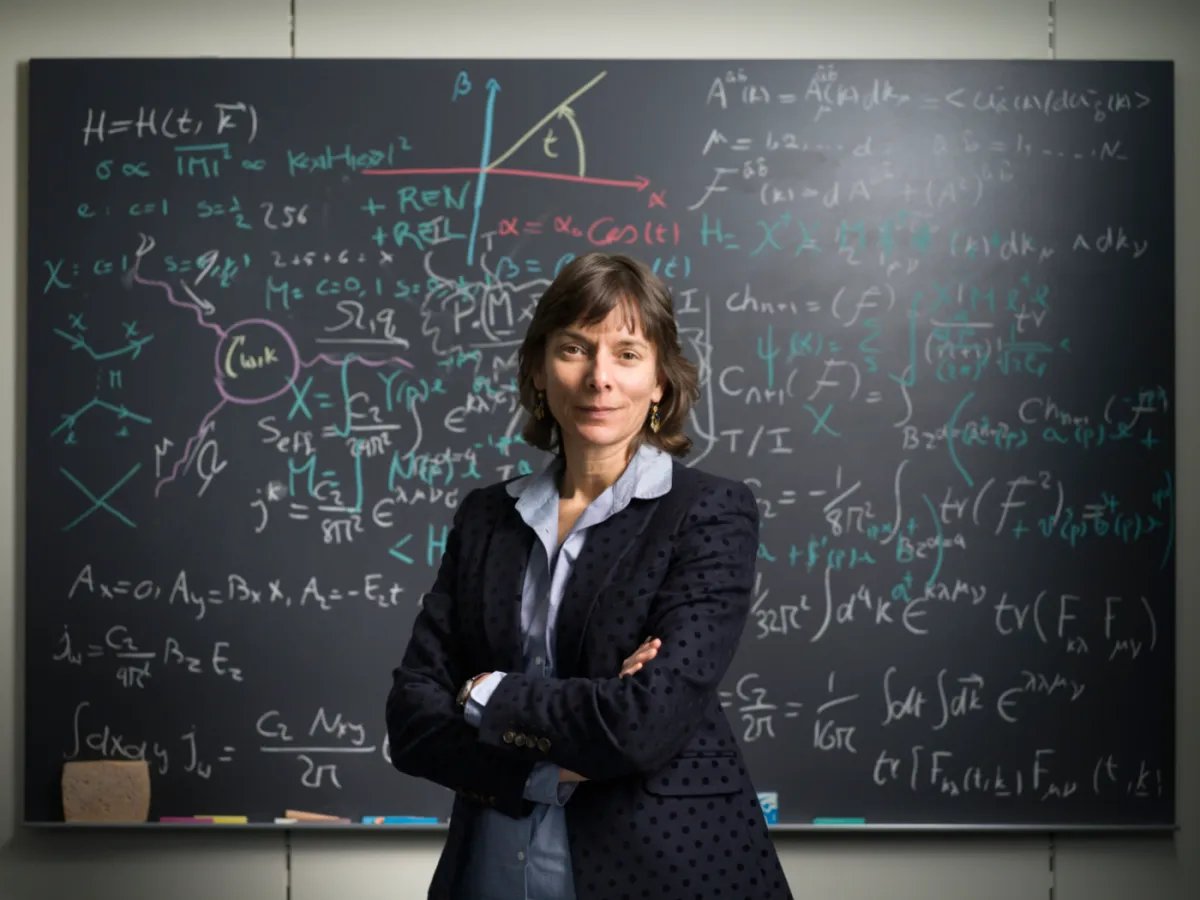

ETH researcher Nicola Spaldin is considered a favourite for the Nobel Prize
Keystone-SDA
In just over two weeks’ time, the 2026 Nobel Prizes will be announced in Stockholm. The identities of the winners remain a closely guarded secret right up until the last moment. Nevertheless, there is already a flurry of speculation. A Swiss-British researcher is also being tipped as a possible laureate.
Nicola Spaldin, a professor at the Swiss Federal Institute of Technology ETH Zurich, features on the list of researchers of Nobel Prize calibre published on Thursday by the British-American data firm Clarivate.
The names of those nominated for a Nobel Prize are, as a rule, kept secret for 50 years. No information about the committees’ deliberations are made public. The laureates are only informed immediately before the official announcements. It is therefore difficult to predict who might win a prize.
+ British researcher wins top Swiss science award
The list of Nobel Prize contenders compiled annually by Clarivate is based on the impact their work has had within the scientific community – in other words, on how often their academic articles have been cited by other scientists.
Novel materials
Clarivate considers ETH researcher Spaldin to be a potential Nobel Prize candidate in the field of physics. This is due to her theoretical work on so-called magnetoelectric multiferroics.
These are materials that can be influenced by both magnetic and electric fields. This makes them of interest for applications such as energy-efficient data storage or high-precision magnetic field sensors. Spaldin laid the theoretical foundations for this class of materials.
In total, Clarivate has included 22 researchers on its list this year. Alongside Spaldin, those named come from the US, Canada, Denmark, Israel, Japan and China.
Success rate
Since 2002, Clarivate has honoured a total of 487 researchers as so-called “Citation Laureates”. Some 89 of them went on to win a Nobel Prize. This corresponds to a success rate of around 18%. Often, several years elapsed between inclusion on the list and the award of the Nobel Prize.
Clarivate, for example, predicted the Nobel Prize for the Swiss physicists Didier Queloz and Michel Mayor – albeit six years before they received it.
More
More
The Basel researcher whose work triggered a longevity revolution
Other researchers working at Swiss universities who have not yet received a Nobel Prize were also honoured as Citation Laureates in previous years. These include the chemist Michele Parrinello (Università della Svizzera italiana and ETH Zurich), the biochemist Michael N. Hall (University of Basel), the chemist Michael Grätzel (Federal Institute of Technology Lausanne – EPFL), the economist Ernst Fehr (University of Zurich), the physicist Daniel Loss (University of Basel) and the immunologist Andrea Ablasser (EPFL).
The Nobel Prizes in the sciences will kick off on October 5 with the Nobel Prize in Medicine. This will be followed on October 6 by the announcement of the Nobel laureates in Physics, and on October 7 by those in Chemistry.
+ How we produce news in English
Translated from German, reviewed by an English Department journalist.