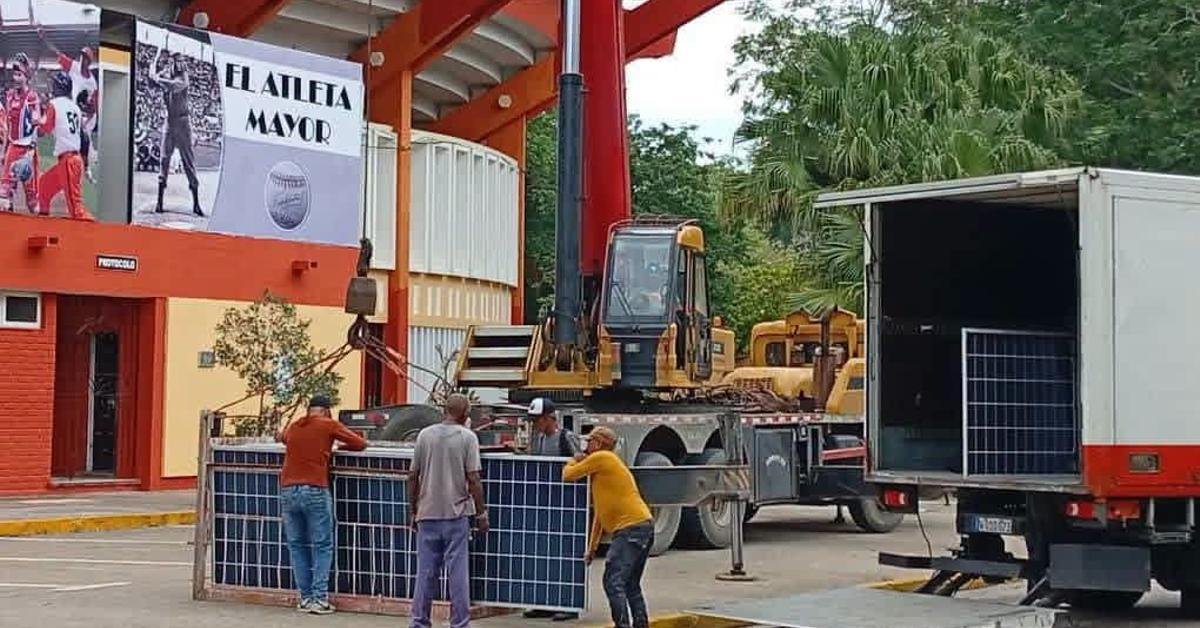
Madrid/The Augusto César Sandino baseball stadium, home of the Villa Clara Leopardos, began the assembly of solar panels for its electricity supply, in preparation for the games in the National Baseball Series, in the midst of an energy crisis that punishes the entire Island with prolonged daily blackouts.
The state facility, attached to the National Sports Institute (Inder), will host the subseries on October 14 between the Leopards of Villa Clara and the Crocodiles of Matanzas. Unlike what some users speculated in the official publication –among them, those who regretted that the resources were allocated to sports and not to health or basic services–, the meeting will not be at night: it is scheduled for two in the afternoon.
In March of this year, a coach who worked at Sandino, Fernando Carvajal Iglesias, was dismissed from his position for criticizing government leaders regarding the deterioration of the province’s sports facilities, as reported by the coach at the time. Cuban Institute for Freedom of Expression and Press (Iclep). When consulted by the organization, an Inder official stated that Carvajal had violated the code of ethics that the coaches sign and that “commits them to comply with the revolutionary principles.”
The solution sought in the stadium in the face of blackouts adds to the expansion of the use of photovoltaic systems in state facilities, which official media present as part of the so-called “energy transition.”

/ The Artemiseño
Also in Santa Clara, the Villa Clara Agroforestry Company opened La Casa del Forestal, “the first store of its kind in Cuba,” according to indicates the official announcement. Between wood and plants, the place offers “alternatives for cooking food in the face of energy contingencies, such as stoves that use sawdust and pine roots to facilitate the ignition of charcoal.”
In San Cristóbal, Artemisa, the solution at the José Martí state bakery has been to replace diesel for marabou. His workers removed the burner and built a forge that generates steam outside the furnace and conducts it inside using a fan. The center’s administrator, Damarys Trujillo Hernández, said that they arrived at that design after several tests. “The idea was to create a forge, which we could work with using firewood, but maintain the original structure of the oven, to resume its use when conditions improve regarding fuel,” said Trujillo.
The lack of flour and sugar, however, continues to limit production. As “solutions” to these “obstacles,” the administrator relates how the bakery has partnered with non-state economic actors: “Now we are partnering with a self-employed person and it could be with a MSME, to have more possibilities for raw materials that allow us to produce more, so that the population can access better bread options.”
In July, Prime Minister Manuel Marrero said that 4,292 photovoltaic systems had already been installed throughout the Island through state projects. As part of this “energy transition” the state telecommunications company Etecsa has been installing solar panels at its stations for months to keep them operational during blackouts. Díaz-Canel stated on September 24 that 25% of the radio bases already had photovoltaic systems. In Sancti Spíritus, residents of the community of Zaza del Medio They had to raise 10,000 dollars on their own to buy the radio base panels from the state company.