The change of course in Nicaragua is both political and economic. In addition to unmasking the false welfare economy, a clear response needs to be shown that reverses the delay and allows progress towards progress through long-term solutions.
The growth of the economy in 2026, a question of consumption
In the popular voice, and among micro-entrepreneurs, it is said that the country sees a lot of economic activity and even that there are investments by companies in new restaurants and tourist centers.
The data shows that economic performance registers a growth of 3.3% for the first six months—that is, there is no upward change. Rather, this slight growth is fundamentally tied to two large sectors, a strong increase in exports and the continuity of sending remittances, plus a modest increase in private investment.
Despite this, what exists is an enclave economy with little reproduction of the value chain within the country, which operates in parallel to the kleptocracy, typical of State capture (which covers 15% of national income), while the urban informal sector represents more than two thirds of the workforce, without registering salary improvements.
In all of this, the underlying factor is that behavior revolves around consumption, rather than productivity, so a shift towards contraction in consumption would cause a sudden economic slowdown.
Exports grow in the face of declining employment and fewer companies in the free zone.
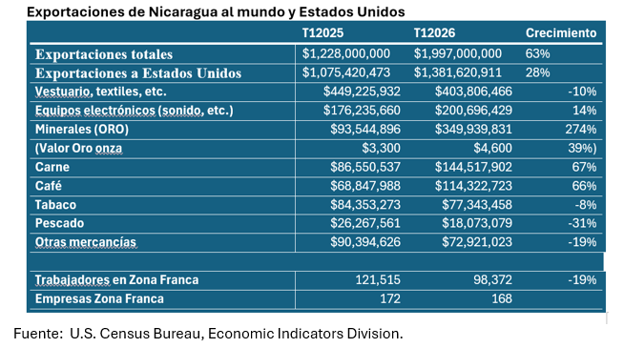
The volume of exports grew astronomically by more than 60% as a result of import demand from the United States. But the increase is attributed to gold exports, which went from $300 to $900 million between the first quarter, including the volume exported to the United States.
In fact, the share of exports to the United States rises to 65% of total exports, 15 points above the traditional trend, while maintaining a surplus even greater than that caused by the 301 investigation (imports from the United States did not grow in this period).
It is no coincidence that international sanctions have been imposed on Chinese companies involved in mining, including expansion, extortion, and confiscation of domestic and foreign assets.
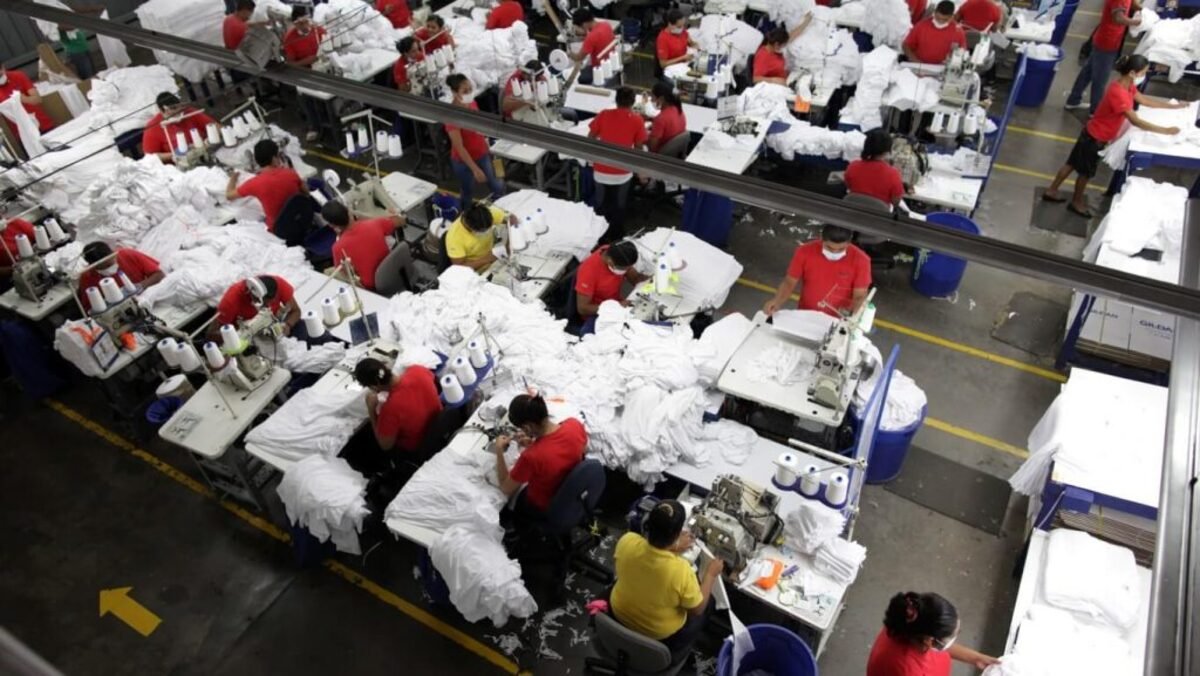
Despite this growth, the benefit is not distributed nationally or territorially. The profits from gold benefit more than 40,000 workers, but above all they significantly benefit transnational companies due to the increase in the value of gold. Meanwhile, there is a decrease in hiring in the free zone of more than 20,000 workers in two years.
Remittances continue their pace
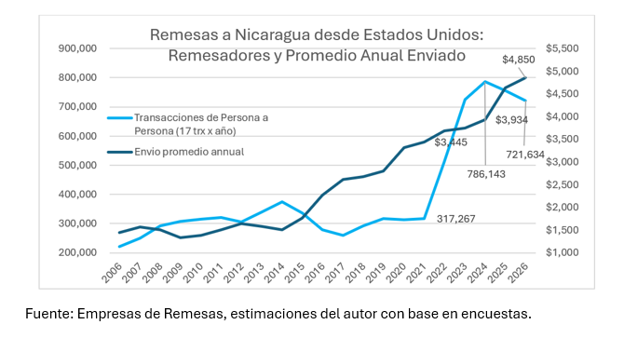
Sending money continues to grow, although at a slower rate than the previous year and with fewer migrants sending money due to deportations.
80% of remittances come from the United States, the average sent in 2026 will grow less than 10%, but it will offset the decreases in the number of people sending money, so that the total volume exceeds a little more than 10% when including the growth of Spain and Costa Rica in particular (in 2025 remittances grew 23%).
It is a fact that the Central Bank avoids making known and censors the publication of statistics on remittances, which delays the dissemination of other data. Knowing the country’s level of dependence on this influx of money puts it in trouble (when consulted, its officials act crazy).
Private investment and consumer credit
To a lesser extent, but more than public investment, which is concentrated in construction, with external financing paid by Nicaraguans in contracts with the regime’s companies, private investment also has an impact.
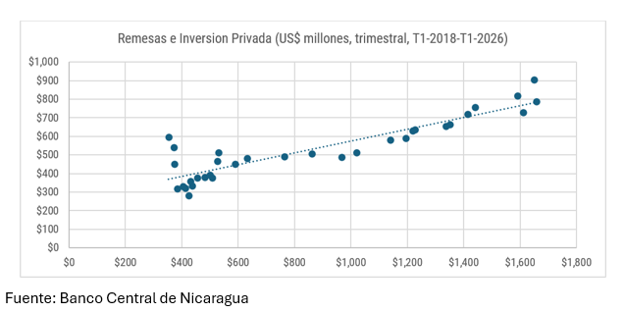
Private investment has projected the continuity of demand for food consumption and other merchandise, under the assumption that the growth of remittances is maintained.
The level of dependence of the economy on remittances is reflected in the fact that they represent 36% of private consumption this year. This orientation reduces the expectation of a strategic expansion in the productive sector and, at the same time, puts the return invested at risk in the face of possible fluctuations in money in the event of a slowdown, in addition to the return of deported migrants, which may reach 20,000 this year.
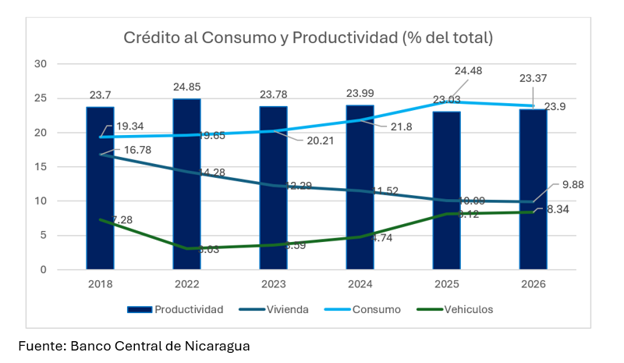
Everything is political, although it is not completely spelled out: the financial sector has increased its level of liquidity, but it is not disbursing loans in large quantities, and when it does, it bets on short-term profit: on consumer credit.
This type of credit has increased in the sale of vehicles and credit cards, but not in the productive sector. Rather, an indicator of confidence in the economy, mortgages, is not growing, falling from 17% to 10% of loans since 2018, despite the increase in savings in the country.
The waste of opportunities
In general, the growth recorded does not translate into an improvement in the economic condition of families: employment does not grow, salaries do not rise, even though exports grew and remittances keep income stable.
What happens is that the level of economic activity is fragilely sustainable in the short term thanks to remittances.
The rest really doesn’t stay in Nicaragua.
The result of these activities is that Nicaraguans continue to live day to day with an average of US$250 per month, and the money is not enough, compared to a regime that cares little about the condition of their families, but does care about making profits in a few companies.
The Ortega-Murillo clan, with Laureano at the helm, has bet on import businesses, investing in properties, some of which have been confiscated, and gold extraction with Chinese capital, but not on economic development.
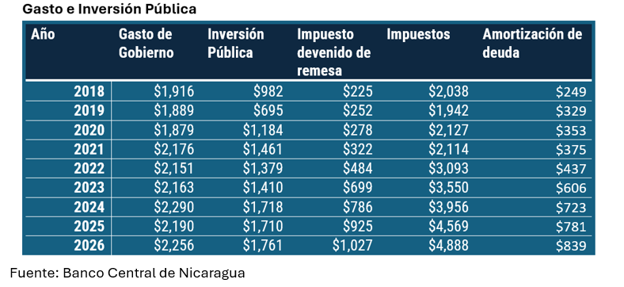
The country has collected twice as much taxes in eight years, at an annual rate of 10%, but spending has not grown more than 2% while public investment, which has been financed with 60% external debt during that period, grew 7%.
The taxes are not returned to the people, they are passed on to the clan in the circle of power.
Nicaragua has potential in its human and natural resources, which the Ortega Murillos have wasted. During all this time they have not worked to promote investment in leading sectors of the economy, or to invest in human capital.
Rather, the country is going like a crab, economically backwards, instead of investing in human capital, it imprisons it, impoverishes it, banishes it, and even kills it in prisons.
Foreign investment is a myth, because to sell KFC chickens you need to have customers with incomes greater than $500 per month who are able to spend 5% on a single family outing.
To attract tourism in a country where it has rather decreased (in the first quarter of 2026 in high season, tourism decreased by 15%), this investment does not fit, unless financial liquidity induces you to invest in properties.
The precariousness of current material conditions and the absence of a vision of economic progress are creating an even more harmful future for Nicaraguans.
It is urgent to define priorities aimed at economic development with democracy.
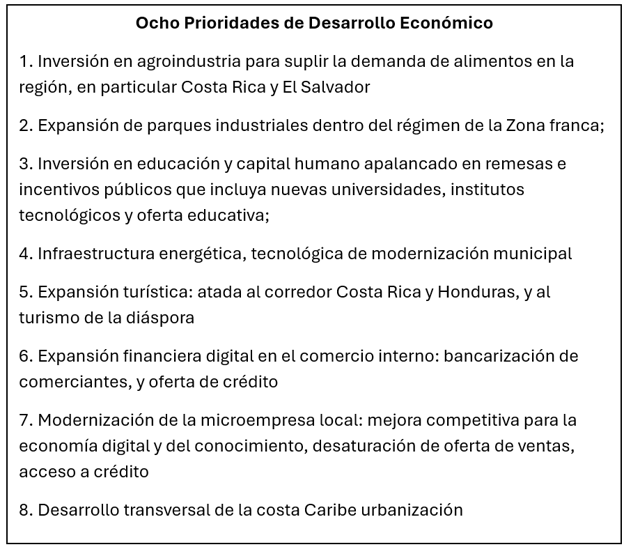
There are at least eight opportunities to lift Nicaragua up with an economic modernization plan that, in the short term, would raise per capita income equitably to more than 20% of the current level.
The Ortega-Murillo clan is not in a position to carry out actions of this type, either because their times are shortening or because their kleptocratic philosophy prevents them from doing so.
For this reason, the discussion about Nicaragua must revolve around economic modernization, regardless of the ideological disputes that remain and do not add up between groups that agree on the democratic rule of law, the free market and sustainable social inclusion.
An agenda for the reconstruction of Nicaragua must include these three pillars, and it is everyone’s responsibility to start this process today, and not postpone it until the day after the dictatorship falls from power.