Loading Text-to-Speech…
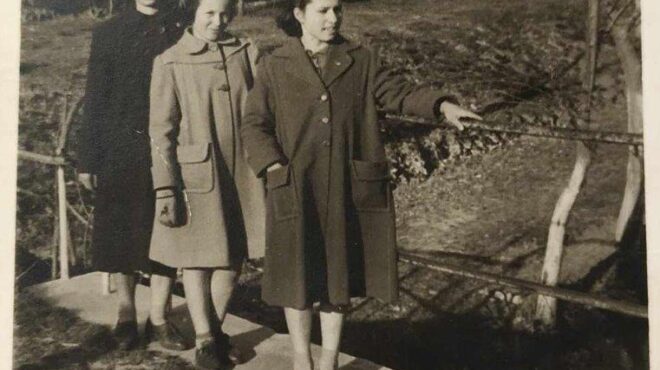
When the Ourania Kurkouta he finished primary school in 1964 in Lagorrachis, Pieria, there were no options. The High School was located in Katerini, fifteen kilometers away and the idea of renting a house in the city was unrealistic to say the least. It wasn’t just the money that wasn’t there or that a girl couldn’t stay alone in the city. It was also the movement that seemed impossible. Difficult roads, dirt roads, and the distance from the mountain village to the high school was getting even longer.
“Those were difficult times, especially for us girls,” says Ms. Kurkouta as she tells “K” about those years. “I wanted to continue school, but I couldn’t. I grew up in the village and at eighteen I left as an immigrant. I worked in a factory in Stuttgart and after four years I returned to Greece and got married.”

Another attempt to settle in Germany followed, this time with her husband. The two worked in restaurants, but after two years they returned to Lagorrachis, had children and have not left since then. All these years, however, the “dream” of student life remained alive in Urania Kurkouta’s mind.
“Always, I was missing something. Of course, I was busy raising children and grandchildren, but when they became independent, I had no reason to sit around. I learned that attending the Second Chance School is a total of two years and I didn’t even think about it. I got up the next day, went to Katerini and signed up. I didn’t tell anyone,” he says.

Kurkouta returned to the desks in September 2021, at the age of 71. Last year on days like this, children and grandchildren saw her excitedly receive her high school diploma from the Second Chance School. For her, it was a moment of vindication.
“I lived two wonderful years at the desks, learning History, Geography, Mathematics. My classmates and I shared the same goals, but also wonderful memories in and out of the classroom. Now I’m looking ahead and the next step is to enroll in EPAL to learn an art. It is a decision that I feel I am now ready to make”, she emphasizes.
Their stories
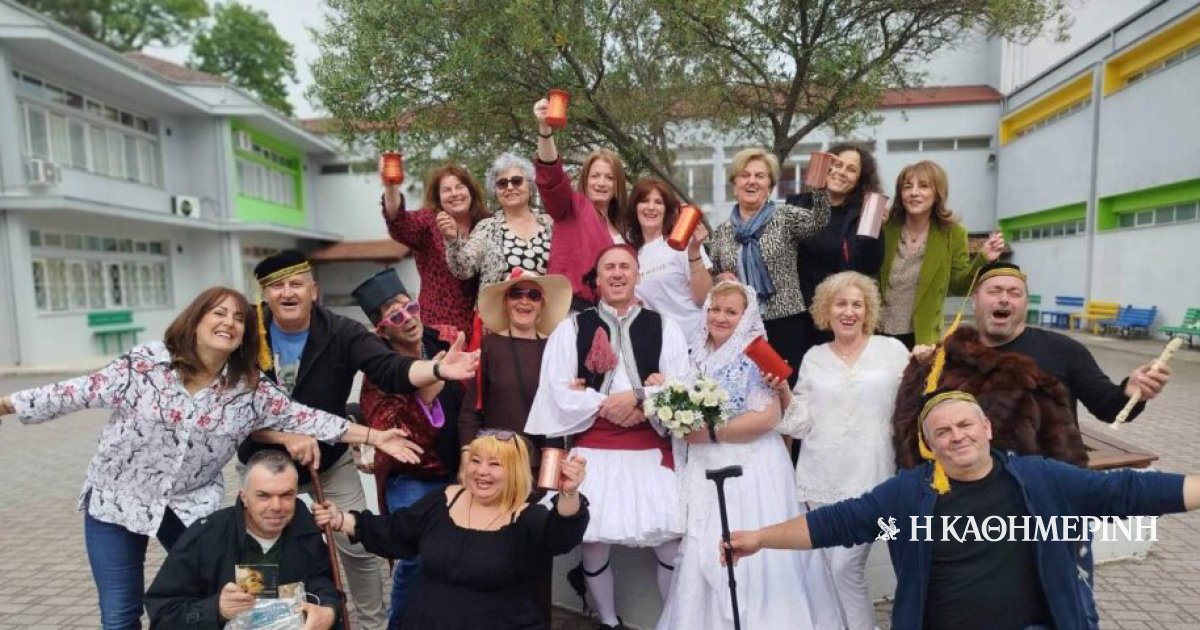
The story of Urania Kurkouta is one of those that the Chrysavgi Drista, director of the Second Chance School of Kateriniswants them to come to light. In recent years, at the graduation ceremony, it is not enough to award a degree. He asks the graduates themselves to talk in front of a camera about their journey, about what once deprived them of their high school education, but also about what returning to the desks gave them. Last year’s video, as she says, moved Pieria, but also had a wider appeal. A similar one is being prepared these days with the protagonists of this year’s graduates. “We wanted these people not to be a number or a name. We wanted to listen to them, get to know their stories and not just give them the diploma and return to their place”, says Ms. Drista to “K”.

For her and the school’s teachers, highlighting these stories is part of a larger, almost daily awareness campaign that begins each year just before the end of the school year. They go to villages, clubs, local festivals and fairs, set up stands, distribute leaflets, talk to people who often don’t know they can still complete compulsory education.
“It’s a fight we fight every year to make these schools viable. There are fellow citizens who hesitate to come either for psychological reasons or because they work and are unable to study, even though they would like to. We go everywhere, trying to reach them, with the aim of forming the two new fifteen-member first grade classes every year. This year we are fighting to close the second one”, she emphasizes.
Then the woman had to marry and start a family from an early age. At the same time, there were serious difficulties in moving from the villages to the city, so education was left behind.
And when the classes are filled, the number of female students dominates the class. Every year, according to the school director, 60-70% of the students of SDE Katerinis are women who come from the surrounding area. Their starting points differ, but often their stories are similar. “The older women who come to us usually carry the difficulties of another era,” explains Ms. Drista. “Then the woman had to marry and start a family from an early age. At the same time, there were serious difficulties in moving from the villages to the city, so education was left behind. For many of them, school could not be an option.”

She also refers to the cases of younger generations who, growing up, faced different conditions, but equally great difficulties. “It wasn’t that their parents told them to get married, have a family, but many married early by their own choice, worked in the fields or devoted themselves exclusively to raising their children. Somehow they left school in the middle and gave weight to family obligations.”

Adolescence, again
One such case is her story Katerina Zissou51 years old today, who has lived since childhood in Karitsa, Pieria. He dropped out of high school when he was still in the first grade and returned to the desks after more than three decades.
“I loved letters very much, but life brought them differently. My brother was killed when I was still in school and I had a mental breakdown. Later I was engaged and married at eighteen to give joy to my dying father. Immediately the first child came and then the other two and so I gave all my weight to the family. All these years, I had in the back of my mind to start an evening school, but I didn’t dare to do it”, Ms. Zissou tells “K”.
The only regret I have, looking back, is that I let time pass.
Her sister made the decision for her. Three years ago he enrolled in Katerin’s Second Chance School and did the same for her. “One day the director called me and there – hesitantly – I decided. The only regret I have, looking back, is that I let time pass,” he says. On the days he went to school, he had to work at the hotel at the same time, but that didn’t stop him. Within two years she managed to get her high school diploma.

“In the morning I went to work and in the afternoon to school, but there was so much help from the teachers that I didn’t feel like I was struggling anywhere. I did my lessons with great enthusiasm and went to school every day happy. It was like going through adolescence all over again, I felt like I had picked up the baton again from where I had left it,” she describes.
Since the day of graduation, her life, she says, has changed a lot. “I finally started to attend educational seminars for hotels, in which before I could not participate because I did not have a high school diploma. I now feel that I can contribute even more to my work,” she enthuses, putting behind her the days when she felt uncomfortable in her company. “I tried not to show it, but I felt at a disadvantage because all my friends had finished school or studied. When I came home I thought about it, I said “what a mistake I had made”. Today, continuing in high school as well, I feel that I have closed an open account”, says Katerina Zisiou.
Mother and son at the same desks

These days, among those graduating from Katerinis Secondary School is Konstantina Tagdalidou49 years old. For her, education took a backseat to her High School years, when work entered her life early. She lived with her family at the time in Ampelokipi, Thessaloniki. “I reached the third year of high school, but the lessons seemed difficult to me and I couldn’t attend them. So I decided to go to work. When I turned fifteen, I started working in a clothing factory”, he tells “K”.
That decision, which seemed natural at the time, followed her for decades. Daily obligations at home left no room for second thoughts, while school slowly became a backlog left open. The return to the desks came many years later, when she moved with her family to Katerini and learned about the Second Chance School. As she says, in these two years, she came face to face with the fears she had been carrying since her student days. And he surpassed them.

“When I was a child I thought I didn’t get the letters. Going back to school I realized that I could. I just needed different time, different support and more faith in myself,” she says. Today, having now completed her studies, she plans the next step. From September, he intends to continue at EPAL, in a situation he could never have imagined.
“My youngest son will attend the same school with me, he is also a student of the first Lyceum. He will go in the morning, while I go in the afternoon. I joke with him and tell him that we will help each other in the lessons and he laughs”, says Mrs. Tagdalidou, adding that her eldest son, who has just finished the second high school, is already studying at the same school. As for how she sees her future after school, this, as she clarifies, is not yet something that concerns her. “It’s a decision I made for myself. I don’t know which specialty I will choose or if I will find a job tomorrow or the day after. I’ll continue school and whatever comes up.”
Thrill and excitement
Behind the desks of the Second Chance School there are also cases like that of Giorgos Antoniou who is graduating this year, at the age of 53. He had dropped out of high school because, he says, of a teacher’s behavior, and despite his father’s efforts, he refused to return. In the years that passed he worked hard, got married and became the reason for his wife to enter a schoolroom again.
“We had visited an exhibition and her eye caught the applications for the Katerinis SDE. Without telling me anything, she filled out the application for me herself,” says Mr. Antoniou and describes how he felt the first time in class.

“I went to school and although the first two days I felt hesitant, even ashamed, from the third day the feelings changed. I came home excited and told my wife, in no uncertain terms, that I wouldn’t miss a day of school.”
Today, Antoniou works as a private employee and is now waiting to take exams for a diploma that he was previously not allowed to get without a high school diploma. He even states that he is proud of his wife for leading him to a decision that he would never have made on his own. “When I think about it, I feel like crying. I did it with all my heart and I would do it again,” he concludes.