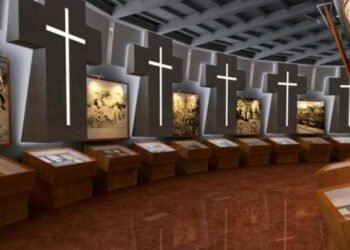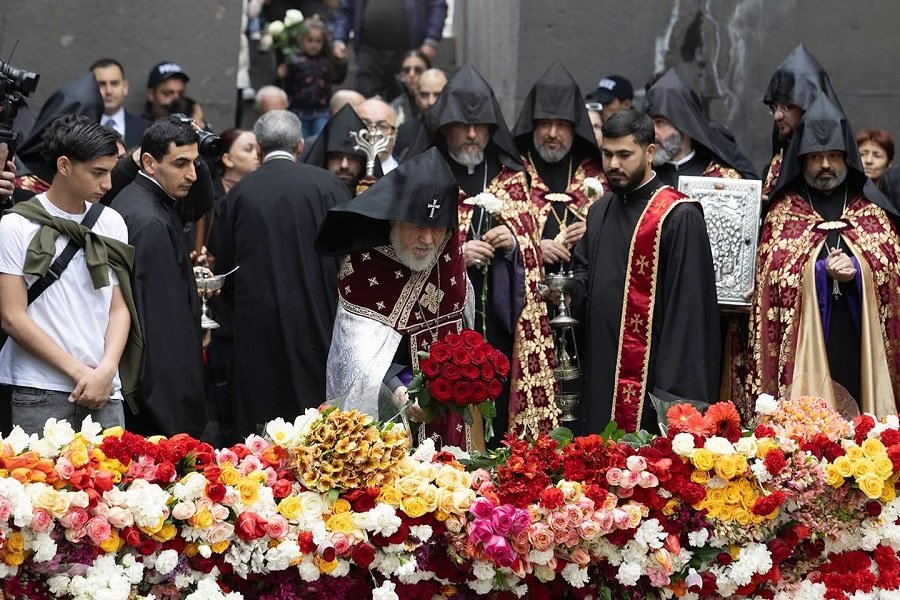
On April 24, at the height of Tsitsernakaberd, journalistic questions addressed to the Catholicos of All Armenians targeted the future of the Church and the tension in relations with the authorities.
“Your Holiness, how are you going to face the anti-church campaign?” In response to these and similar questions, His Holiness uttered a short but powerful statement: “Don’t disrupt the day’s council and our feelings.” Although the audience and the media might have expected sharp political statements, the response of the Armenian Patriarch had a much deeper address.
April 24 is a holy place of remembrance of canonized martyrs and spiritual rebirth, where every word will be called a prayer and every step will be incense. What many may perceive as an evasive stance was actually a display of spiritual endurance.
Gennady Mnatsakanyan
St. Jovhan Voskeberan teaches: “Silence is better than words when the other person is not ready to hear the truth or is looking for an opportunity to distort your words.” Essentially, urging to remain in the council of the day, His Holiness did not allow the speech of the Spiritual Leader to turn into a news show or a tool of political manipulation.
Biblical wisdom says: “There is a time for everything…a time to be silent and a time to speak” (Ecclesiastes 3:1-7). April 24 is a moment of prayer and fasting. The patriarchal attitude was a reminder that there are sacred moments when the human language is silent so that the soul can speak. This is not fear, but awe for the memory of the martyrs. the same feeling that surrounds us in Erablur.
The mission of the Patriarch of All Armenians is unification, so he cannot descend to the level of street protests. By answering provocative questions in political terms, he would become one of the parties, while he is the father of all Armenians. As St. Gregory of Tateva describes, it is appropriate for a spiritual leader to be a peacemaker and to stay away from crowd-pleasing behavior. It has long been obvious that the policy adopted by the RA authorities is worrisome and controversial from the point of view of church regulations, and in the background of all this, the reserved position of His Holiness the Patriarch testifies to Christian steadfastness. This is the silence with which Christ answered Pilate, showing the majesty of truth before earthly judges. His Holiness’ attitude in Tsitsernakaberd was an expression of not degrading the Papal Throne and national dignity. The Armenian Church faced centuries-old trials not with noise, but with unshakable faith.
“Do not disturb the counsel of the day and our feelings” The papal admonition was the best answer to those who try to bring division into our national-ecclesiastical life.
Gennady Mnatsakanian
According to the “Copyright and Related Rights” Law, the reproduction of extracts from news materials should not reveal the essential part of the news material. When reproducing excerpts from news materials on the website, it is mandatory to indicate the name of the media outlet in the title of the excerpt, and it is also mandatory to insert an active link to the website.