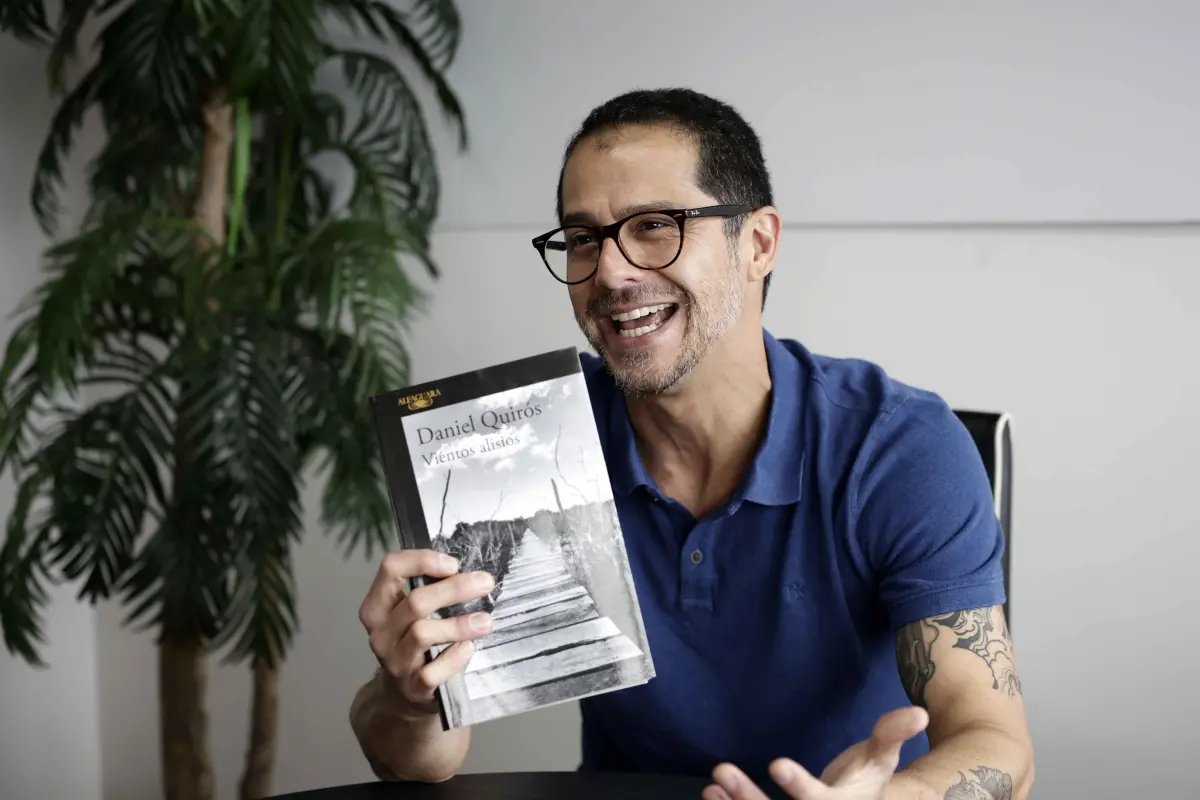
The Costa Rican writer Daniel Quirós highlighted the importance of reflecting through fiction, in works such as his new book ‘Trade Winds’, contemporary Costa Rica characterized by its green and tourist image, but which also faces social and economic problems such as gentrification, drug trafficking and environmental damage.
“It is very important that we begin to see ourselves in literature, in fiction, that there is fiction that represents a contemporary Costa Rica that connects with the problems of the people, with the country that people are seeing. Literature allows that,” declared Quirós (San José, 1979) in an interview with EFE.
Quirós recently launched the novel ‘Trade Winds’, in which he exposes the country’s social problems in the setting of the province of Guanacaste (Pacific), a place rich in biodiversity, natural resources and beaches, which is one of the tourist centers of Costa Rica where everything from small hotels to large five-star chains are located.
It is a crime novel that tells the story of the disappearance of biologist Jaime Morales while carrying out an environmental study in an estuary, whose connection with the sea had been destroyed in the midst of luxury tourist developments.
Don Chepe, an informal researcher, is hired to look for the biologist and as his work progresses he discovers tensions between the locals and mass tourism, gentrification and large tourist developments, but drug trafficking also appears as a key factor, which in recent years has become the main security problem in Costa Rica.
“What literature achieves is a type of reflection of what is happening socially. I see it as this metaphor, I don’t know if it’s corny, of the mirror. What literature does is reflect ourselves to become aware of a reality that we sometimes take for granted,” he said.
Quirós added: “It is very good that we are beginning to see ourselves as a literary theme, which is something that has been missing in Costa Rica for a while, to recognize ourselves in our spaces, in our socioeconomic and cultural reality and to see ourselves reflected to begin to reflect.”
For the writer, ‘Trade Winds’ comes to “open a discussion on certain problems of contemporary Costa Rica” such as the “fragile balance” that exists in the country between tourism and economic development and the protection of the environment and fragile ecosystems.
Another aspect of the novel is the penetration of drug trafficking in Costa Rica, a country that is located in a strategic geographical position on the drug routes between South American producers and the United States market.
”Many of the things mentioned in the novel, although they are fiction, are definitely based on real events and on growing crime and real violence in Costa Rica, which not only has a component of physical violence such as homicides, but also a component of money laundering,” he expressed.
This is the third novel in a series by Daniel Quirós that includes ‘Verano Rojo’ and ‘Lluvia del Norte’, which also have the researcher Don Chepe as the protagonist.
Quirós affirms that writers always have “something up their sleeve” and that he hopes to soon finish a new “speculative fiction” novel set within a post-apocalyptic period in which most of the people in Costa Rica have disappeared and nature has taken control.