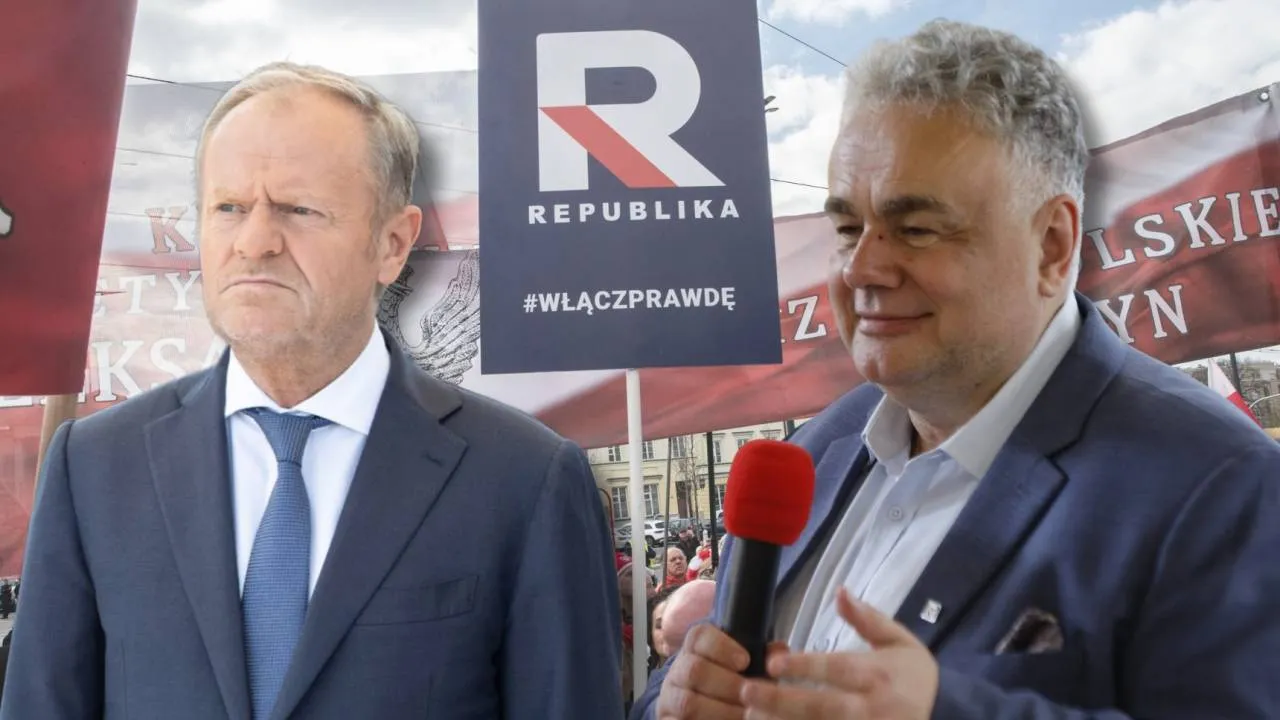
Through the Zondacrypto affair, the current ruling coalition is allegedly attempting to target the opposition and independent media, particularly TV Republika. Today, PiS politicians are speaking openly—calling it “Donald Tusk’s crypto scandal,” in which the government and state services, much like in the Amber Gold case, allegedly did nothing. Online, calculations have begun circulating, suggesting that millions flowed to TV Republika from Zondacrypto advertising. These claims were addressed by the station’s president, Tomasz Sakiewicz.
“As I understand it, since no accusation can be made that Zonda advertised exclusively with us—given the very broad scope of its campaign—haters linked to the current ruling camp are attempting to level accusations based on falsified data regarding the scale of advertising engagement,” he said.
A week ago, prosecutors launched an investigation into the cryptocurrency exchange Zondacrypto, focusing on suspected large-scale fraud and money laundering. At the time the proceedings were initiated, estimated losses amounted to at least PLN 350 million. In April, media reports indicated that the exchange might be facing liquidity issues, while users reported problems withdrawing funds.
In mid-April, Zondacrypto CEO Przemysław Kral stated that the company allegedly holds a wallet containing 4,500 bitcoins worth over $300 million. However, according to Kral, the keys to this wallet are believed to be in the possession of the missing Sylwester Suszek, founder of BitBay—the predecessor to Zondacrypto.
The ruling coalition is allegedly using the Zondacrypto case to target the opposition and independent media, particularly TV Republika.
Bocheński: Donald Tusk’s Crypto Scandal
PiS MEP Tobiasz Bocheński addressed the issue during a press conference today.
“Strangely enough, whenever Donald Tusk governs, Poles end up as victims in financial scandals. We all remember the Amber Gold scandal during his first government—a case of state inaction, of services and institutions failing to act. We remember the words of Donald Tusk’s son: ‘Father knew it was a scam.’ Today, Poles have likely lost around PLN 350 million in the Zondacrypto scandal. The government and administration were informed, they could have drawn on knowledge from Estonian services, and there were press articles about potential irregularities. Yet in this case, just like with Amber Gold, the government and services did nothing,” Bocheński said.
He recalled that PiS MPs had demanded the declassification of a Sejm session on December 5, 2025, during which Donald Tusk addressed cryptocurrency-related issues. The parliamentary majority rejected the request.
“Today we are witnessing a desperate attempt to shift this hot potato onto the opposition, even though it is Donald Tusk and his administration who are responsible for inaction—for doing nothing—for Donald Tusk’s crypto scandal,” the PiS MEP added.
In his view, the investigation into Zondacrypto began too late—only after media reports—and was initiated “in a manner that defies basic standards.”
“The prosecutor who initiated the proceedings went on vacation the very next day. Those who assigned the case failed to check that, although experienced, he could not handle it and soon recused himself because he had previously consulted with Zondacrypto employees. No one is in control of this case today, and Poles—who were not informed—along with media outlets and various organizations that benefited from Zondacrypto sponsorship funds, were also left in the dark,” Bocheński argued.
He accused Tusk’s government of passivity and incompetence, claiming that Poles are being defrauded through complex financial mechanisms.
Bocheński also referred to a government bill on the crypto-assets market. In his opinion, its provisions would have effectively made Zondacrypto—a company registered in Estonia—a monopolist, as the regulations would apply only to entities registered in Poland. He added that even if signed by the president, the law would not come into force until July 2026, meaning it would not address the current Zondacrypto situation or protect Polish citizens.
“Is this just a coincidence, or does someone in the government administration responsible for this bill lack understanding of the market? Or was it a deliberate move—was the government consciously trying to create a monopoly?” the PiS MEP asked.
PiS politicians presented five questions to Donald Tusk in connection with the Zondacrypto scandal.
Chaos in the Prosecutor’s Office
Controversies surrounding the prosecution’s handling of the case have also been reported.
The case was assigned to the Regional Prosecutor’s Office in Katowice. In February, prosecutor Marek Wełna became head of the Silesian department for organized crime within the National Prosecutor’s Office and decided to dismiss investigators working directly or indirectly on the case of the disappearance of Sylwester Suszek, founder of BitBay. The Zondacrypto case itself was initially assigned to prosecutor Sławomir Sola from Gliwice, who later filed for recusal due to prior cooperation with Zondacrypto employees.
“In an emergency procedure, prosecutor Leszek Sroka was ultimately assigned as the case handler and was urgently recalled from vacation,” we reported.
Media also reported yesterday that Prosecutor General Waldemar Żurek dismissed six prosecutors from the National Prosecutor’s Office who had been involved, among other things, in the Suszek case. The move was reportedly requested by Wełna. According to Rzeczpospolita, Wełna told the dismissed prosecutors that he had “nothing against them” but had “come to do the dirty work.” The decision was criticized by Deputy Prosecutor General for Organized Crime Beata Marczuk, and the prosecutors plan to appeal.
Ultimately, National Prosecutor Dariusz Korneluk appointed a team of three prosecutors to handle the case on Friday.
Interestingly, prosecutor Marek Wełna had previously supervised the Polnord case, in which charges were brought against Roman Giertych, now an MP from the Civic Coalition.
As revealed by Gazeta Polska Codziennie, at the end of October 2024, a document signed by Wełna was submitted to the prosecutor’s office in Lublin suggesting that the investigation against Giertych should be discontinued due to weak evidence. In January 2025, after the prosecution service came under the control of nominees of Adam Bodnar, the case against Giertych was indeed dropped.
Sakiewicz: IMM Data Has Nothing to Do with Reality
Roman Giertych has recently been among the politicians leading attacks on TV Republika in connection with Zondacrypto. As early as December 5, 2025, following a classified Sejm session, PiS MP Bartosz Kownacki claimed that “the editor-in-chief of your station is being surveilled by state services and this is being used for a brutal, primitive political game.”
“Today, the services are being used for political combat. They are not protecting citizens or ensuring security, but rather trying to destroy specific newsrooms,” Kownacki said at the time.
Giertych recently cited information circulated by the Institute of Media Monitoring, claiming that TV Republika was the largest beneficiary of Zondacrypto advertising—worth over PLN 37 million—suggesting that “Zondacrypto was effectively the owner of TV Republika” and that these funds “should be secured in the station’s accounts.” Michał Rachoń, the station’s program director, responded that Giertych was lying and that the real aim was to destroy the station.
Today, Tomasz Sakiewicz, president and editor-in-chief of TV Republika, also responded to the IMM reports:
“Data from the Institute of Media Monitoring regarding the alleged advertising budget of Zonda Crypto in TV Republika has appeared in the public space. This information has nothing to do with reality. Advertising prices and the budget are inflated roughly sevenfold (not to mention that Zonda has not paid for all advertisements), and IMM did not even attempt to verify the data it presented. Nor can their figures be justified by calculations based on rate cards for individual ads, as these do not apply to large campaigns, which are determined by order size, GRPs, and placement of spots. This is common knowledge for anyone familiar with the advertising market. Zonda advertised across many media outlets, and the prices we offered were simply more competitive. Since no accusation can be made that Zonda advertised exclusively with us, haters associated with the current ruling camp are attempting to fabricate allegations based on falsified data regarding the scale of advertising engagement,” Sakiewicz wrote.