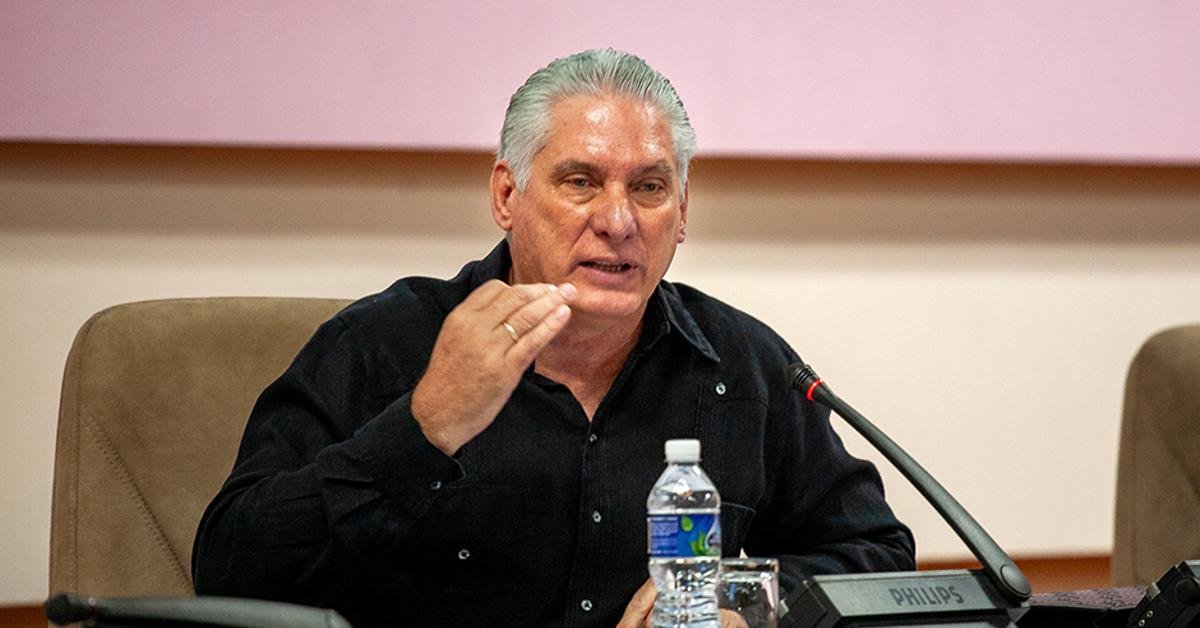
Havana/Faced with a country in crisis in its three fundamental dimensions, as an infrastructure, as a nation and as a model of State, Miguel Díaz-Canel should step aside. He should not insist on presiding over Cuba. Their illusion of power, with the symbolic capacity of all representation, is a serious problem for the new consensus that needs to begin to be built. His retirement, on the other hand, would save him something of whatever we call his legacy.
Here are the eight reasons why the current president would have to resign:
1. He has the legitimacy of the Cuban Communist Party (PCC) to be its general secretary, but not that of 99% of the people to be the president.
2. As the PCC is a selective party, in which the people do not vote for its leaders, it does not have popular legitimacy to designate, from its instance, who will lead the country. Its composition is less than 1% of the active population, that with the right to vote.
3. He only has the legitimacy of those who, in his constituency, voted for him to be a candidate for the National Assembly, without competing with another candidate, of course. It is good to know that he, like many others, was proposed directly by the Candidacy Commission, which has the power to directly propose 50% of the nominees to be part of an Assembly in which there is no competition for each of its 416 seats. Let us remember that one candidate per seat is ratified through the vote.
It does not have the popular support that in seven years could have generated a certain legitimacy of its functions if it had had the intellectual competence
4. Nor did he even compete within the National Assembly with other candidates, so he only had one ratification vote, after the triple appointment of Raúl Castro, of the PCC and of the Candidacy Commission, the latter made up of mass organizations, now empty, that are within the electoral system above the popular will.
5. It does not have the popular support that in seven years could have generated a certain legitimacy of its functions if it had had the intellectual competence and the powers of the mandate granted to solve the people’s problems.
6. It does not have – important in a regime that rewards personality – the empathetic legitimacy that comes from popular sympathy. That the guy doesn’t solve, but at least he’s nice. But – the worst thing – his lack of sympathy does not end in indifference, but in antipathy. I don’t remember a public person as detested in Cuba as Díaz-Canel. And this is a serious problem for running a country, because it obstructs communication between power and the people.
7. It is not a critical power factor, because it does not have the capacity or competence to determine the guidelines in the most fundamental political and diplomatic relations for Cuba, those that have to do with the United States.
8. Finally: he is not an ideologue or an intellectual, a disseminator of at least some political doctrine, nor a particularly gifted communicator, which would provide him with respectability at least within a certain segment of the elite.