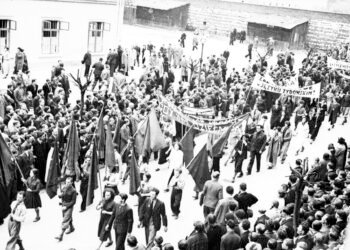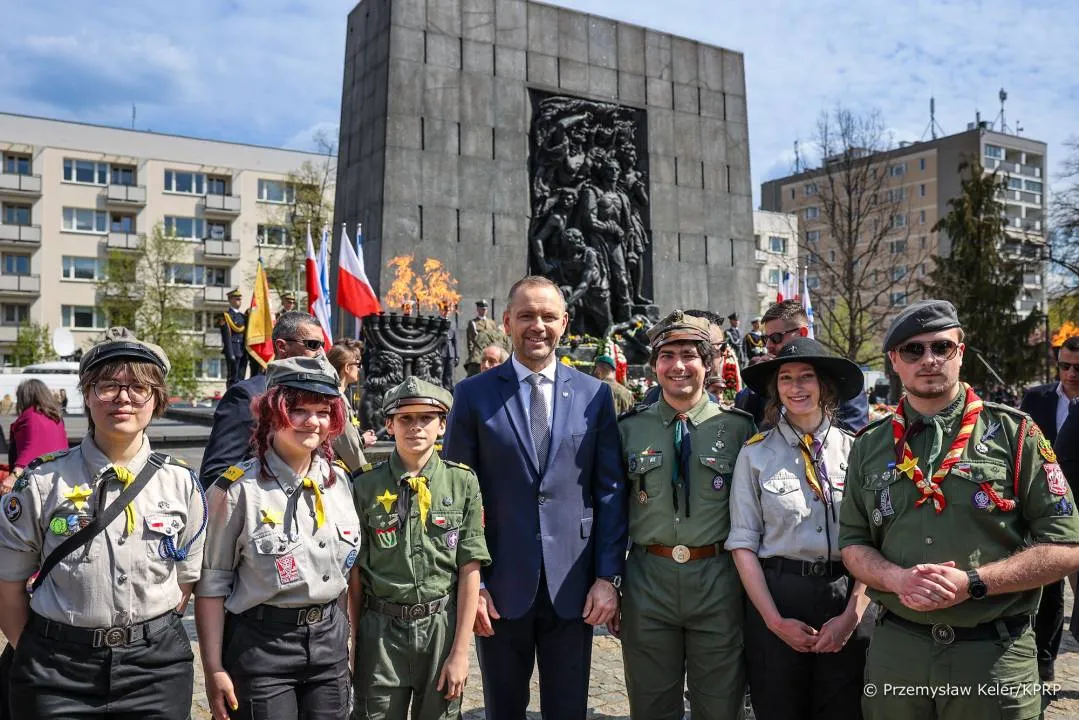
Today marks 83 years since the outbreak of the Warsaw Ghetto Uprising. At noon, anniversary ceremonies were held at the Monument to the Ghetto Heroes in Muranów, attended by the President of Poland, Karol Nawrocki.


On April 19, 1943, two thousand Germans entered the ghetto to liquidate it once and for all. They were met with resistance from several hundred young people from underground units – the Jewish Combat Organization and the Jewish Military Union. Many Jewish fighters knew they had no chance, but chose to die fighting to preserve their dignity. The insurgents, under the command of Mordechai Anielewicz, were exhausted and poorly armed. Many knew they had no chance, but preferred to die in battle to save their dignity. The remaining inhabitants of the ghetto – around 50,000 civilians – hid for weeks in shelters and bunkers.
For four weeks, the Germans razed the ghetto to the ground, burning house after house. Those captured were killed or deported to extermination camps. On May 8, Anielewicz and dozens of insurgents were surrounded and committed suicide. A small number of Jews managed to escape through the sewers from the burning ghetto. On May 16, as a sign of victory, the Germans blew up the Great Synagogue on Tłomackie Street. The Warsaw Ghetto ceased to exist. Only a few Jews in hiding remained among the ruins. Very few managed to cross to the other side of the wall. The last left the “ghetto graveyard” in January 1944.
According to reports by Jürgen Stroop, more than 56,000 Jews were in the ghetto during the uprising. Around 6,000 died on the spot in combat, as a result of fires and suffocation. The Germans murdered 7,000 Jews within the ghetto and sent another 7,000 to the extermination camp in Treblinka. The remaining group of approximately 36,000 was deported to other camps, primarily Auschwitz and Majdanek; the ghetto area was completely destroyed.
The memory of the ghetto’s heroes was honored today by state authorities led by the President of Poland, Karol Nawrocki. The ceremonies began at noon at the Monument to the Ghetto Heroes in Warsaw’s Muranów district. The day was also commemorated by the U.S. Ambassador to Poland – Tom Rose: